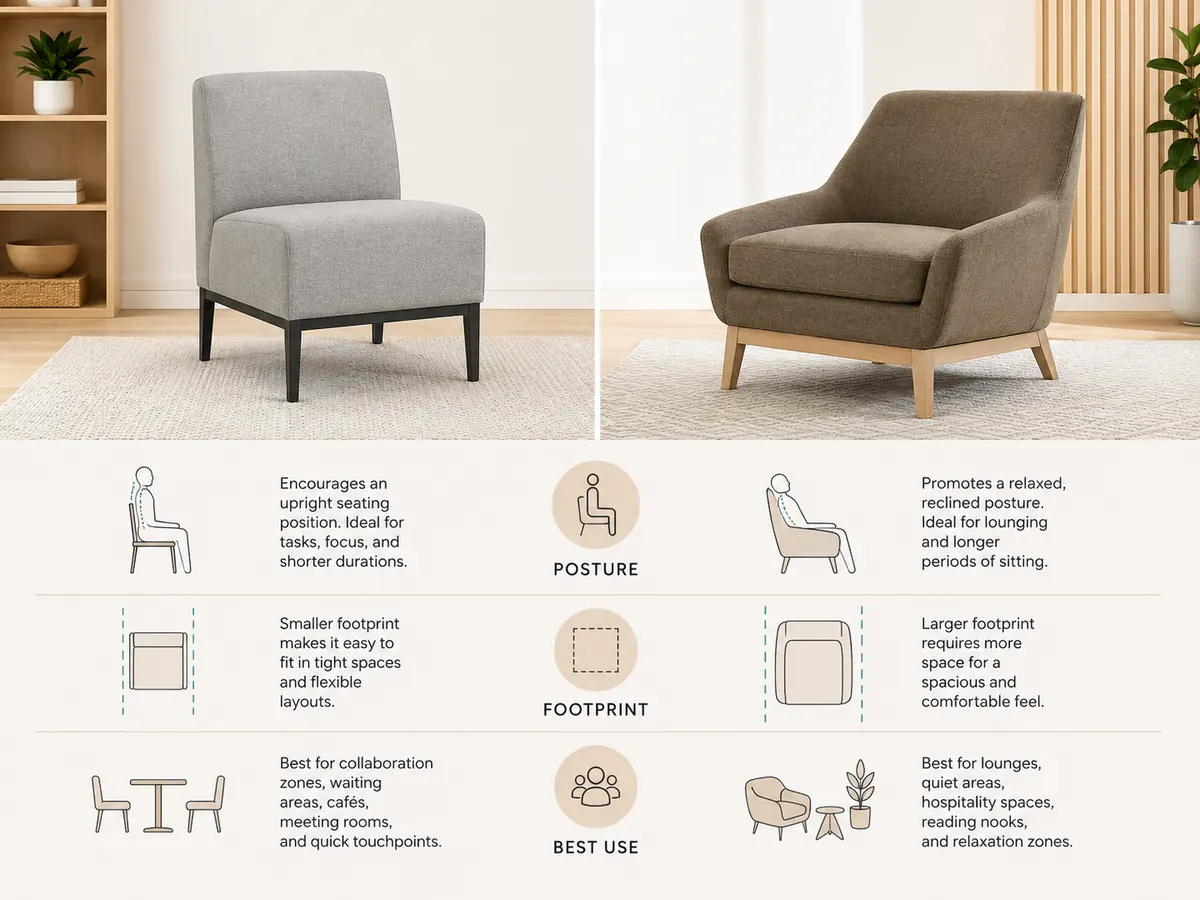
Choosing the best material for lounge chairs usually comes down to three real-world questions:
How does it feel to sit in for 10 minutes vs. 2 hours?
How painful is it to clean when spills (or disinfectants) are part of daily life?
Will it still look “presentable” after years of sliding in and out of the seat?
Leather and fabric can both be great lounge chair upholstery. The problem is that buyers often compare labels (“leather” vs “fabric”) instead of comparing the specific material grade + maintenance fit.
Below is a practical, specs-aware framework for commercial lounge seating, with home use included only as a comparison point where it helps explain comfort, cleaning, or appearance trade-offs.
Quick comparison: leather vs fabric lounge chair upholstery
Peruste | Leather upholstery | Kangasverhoilu |
|---|---|---|
Comfort (temperature + feel) | Can feel cool at first, then warms up; surface is smoother and sometimes “slippery” depending on finish | Typically feels warmer/softer immediately; more breathable options exist; texture can add grip |
Cleaning day-to-day | Many spills wipe off quickly; needs the right cleaner + periodic conditioning | Depends heavily on fabric type; performance fabrics can be very wipeable, while standard fabrics absorb stains |
Durability over time | Varies widely by leather grade/finish; scratches and patina are part of the story | Varies widely by weave + fiber blend; can pill, snag, or fade; high-spec contract fabrics can last well |
Paras | Reception areas with frequent wipe-downs; allergy-sensitive environments; “patina is OK” aesthetics | Spaces where “cozy” feel matters; high-scratch risk; projects that need lots of colors/textures |
Common regret | Buying “bonded leather” or low-grade faux leather that peels/cracks; using the wrong cleaners | Choosing a standard fabric for heavy traffic; underestimating stain/odor/allergen retention |
Keskeinen asia: If you want a durable lounge seating decision, compare material subtype + test data + cleaning protocol, not just “leather vs fabric.”
Lyhyt vastaus: For hotel lobbies, reception areas, and café lounge zones, leather or coated materials usually make sense when fast wipe-down cleaning is the main priority. Performance fabric is often better when warmth, color choice, texture, and scratch tolerance matter more. Avoid choosing only by the word “leather” or “fabric”; the safer decision is to confirm the exact material grade, approved cleaners, abrasion data, colorfastness, and replacement options before bulk ordering.
Comfort: what actually makes leather or fabric feel better
Comfort isn’t only the surface material. Cushion build (foam density, wrap, suspension) and seat geometry matter just as much.
That said, upholstery material changes how the chair feels in predictable ways:
When leather tends to feel more comfortable
You prefer a smoother surface that doesn’t grab clothing.
You like a chair that breaks in and develops character (patina).
Your space runs cool (leather can feel crisp at first, then warms as you sit).
When fabric tends to feel more comfortable
You want a softer first impression and more “cozy” texture.
You need temperature neutrality (fabric usually avoids the hot/sticky or cold-start sensation).
You want more control over the look (weave, color, texture).
Cleaning: real leather vs PU/PVC vs standard vs performance fabric
Cleaning is where most commercial projects win or lose—especially in hotel lobbies, office reception areas, cafés, and waiting rooms.
First, don’t treat all “leather” as the same material
These labels get mixed up in listings:
Top-grain / full-grain leather: higher-quality hides; usually a better long-term bet jos maintained correctly.
Bonded leather: made from leather scraps combined with binders. It often looks fine at the start but can have much lower long-term durability.
PU/PVC faux leather (“vegan leather”): coated materials that can be easy to wipe, but long-term performance depends on coating quality and how aggressive the cleaning chemicals are.
If your site has daily wipe-down protocols, the “right” answer is often less about what’s easiest to clean today and more about what won’t break down under your actual cleaners.
Fabric cleaning depends on one question: is it a performance fabric?
Standard upholstery fabric can absorb stains quickly.
Performance fabrics are engineered (via fiber choice, weave, and/or finishes) to resist staining and be easier to clean.
For commercial lounge seating, rub counts should be treated as one screening signal, not the final proof of durability. Pair them with cleaning guidance, seam performance, colorfastness, and the supplier’s approved maintenance instructions.
⚠️ Varoitus: “Easy to clean” is not a universal promise. Always request the approved cleaner list and test your real cleaner on a swatch.
Durability: what really predicts whether a lounge chair will hold up
Durability failures usually don’t happen in the middle of a flat seat panel. They show up at:
saumat ja reunusnauhat
seat-front edges
high-touch arm areas
corners where fabric is stretched
For fabric: use abrasion ratings as a screening tool (not a guarantee)
If you’re specifying fabric for durable lounge seating, abrasion tests are the common baseline:
Wyzenbeek (double rubs) is widely used in North America.
Martindale (cycles) is common in Europe/UK.
ACT’s abrasion guidance for indoor woven upholstery provides two useful reference points:
Low traffic/private spaces: 15,000 Wyzenbeek double rubs or 20,000 Martindale cycles.
High traffic/public spaces: 30,000 Wyzenbeek double rubs or 40,000 Martindale cycles.
These numbers are useful for screening fabrics, but they should not be treated as a lifespan promise. ACT states that abrasion results are not necessarily a reliable predictor of fabric lifespan, and that real durability is also affected by application, cleaning, maintenance, physical abuse, fabric construction, and appearance retention.
Also avoid directly converting Wyzenbeek and Martindale numbers as if they were the same test. ACT notes that the methods do not correlate reliably, so use the test method requested by your market or project specification.
For leather: durability depends on grade, finish, and expectations
Leather can last a long time, but “durable” may include visible wear (scratches, patina, slight creasing). In other words, leather can remain structurally sound while looking “lived in.”
If your project requires a pristine look under heavy use, you should be more cautious—and consider high-spec performance fabrics or commercial-grade coated materials with documented cleaner compatibility.
Before confirming a bulk order, request material swatches and test them against your actual use conditions: the cleaner or disinfectant you plan to use, the expected food or drink stains, direct sunlight exposure, and repeated hand contact on arms or seat-front edges. This does not replace lab data, but it helps catch practical problems that a spec sheet may not show clearly.
How it ages: patina vs pilling, and why appearance standards matter
If your lounge chair is in a public-facing space, “durability” includes how it looks at month 18.
Leather may develop patina (often desirable) but can show scratches.
Fabric may show pilling, snags, or fade depending on weave/fiber and light exposure.
This is where it helps to define your acceptance standard upfront:
Is “a bit of character” acceptable?
Or does the chair need to look uniform across a series in a lobby?
For projects that require reorder consistency, it’s also smart to plan for batch control and replacement parts. YeZhi’s overview of chair types and how to choose the right one includes practical notes on commercial seating trade-offs.
Cost and total maintenance effort
Sticker price is only one cost. The bigger drivers for many projects are:
cleaning labor (daily wipe-down vs periodic deep cleaning)
replacement cycle (how soon it looks worn, not just when it fails)
downtime (taking a chair out of service to clean or reupholster)
A “cheaper” upholstery can become expensive if it stains easily or can’t tolerate your cleaning routine.
Best choice by scenario: hotel lobby, office reception, café lounge, and home use
Use this as a quick self-selection framework. For commercial spaces, prioritize cleaning protocol, traffic level, appearance standard, and reorder consistency before style preference.
Skenaario | Usually prioritize | Often a good fit | Watch-outs |
|---|---|---|---|
Home reading corner | comfort + style | fabric or leather (personal preference) | pets + claws (leather scratches); light exposure (fading) |
Hotel lobby / public lounge | cleanability + appearance retention | higher-grade leather tai high-spec performance fabric | verify cleaning protocol + cleaner compatibility; define “patina OK?” |
Office reception / waiting area | wipe-down ease + neutral look | leather, commercial-coated materials, or performance fabric | avoid weak faux leather that can peel under frequent cleaning |
Café lounge area | turnover + stain resistance | performance fabric and easy-to-maintain finishes | food/oil stains; fast spot-clean needs; plan reorders |
If you’re selecting seating for food-and-beverage spaces, YeZhi’s guide on how to choose café chairs for comfort, turnover, and easy cleaning is a useful companion.
What to ask for on commercial lounge seating (RFQ-ready)
Here’s a practical checklist you can drop into an RFQ when specifying commercial lounge chair materials:
Upholstery type: top-grain leather / full-grain leather / PU / PVC / performance fabric (spell it out)
Abrasion: Wyzenbeek double rubs tai Martindale cycles (include method + endpoint)
Pilling resistance (where applicable)
Seam performance (seam slippage / seam strength)
Colorfastness and lightfastness (if near windows)
Approved cleaner list + disinfection compatibility notes
Replacement parts and reupholstery approach (glides, covers, upholstery panels)
Reorder controls: batch/lot tracking, color tolerance approach, lead time for repeat orders
Keskeinen asia: Treat “commercial grade” as something you can verify—construction evidence, testing scope, and warranty clarity—not just a label. (Related: Commercial vs residential dining chairs—how to compare.)
If the chair will be used in public or shared indoor spaces, you can also discuss structural expectations with suppliers using ANSI/BIFMA X5.4 for public and lounge seating as a reference point. This standard is relevant to seating commonly used in waiting, reception, restaurant, cafeteria, and gathering areas, but suppliers should still confirm which exact tests and product configurations apply.
FAQ
Is leather or fabric better for a lounge chair?
Neither is universally better. Leather often wins on quick wipe-down cleaning and allergy friendliness, while fabric often wins on immediate coziness and texture variety. The best choice depends on material subtype, use frequency, ja how you actually clean the chair.
What is the most durable lounge chair upholstery?
For heavy use, durability usually comes from higher-grade leather tai contract-grade performance fabric, backed by test data and a cleaning protocol the material can tolerate. Avoid assuming “higher rub count = longer lifespan”—ACT explicitly warns abrasion results aren’t reliable predictors of real-world lifespan.
What’s a good Wyzenbeek or Martindale rating for commercial lounge seating?
Use ACT’s thresholds as a starting point: 30 000 Wyzenbeek-kaksoishankauskertaa (high traffic/public spaces) or 40,000 Martindale cycles as a common screening baseline—then validate with other specs and your cleaning routine.
Is faux leather (PU/PVC) good for lounge chairs?
It can be a practical choice when wipe-down cleaning is frequent and budgets are tight, but quality varies a lot. The biggest risk is long-term surface breakdown under heat, humidity, and aggressive cleaning chemicals. Always request the material spec and approved cleaner list.
Next steps (if you’re sourcing for a project)
If you’re building a lounge or reception seating shortlist, start with traffic level, cleaning protocol, appearance standard, and budget range. Then request swatches and spec sheets before confirming the upholstery direction.
For a YeZhi lounge chair quotation, you can share:
Project space: hotel lobby, office reception, café lounge, apartment project, or other setting.
Preferred material direction: leather, PU/PVC coated material, standard fabric, or performance fabric.
Cleaning requirements: daily wipe-down, spot cleaning, disinfectant use, or low-maintenance preference.
Specification needs: color, texture, size, frame finish, packaging, lead time, and repeat-order requirements.