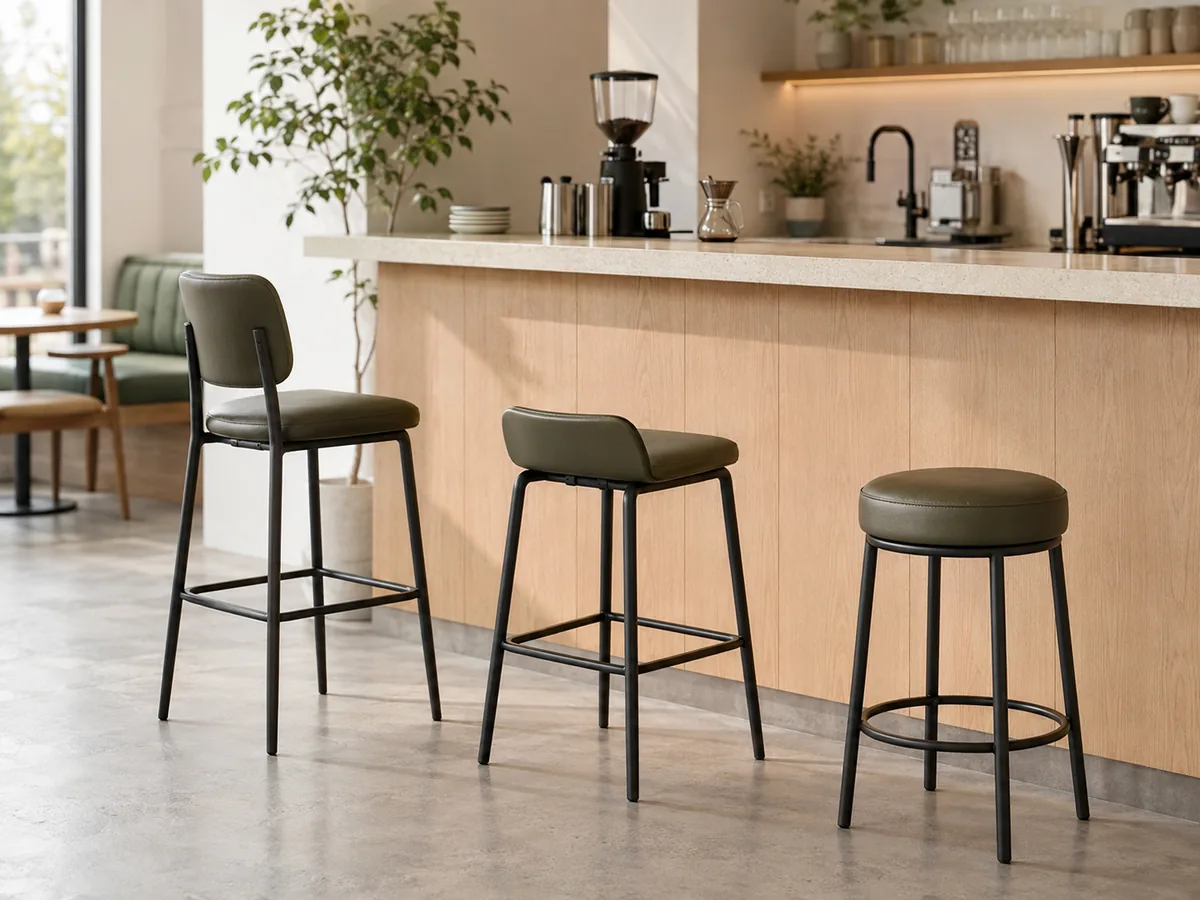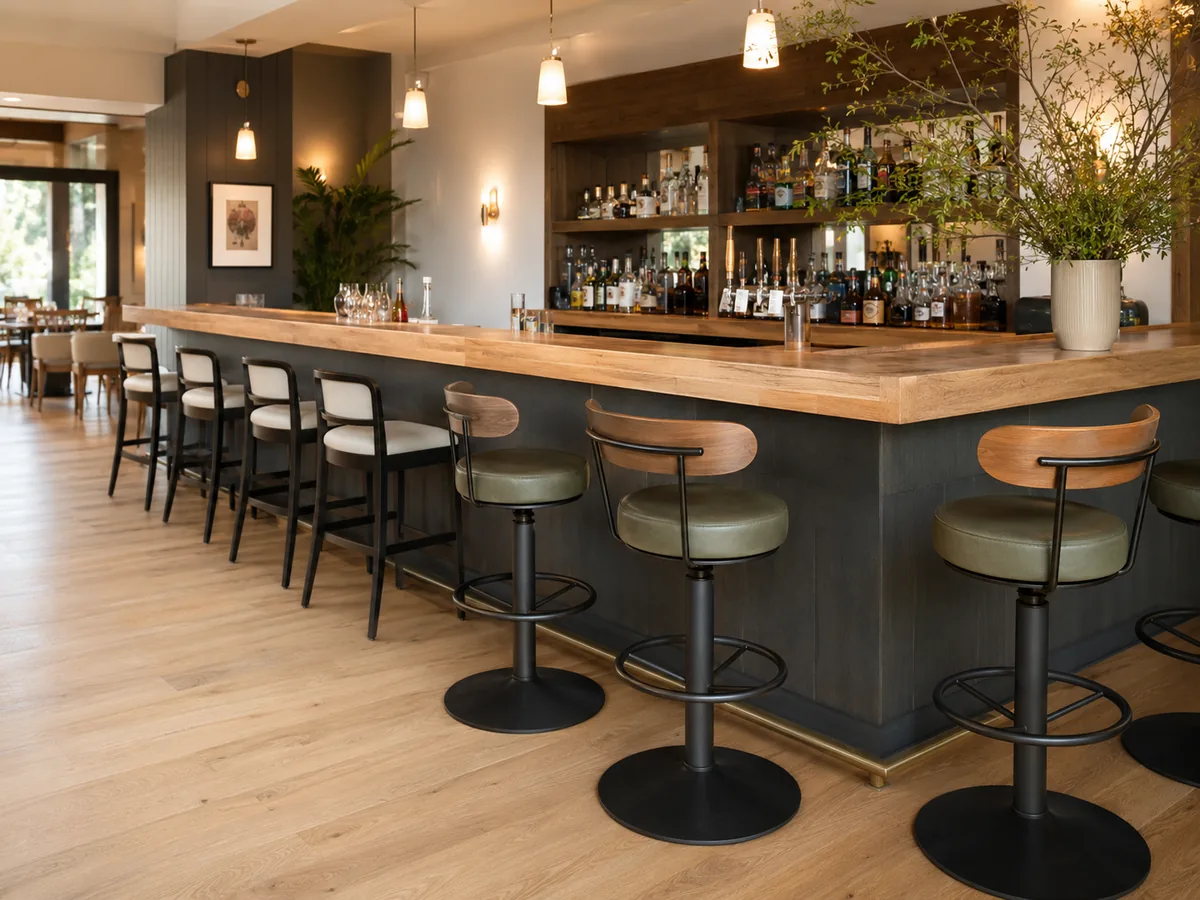
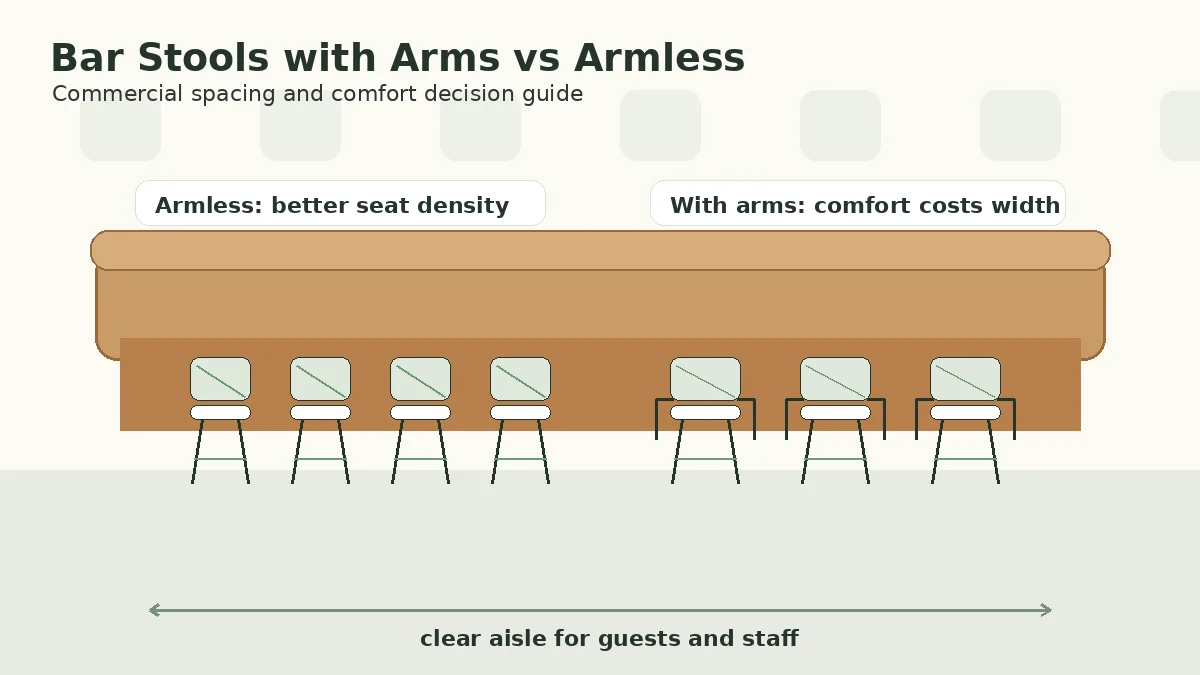
For most busy commercial bars, cafes and restaurant counters, armless bar stools are the safer default. They fit more seats, allow easier side entry and usually create fewer spacing problems.
Bar stools with arms are better when comfort matters more than seat count. They make sense for hotel lounges, VIP bars, private clubs and slower-service spaces where guests sit longer and the venue can afford extra width.
At YeZhi, we look at the installed result first, not only the catalog photo. Not style first. Not photo first. For a commercial order, the first question is simple: How many good seats can this counter actually hold without making guests and staff fight the space?
Decision first
Quick Answer: Are Bar Stools with Arms Better Than Armless?
Bar stools with arms are better for longer sitting, but armless bar stools are better for tight commercial layouts and higher seating density.
| Business Situation | Better Default | Commercial Reason |
|---|---|---|
| Fast-turnover bar counter | Senza braccio | More seats and faster guest entry |
| Small cafe counter | Senza braccio | Less width wasted |
| Hotel lounge bar | With arms | Comfort supports longer sitting |
| VIP or private bar area | With arms | Premium feel matters more than density |
| Narrow aisle behind stools | Senza braccio | Easier movement for guests and staff |
| Swivel stool in a tight layout | Usually armless | Swivel plus arms needs more clearance |
If your venue needs every seat, we usually recommend starting with armless stools first. If your venue sells comfort and longer stays, arms can earn their space.
To compare more bar stool styles beyond arms and armless, start with YeZhi’s guide to tipi di sgabelli da bar, which covers backless, low-back, swivel, upholstered and other commercial stool styles.
Width is the real cost
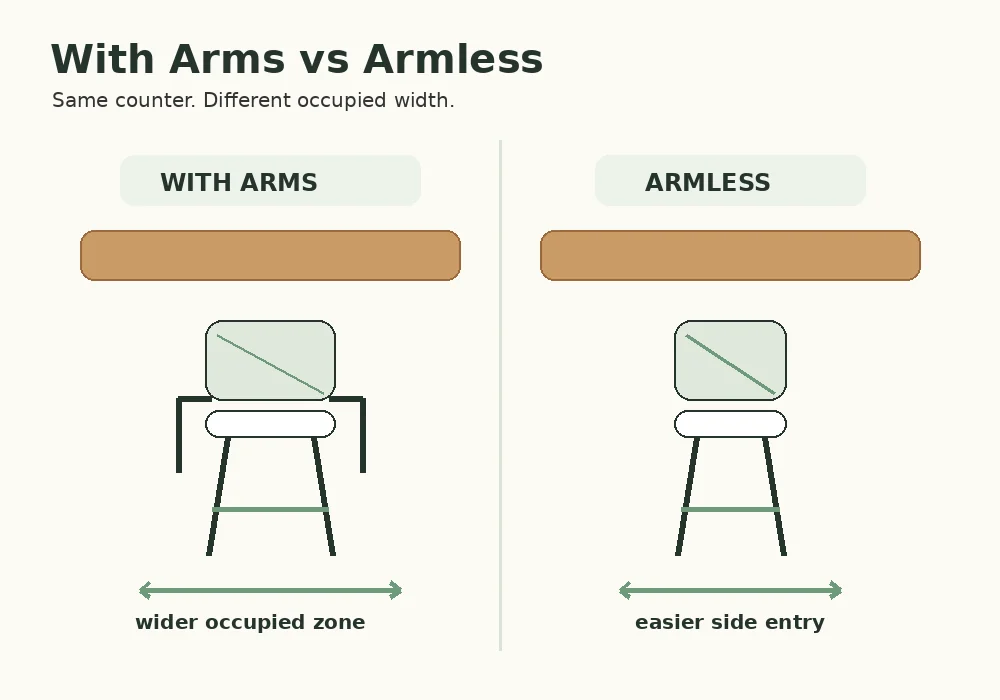
The Real Difference Is Not the Armrest. It Is the Space It Takes.
Many buyers first compare bar stools with arms vs armless by looking at the front photo. In YeZhi projects, we do not stop there. The front photo does not show the real commercial problem: occupied width.
A stool with arms usually needs more side clearance than an armless stool. The arm-to-arm width may be wider than the seat itself. The guest may also need to pull the stool farther out to sit down, especially if the arms do not slide under the counter.
Measure the stool
- Larghezza totale
- Arm-to-arm width
- Inside seat width
- Profondità complessiva
- Back height
Measure the site
- Counter underside clearance
- Bar/counter height
- Aisle behind stools
- Edge reserve
- Swivel clearance
For a YeZhi project order, a front-view photo is only the starting point. Counter height, target seat count, side view, top view and dimension drawing should be checked before production.
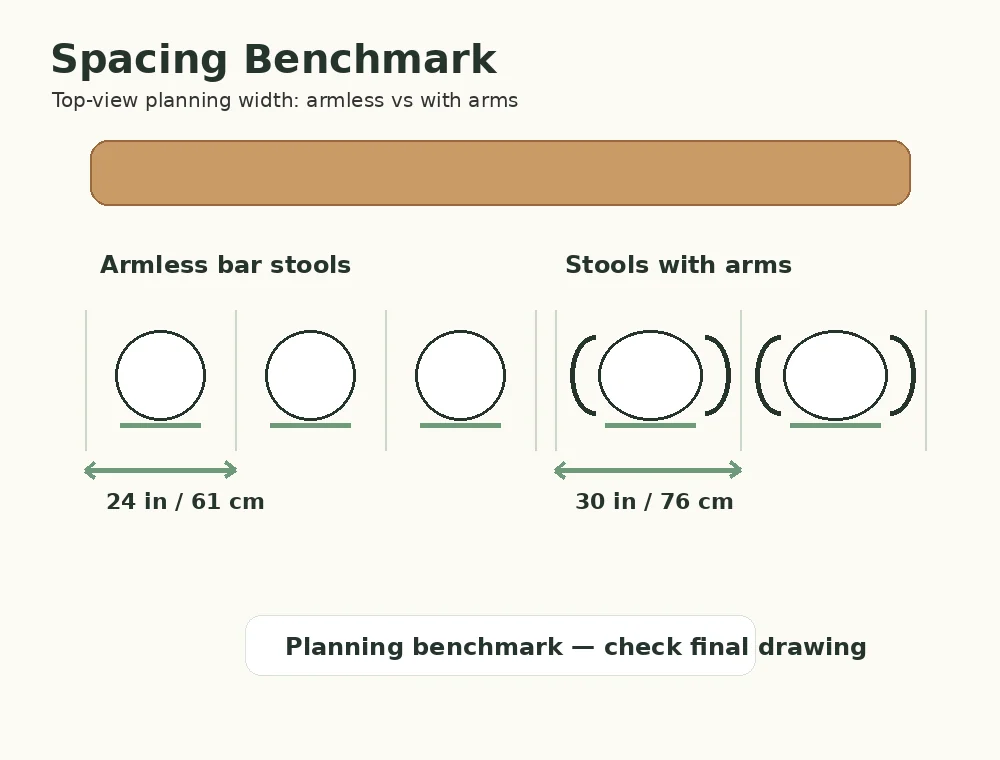
| Tipo di sgabello | Planning Width | How to Use It |
|---|---|---|
| Armless bar stool | 24 in / 61 cm per stool | Good starting point for compact commercial counters |
| Bar stool with arms | 30 in / 76 cm per stool | Better starting point for arm stools or wider stools |
| Wide stool trigger | Over 22 in / 56 cm overall width | Treat as a wider layout item, even if the seat looks compact |
We use these as commercial planning benchmarks. Final spacing should still be checked against the selected stool drawing and site layout. For counter-length and stool-quantity calculation, YeZhi’s guide on how many bar stools you need gives a fuller layout method.
Comfort must earn the space
Comfort Comparison: When Arms Help and When They Get in the Way
Bar stools with arms are usually more comfortable for longer sitting because they support the arms and upper body. That helps in hotel bars, club lounges, private rooms and relaxed hospitality spaces.
But comfort is not only armrests. Comfort is seat height, footrest position, seat width, back support and sitting time. Arms are only one part.
| Guest Sitting Time | Better Default | Reason |
|---|---|---|
| Short sitting under 20 minutes | Senza braccio | Fast entry, fast exit, higher density |
| Casual meal at a counter | Armless or low-back armless | Comfort matters, but spacing still matters |
| Lounge-style sitting of 45–60 minutes or more | With arms | Extra support can justify the width |
| VIP or premium seating | With arms | Comfort and perceived value can justify the width |
If guests sit for a short drink and leave, arms often waste space. If guests sit for a long cocktail, lounge service, or premium hospitality experience, arms may pay for themselves through comfort.
For bar, cafe and hotel projects, YeZhi’s sgabelli da bar commerciali page shows more product directions.
Capacity math
Width and Spacing: How Many Stools Can You Really Fit?
This is where many bar stool projects lose seats. A stool can look strong, comfortable and premium, but the installed counter may fit fewer seats than planned.
We use this formula with buyers: usable bar length ÷ planning width = estimated stool count. Then we round down. We do not round up.
- 24 in / 61 cm per armless stool
- 30 in / 76 cm per stool with arms
Example: a bar counter is 10 ft / 305 cm long.
| Tipo di sgabello | Planning Width | Estimated Count |
|---|---|---|
| Armless bar stools | 24 in / 61 cm | About 5 stools |
| Bar stools with arms | 30 pollici / 76 cm | About 4 sgabelli |
If you reserve 6 in / 15 cm at each end, the final count may drop by one stool. For example, a 10 ft / 305 cm counter has 108 in / 274 cm of usable length after a 12 in / 30 cm total reserve. That means about 4 armless stools at 24 in / 61 cm each, or about 3 arm stools at 30 in / 76 cm each.
Over a 20 ft / 610 cm counter, armless planning can be about 10 stools, while stools with arms may be about 8 stools before edge reserve. That is not a small style difference. It is a capacity decision.
To compare current models, finishes and frame directions, start from YeZhi’s bar stool chair category.

Clearance risk
Bar Stool Armrest Height: The Clearance Check Buyers Forget
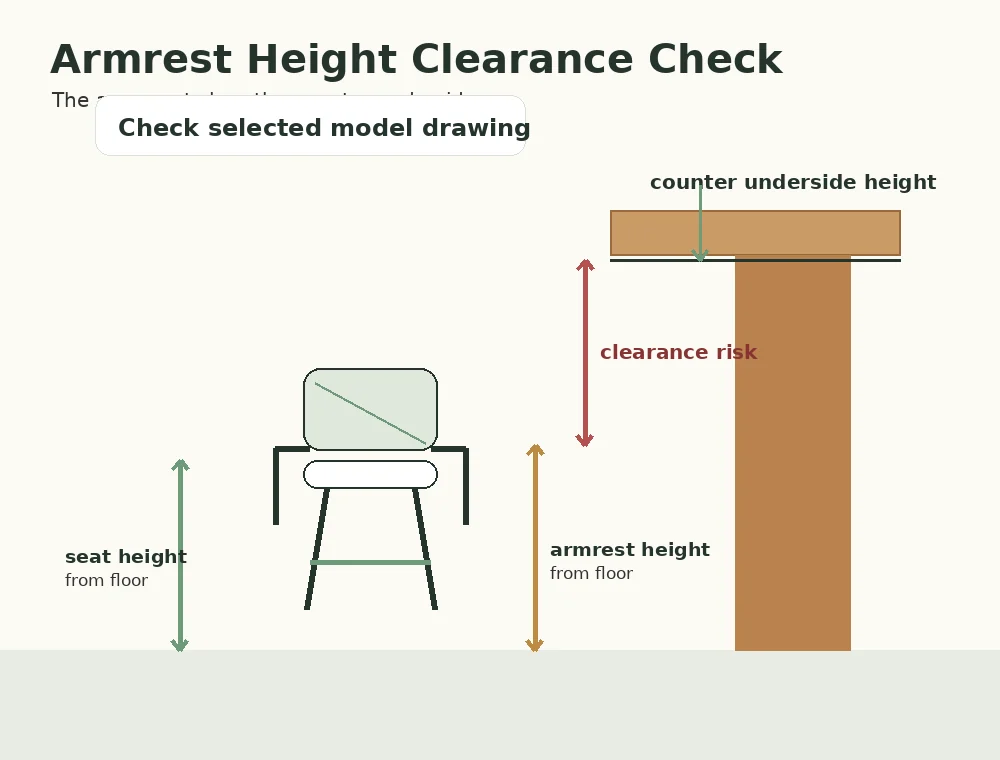
Armrest height is one of the most dangerous details in this decision. A stool with arms can look perfect in a photo but fail in the actual bar because the arms hit the counter edge or cannot slide under the counter.
The most important bar stool armrest height check is whether the arms can clear the counter underside when the stool is pushed in.
| Misurazione | Perché è importante |
|---|---|
| Seat height from floor | Must match bar or counter height |
| Armrest height from floor | Determines whether arms can tuck under |
| Counter underside height | Must be higher than the armrest if tuck-under is expected |
| Overall stool depth | Affects pull-out space |
| Back height | May hit the counter or wall in tight layouts |
| Swivel radius | Arms may swing into nearby stools or counter panels |
- Bar stool seat height: 29–32 in / 74–81 cm
- Counter stool seat height: 24–27 in / 61–69 cm
- Seat-to-counter clearance: 9–12 in / 23–30 cm
We use these as planning benchmarks. Final height should be checked against the real bar height, counter underside, seat thickness and selected stool drawing. For project orders, send the counter underside height and selected stool style early, so the armrest clearance can be checked before production.
For project orders, these details should be confirmed before the model is treated as ready for production.
For a fuller height-check method, YeZhi’s guide on Come misurare l'altezza dello sgabello da bar is a useful next read.
Scene decision
Best Choice by Venue Type
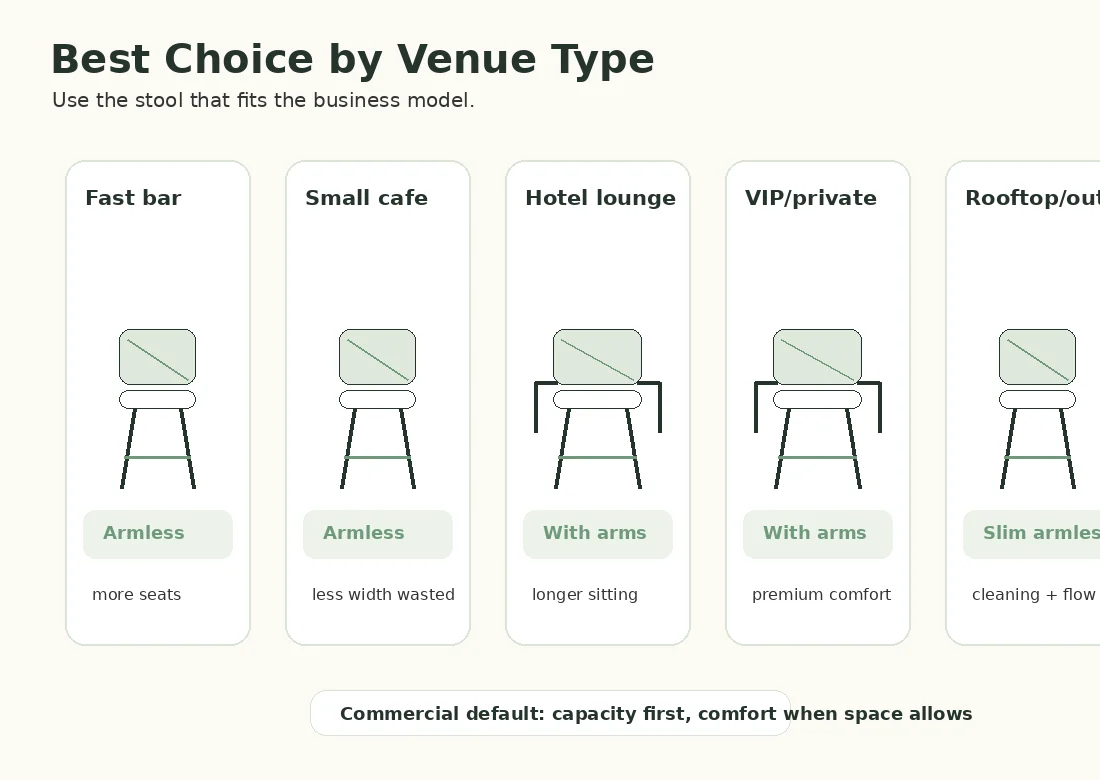
For commercial projects, a clear default helps the buyer move faster. Here is how YeZhi usually frames the choice.
| Tipo di sede | Better Default | Perché |
|---|---|---|
| Fast-turnover bar counter | Senza braccio | More seats, easier side entry and faster turnover |
| Small cafe counter | Senza braccio | Width matters more than arm comfort |
| Restaurant bar waiting area | Senza braccio | Most guests sit briefly before moving to a table |
| Hotel lounge bar | With arms | Guests sit longer, and comfort supports the venue image |
| VIP/private bar area | With arms | Comfort and perceived value matter more than seat count |
| Narrow aisle behind stools | Senza braccio | Arms increase movement difficulty |
| Swivel stools in a tight layout | Usually armless | Swivel plus arms multiplies clearance problems |
| Outdoor or rooftop bar | Usually armless or slim-frame designs | Easier movement, easier cleaning and less visual bulk; outdoor material and finish must be confirmed |
| Large open bar with premium service | With arms can work | Space is available and comfort may justify the width |
Do not make this choice by style alone. A good-looking arm stool in the wrong floor plan becomes an operational problem.
For restaurant projects and wholesale sourcing, YeZhi’s sgabelli da bar per ristoranti all'ingrosso page is the practical product direction.
Pros and cons
Pros and Cons of Bar Stools with Arms
Bar stools with arms are not wrong. They are just not free. The cost is width, movement and clearance.
| Fattore | Bar Stools with Arms |
|---|---|
| Comfort | Stronger for longer sitting |
| Visual value | Often looks more premium |
| Guest support | Better elbow and upper-body support |
| Width | Needs more space |
| Seat count | Usually reduces capacity |
| Entry and exit | Harder in tight layouts |
| Counter clearance | Must check armrest height |
| Swivel risk | Higher if the stool rotates |
| Best use | Hotel bars, lounges, VIP areas, slower-service counters |
Pro
The main advantage is comfort during longer sitting. Stools with arms help guests feel more settled in hotel lounges, members’ clubs, private bars and higher-end hospitality areas.
Contro
The main disadvantage is lost space. Arms increase overall width, make side entry harder, and can stop the stool from sliding under the counter.
A stool that blocks the aisle is not premium. It is a service problem.
Pros and cons
Pros and Cons of Armless Bar Stools
Armless stools are often treated as the simple option. In commercial furniture, simple is sometimes better.
| Fattore | Armless Bar Stools |
|---|---|
| Comfort | Can be good with correct seat, back and footrest |
| Width | More efficient |
| Seat count | Usually fits more stools |
| Entry and exit | Easier from the side |
| Cleaning access | Easier around the stool body |
| Movement | Better for tight bars and cafes |
| Premium feel | Depends on material, finish and design |
| Best use | Fast-turnover bars, cafes, casual restaurants, narrow counters |
Pro
The main advantage is layout efficiency. Armless stools fit tighter counters, allow easier side entry, and help staff move around the bar area.
Contro
The main disadvantage is less upper-body support during long sitting. For hotel lounges or VIP bars, some guests may prefer arms.
Before deposit
What to Confirm with YeZhi Before Bar Stools with Arms Go into Bulk Production
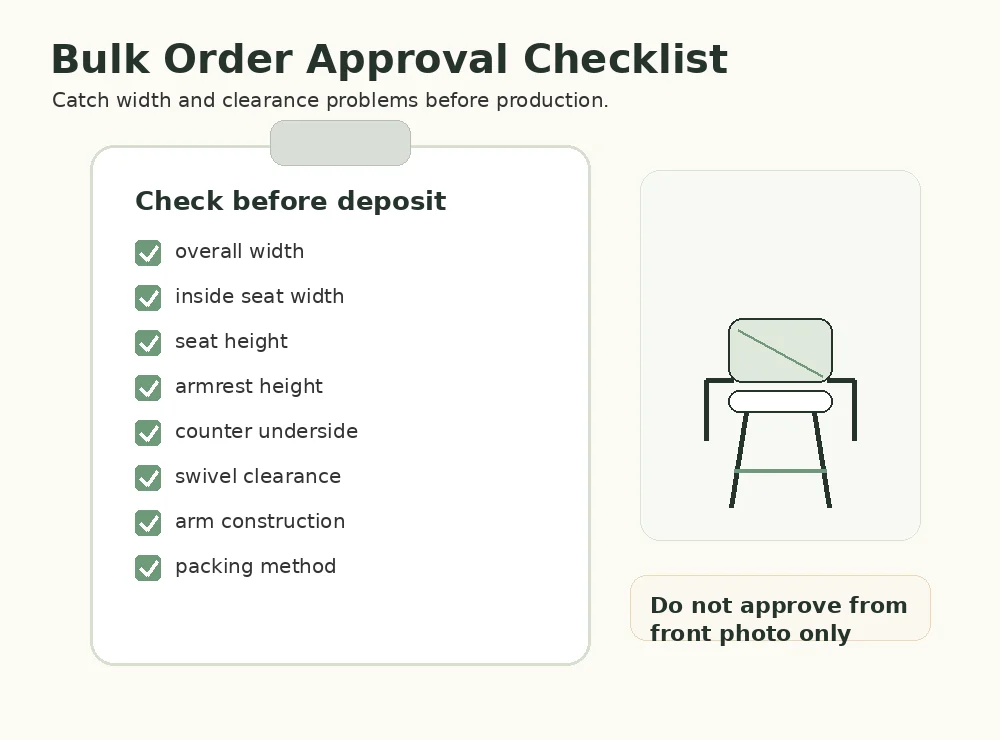
Bulk orders are where small measurement mistakes become expensive. A small sample adjustment is manageable. A full project batch with the wrong dimensions is expensive. Because most wholesale orders are made to order, width and clearance should be settled before production.
Before bulk production, YeZhi confirms the drawing, not only the product photo.
Dimension check
- Larghezza totale
- Inside seat width
- Altezza del sedile
- Armrest height from floor
- Profondità complessiva
- Back height
Production check
- Footrest height and position
- Whether arms tuck under the counter
- Swivel clearance
- Arm construction
- Carton size and packing method
- Warranty scope confirmed on the PI
For stools with arms, construction matters. Loose arm joints become complaints in high-use bars. The arm structure can be confirmed before the order is approved, whether it is welded, bolted, or integrated into the seat/back design.
For high-risk custom orders, check 1–2 samples before a large custom batch as a planning benchmark.
YeZhi works with commercial furniture buyers for restaurant, cafe, bar, hotel and project furniture. Regular MOQ usually starts from about 15 pcs per SKU, while final MOQ depends on the model, finish route, and quotation. Full OEM/custom production usually starts from about 100 pcs per design. Production lead time is about 30 days after order confirmation, and ocean freight planning baseline is about 30 giorni.
For factory supply, production and order-handling details, see YeZhi’s fabbrica di sgabelli da bar pagina.

Buying mistakes
Common Order Mistakes YeZhi Helps Buyers Avoid
1. Front-view photos only
A front photo does not show pull-out depth, armrest height, swivel radius or counter clearance.
2. Seat width only
Seat width is only the sitting area. Overall width decides how many stools fit.
3. Missing armrest height
We check armrest height against the counter underside, not only the bar top.
4. Swivel plus arms
In tight commercial layouts, we usually treat swivel arms as a high-risk choice.
5. Ignoring the aisle
Utilizzo 36 in / 91 cm behind occupied stools as a conservative planning benchmark.
6. Calling every arm stool premium
A wrong arm stool is not premium. It creates avoidable layout trouble after installation.
For quotation
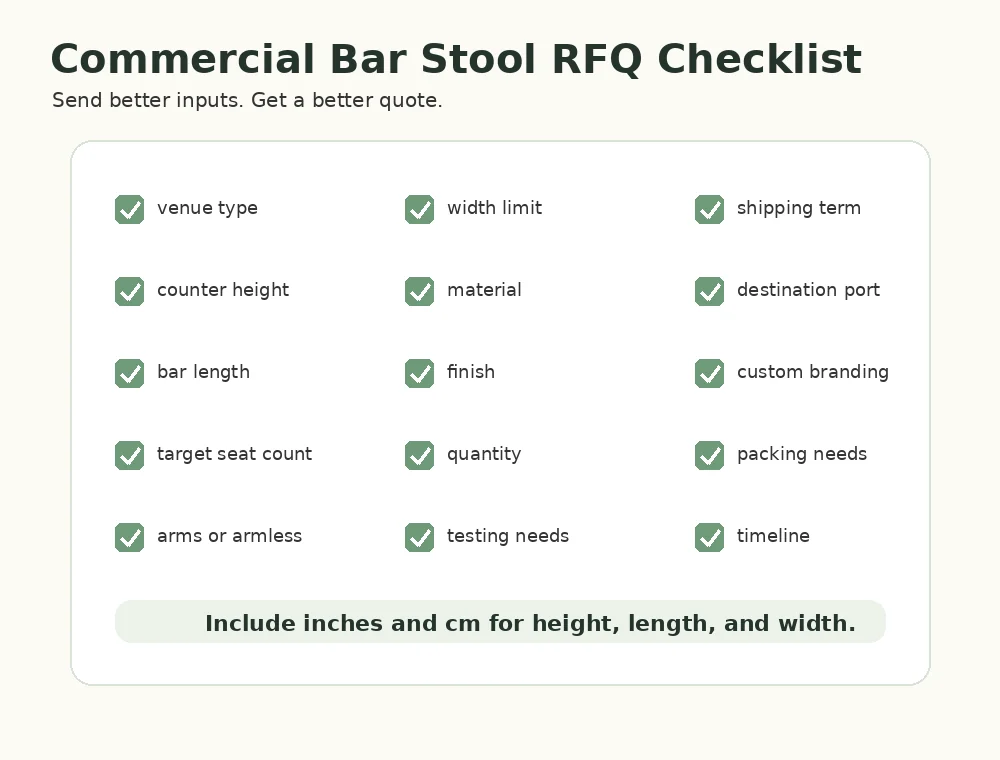
YeZhi RFQ Checklist for Commercial Bar Stool Projects
A useful YeZhi quotation needs more than “send me your best price.” If you want YeZhi to recommend bar stools with arms vs armless accurately, send this information:
| RFQ Item | What to Send |
|---|---|
| Tipo di sede | Bar, cafe, restaurant, hotel, club, project |
| Counter/bar height | In inches and cm |
| Counter/bar length | In inches and cm |
| Target seat count | Number of stools expected |
| Stool preference | With arms, armless, or both options |
| Width limit | Maximum overall width per stool |
| Use scene | Indoor, outdoor, covered outdoor |
| Material preference | Metal, solid wood, upholstery, rattan, teak wood, fabric, leatherette or mixed material |
| Finish requirement | Wood finish, metal color, upholstery color |
| Quantità | Pieces per SKU or per design |
| Custom needs | Branding, packaging, finish, material matching |
| Testing/compliance needs | Required load rating, ANSI/BIFMA review, EN 16139, fire performance, abrasion or outdoor finish test |
| Shipping term | EXW, FOB or CIF |
| Destination | Country and destination port |
For projects that need test or compliance documents, include the requirement in the RFQ. YeZhi can review load rating, ANSI/BIFMA-related requirements, EN 16139 documentation, fire performance, abrasion data, outdoor finish tests and warranty scope by model, material and order requirement before production.
YeZhi supports mixed models, colors and materials in one order. YeZhi also supports OEM/ODM customization for finishes, materials, packaging, branding, upholstery colors, wood finishes, metal frame finishes and project-based material matching.
Main shipping is ocean freight, with LCL and full-container options for wholesale orders.
Final Buying Recommendation
Choose armless bar stools when seat count, fast turnover and easy movement matter most.
Choose bar stools with arms when longer sitting, lounge comfort and premium positioning matter more than maximum capacity.
Before deposit and production, confirm the width, armrest height, drawing, finish, packing method, shipping term and PI warranty scope.
Do not let one good product photo reduce your installed seat count. The right stool is the one that still works after guests sit, staff pass behind it, and the counter area is full.
Send YeZhi your bar stool layout and RFQ detailsQuick answers
FAQ
Are bar stools with arms more comfortable?
Yes, bar stools with arms are usually more comfortable for longer sitting. They support the arms and upper body, which can help in hotel lounges, VIP bars and slower-service areas. For fast-turnover bars and cafes, the comfort gain may not justify the extra width.
Do bar stools with arms take more space?
Yes. Bar stools with arms normally need more planning width than armless stools. Use 30 in / 76 cm per stool with arms as a commercial planning benchmark. Final spacing should be checked against the selected stool drawing and site layout.
How much space should I leave for armless bar stools?
Plan about 24 in / 61 cm per armless bar stool as a starting benchmark. This is not a substitute for the final drawing. Final spacing should be checked against actual stool width, counter length, edge reserve and aisle layout.
How much space should I leave for bar stools with arms?
Plan about 30 in / 76 cm per bar stool with arms as a starting benchmark. If the stool is wide, swivels or has a thick back, check the real drawing before confirming seat count.
What is the best bar stool armrest height?
There is no safe universal bar stool armrest height. The correct check is whether the armrest height from floor clears the counter underside when the stool is pushed in. For bulk production, this should be checked on the selected stool drawing.
Are armless bar stools good for restaurants?
Yes, armless bar stools are often the better default for restaurants. They save width, allow easier side entry and usually work better for faster turnover. For a restaurant lounge or private dining bar, stools with arms may still be suitable.
Are swivel bar stools with arms a good idea?
Swivel bar stools with arms are risky in tight commercial layouts. They need more side clearance and can hit nearby stools, counter panels or guests. Use them only when the layout has enough room.
Should hotel bars use stools with arms?
Hotel bars can use stools with arms when comfort and premium image matter more than maximum seat count. For a lobby bar or lounge, arms can make sense. For a compact breakfast bar or fast-service counter, armless may still be better.
What should I measure before ordering bar stools with arms?
Measure overall width, inside seat width, seat height, armrest height, counter underside height, stool depth and back height. If the stool swivels, also check swivel clearance.
Can YeZhi make custom bar stools with arms or armless designs?
YeZhi supports OEM/ODM customization for commercial furniture projects. Regular MOQ usually starts from about 15 pcs per SKU, while full OEM/custom production usually starts from about 100 pcs per design. Send YeZhi the counter height, bar length, target seat count, preferred stool style, quantity and destination port so we can check the project before production.
How should buyers request load capacity, BIFMA, EN 16139 or fire-performance documents from YeZhi?
State these requirements in the RFQ before quotation. YeZhi reviews load capacity, ANSI/BIFMA-related requirements, EN 16139 documentation, fire performance and other test documents by model, material, order and project requirement.