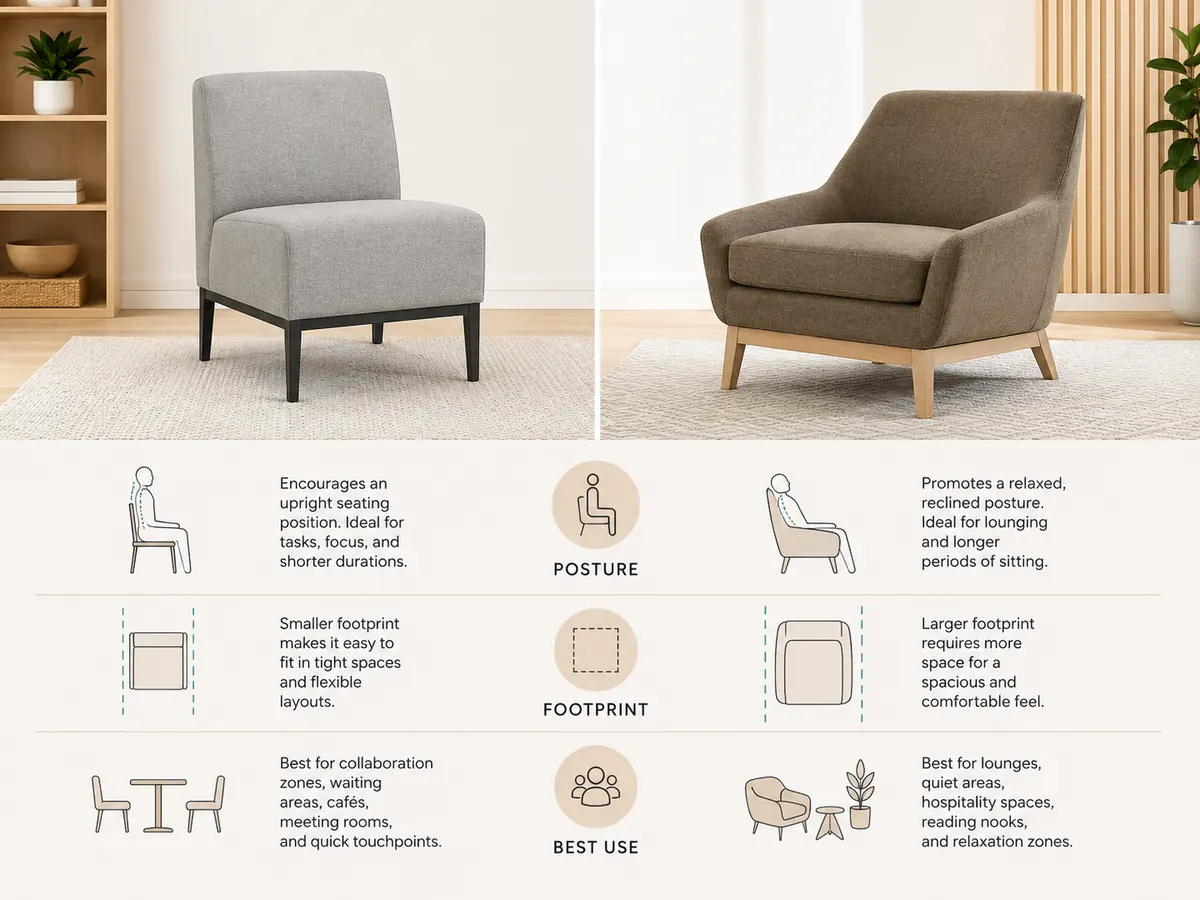
If you’re choosing lounge seating for a hotel lobby, reception area, or office lounge, back height is one of the fastest ways to change how a space feels. It affects support coverage, visual scale, sightlines, and how private a seat feels.
A high-back lounge chair can look more supportive, add visual presence, and create a more enclosed seating zone. A low-back lounge chair can keep views open, feel lighter in the layout, and work better when the furniture may need to move or mix with other seating.
If you’re comparing high back lounge chairs vs low back lounge chairs, don’t treat back height as a comfort score. Use it as a first filter, then check seat depth, seat height, back angle, arm height, and the intended sitting time.
This same logic also applies when searchers use broader terms such as high back armchair vs low back armchair, as long as the buying decision is still about lounge or waiting-area seating.
Quick answer: A high back vs low back lounge chair decision isn’t about which is “better.” High backs usually make sense for longer sitting, stronger visual presence, and semi-private zones. Low backs usually make sense for open sightlines, lighter layouts, and short-stay conversation areas. The right pick depends on sitting time, room scale, user height, and the purpose of the zone.
High back vs low back lounge chair at a glance
Decision factor | High-back lounge chair tends to win when… | Low-back lounge chair tends to win when… |
|---|---|---|
Support coverage | You want potential support up to shoulders/neck/head (depending on shape) | You only need lower-to-mid back support for shorter sits |
Visual scale | The room needs an “anchor” piece with presence | The room needs to feel lighter, less visually crowded |
Sightlines | You want a more enclosed feel in a corner or quiet zone | You want open views across the room (staff visibility, openness) |
Dwell time | People will sit longer (reading, waiting comfortably) | People will sit briefly (greeting, short conversations) |
Layout flexibility | Furniture will stay mostly in place | Furniture may be moved/reconfigured often |
Support: what high-back lounge chairs can (and can’t) do
It’s reasonable to assume a taller back can support more of the body—but only if the geometry matches real posture.
High-back lounge chairs: the support upside
A high-back chair pode provide:
More contact area for upper back and shoulders
Potential head/neck support se the top portion actually meets the sitter where their head naturally rests
A more stable feeling for longer sitting (especially when paired with the right seat depth and back angle)
Why “high-back = more comfortable” is not guaranteed
Two common failure modes:
The back is tall, but the angle/curve is wrong. If the back angle pushes the head forward or misses the shoulder blades, taller doesn’t help.
The seat is too deep or too low. A deep lounge seat can force shorter users to perch forward (losing back support entirely).
A better way to specify comfort is to separate structural performance, body fit, and perceived softness. ANSI/BIFMA X5.4 is relevant for public and lounge seating because it addresses segurança, durabilidade e adequação estrutural for seating used in public spaces such as waiting, reception, restaurant, dining, and gathering areas. But that kind of standard does não automatically prove that one back height is more comfortable than another.
For fit, ergonomic guidance from OSHA and UCLA points in the same direction: users need the seat, backrest, and arm support to match body size and posture. In lounge chair buying, that means back height should be checked together with seat depth, back angle, lumbar/upper-back contact, and arm height.
Principais conclusões: If you’re specifying chairs for longer dwell time, treat back height as a starting filter—not the final decision.
Scale: how back height changes room proportions
Back height changes the visual mass of a chair. That matters in commercial spaces where you’re balancing openness, branding, and traffic flow.
High-back: bigger visual presence (sometimes exactly what you need)
High backs can:
Make a seating group feel intentional in larger lobbies
Help define a zone without adding walls
Look more “premium” in the right finish, because the silhouette reads as a statement piece
Low-back: lighter footprint, easier to mix
Low backs can:
Keep the room feeling open (especially in smaller reception areas)
Work better when you want multiple seats without visual clutter
Pair more easily with other seating types (benches, sofas, occasional chairs)
If you’re calibrating scale, it helps to start from basic lounge chair orientation: lounge chairs are generally lower and more reclined than dining chairs, with dimensions and angles optimized for relaxation rather than upright dining (Dimensions.com lounge chair collection). Use that as context—not as a “standard.”
Sightlines: open visibility vs visual privacy
In hospitality and office environments, sightlines aren’t just aesthetic. They affect:
how easy it is to supervise a lobby
how open (or crowded) a space feels
whether guests feel “on display” when seated
Low-back lounge chairs preserve sightlines
Low-back lounge chairs are often the safer choice when you need:
open visibility across the room
a lighter visual field in tight footprints
flexible seating that supports conversation
High-back lounge chairs create visual privacy (with a caveat)
High-back lounge chairs can make a seat feel more sheltered—even in a busy space.
A contract furniture brand Inside Out Contracts describes high-back lounge seating as creating more of an “isolated bubble” that can minimize distractions in high-traffic environments (Inside Out Contracts: high-back lounges).
Caveat: write and specify this as visual privacy / a more enclosed feeling / partial separation. Don’t frame it as certified acoustic performance—because it isn’t.
Dwell time and zoning: matching chair type to the purpose of the zone
A good commercial layout separates transit zones (people passing through) from dwell zones (people staying). One hotel lobby layout guide recommends arranging seating clusters to provide privacy while keeping sightlines open for staff monitoring (Mingsun hotel lobby layout tips).
That logic maps cleanly to back height:
Dwell zones (quiet corners, reading spots, longer waits): high-back often performs better.
Transit / short-stay zones (near reception, high circulation): low-back often performs better.
Don’t choose by lounge chair back height alone
If you only remember one thing from this post, make it this: a low-back chair can feel supportive, and a high-back chair can feel wrong—depending on the rest of the geometry.
Here’s the short list of specs that matter alongside lounge chair back height:
Variable | What it changes | What to check |
|---|---|---|
Profundidade do assento | Whether the user can sit back e keep knees comfortable | Can a range of users sit back without perching forward? |
Altura do assento | Ease of getting in/out; how “loungy” the posture feels | Too low can be hard for some users; too high can feel perched |
Back angle | Whether the posture supports reading vs deep lounging | Reading usually prefers less recline than napping |
Altura do braço | Shoulder comfort; ease of laptop/phone use | Arms should support without raising shoulders |
Back contour | Where support lands (lumbar vs upper back) | Does the curve land in the right place for typical users? |
Dica profissional: If you’re buying for a mixed user population (hotel guests, visitors, clients), prioritize designs that feel “right” across body sizes, not a perfect fit for one body type.
For bulk or project orders, the safest validation step is to request a sample chair or confirmed dimension drawing before final approval. Ask at least two or three people with different body heights to sit in the chair for more than a quick first impression. Check whether they can sit back without sliding forward, stand up easily, rest their arms without raising the shoulders, and maintain conversation without feeling over-reclined.
Best uses: hotel lobby, reception, office lounge, and reading corners
Which is better for a hotel lobby: high-back or low-back?
In larger lobbies, mixing is common:
Utilização low-back chairs to keep openness and staff visibility in the main flow.
Adicionar a smaller number of high-back chairs in quieter corners to create semi-private zones.
Which is better for a reception or waiting area?
Reception areas typically favor:
low-back chairs for open sightlines and easier reconfiguration
moderately supportive seat geometry (not overly reclined) so guests don’t sprawl or struggle to stand
High-back can work when you’re deliberately creating a calmer, more protected waiting niche—but watch footprint and circulation.
Which is better for an office lounge?
Office lounges usually need multiple “modes”:
low-back for quick chats and flexible meeting points
high-back for focus moments, phone calls, and semi-private seating
Which is better for a reading corner?
Reading corners reward:
supportive back geometry + appropriate recline
a stable armrest for holding a book or device
High-back often fits that brief better, but a well-shaped low-back chair can also work if it supports the upper back and the seat depth fits the user.
A procurement-ready checklist for specifying lounge chairs
If you’re sourcing for hospitality or contract projects, use this as an RFQ-ready checklist:
Confirm the zone goal: open visibility or semi-private feel?
Confirm dwell time: brief sitting (5–10 min) vs longer sitting (20–60+ min).
Request a spec sheet that includes: overall dimensions, seat height, seat depth, arm height, back height, back angle, and upholstery details.
Ask whether the model has relevant public/lounge seating test information or internal durability test records. If a supplier mentions ANSI/BIFMA X5.4, confirm what was tested and whether the report applies to the exact model.
Ask about maintenance: cleaning method, removable cushions, replaceable glides, stain resistance, and fabric/leather care limits.
Ask about consistency: batch-to-batch color control, approved materials list, and finish tolerance.
Plan logistics: carton size, loading quantity, corner protection, moisture protection, and replacement part handling.
If you need a starting point for comparison, use YeZhi Furniture’s lounge chair category to review silhouette, back height, seat depth, arm style, upholstery, and project-use fit against the checklist above. For readers still comparing chair categories, YeZhi’s guide to types of chairs can help clarify how lounge chairs differ from accent chairs and other seating styles.
FAQs
High-back vs low-back lounge chair: which is better?
Neither is universally better. High backs usually suit longer sitting and semi-private zones; low backs usually suit open layouts and social, short-stay seating. The best choice depends on the zone purpose and the chair’s full geometry.
Are high-back lounge chairs more comfortable?
Often they can be—especially when the sitter benefits from upper-back/neck support. But comfort depends on seat depth, seat height, back angle, and contour. A high back with the wrong geometry can be less comfortable than a well-designed low back.
Are low-back lounge chairs bad for posture?
Not necessarily. A low back can still support the lower and mid-back well. Posture and comfort depend more on seat depth, back angle, and how the chair fits the user than on back height alone.
What back height is best for a lounge chair?
Use back height as a directional cue (open vs enclosed), then validate fit using seat depth, seat height, back angle, and arm height. In commercial projects, also consider sightlines, cleaning, and layout flexibility.
Próximas etapas
If you’re planning a hospitality or office lounge layout, start by labeling each zone as open / social ou semi-private / longer-stay, then choose back height accordingly.
To speed up RFQs, prepare one comparison sheet listing: back height, seat height, seat depth, arm height, and intended use zone. You can use YeZhi Furniture’s commercial cafe and hospitality seating overview as a reference point for project-oriented seating categories.