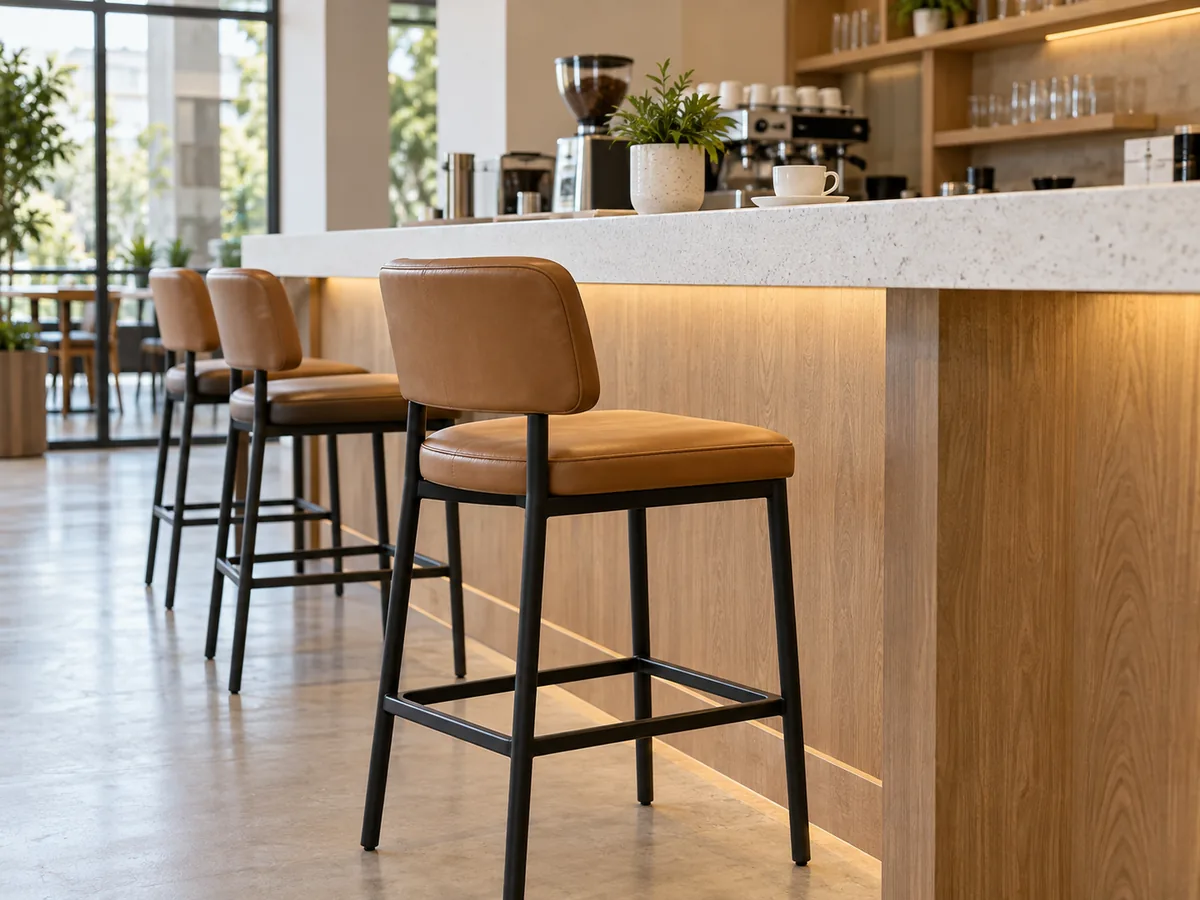
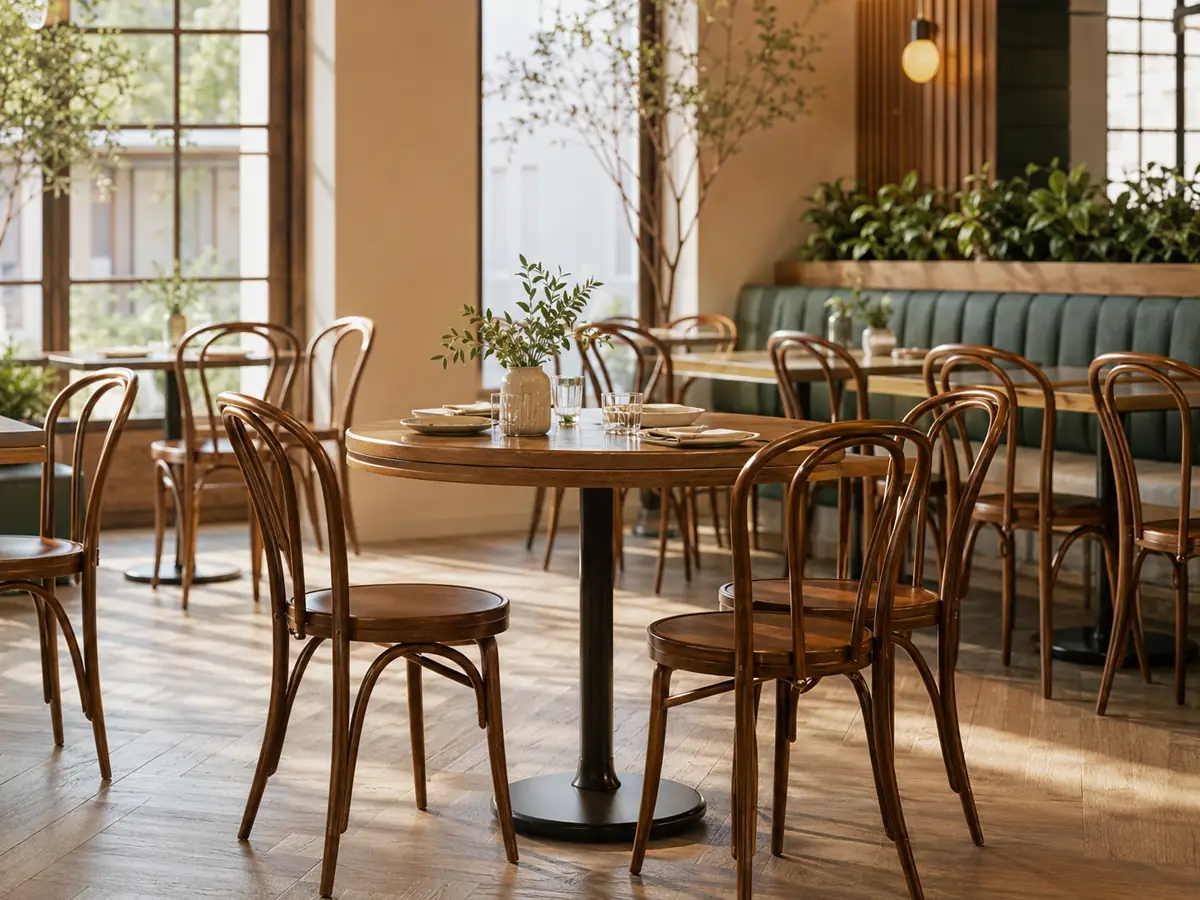
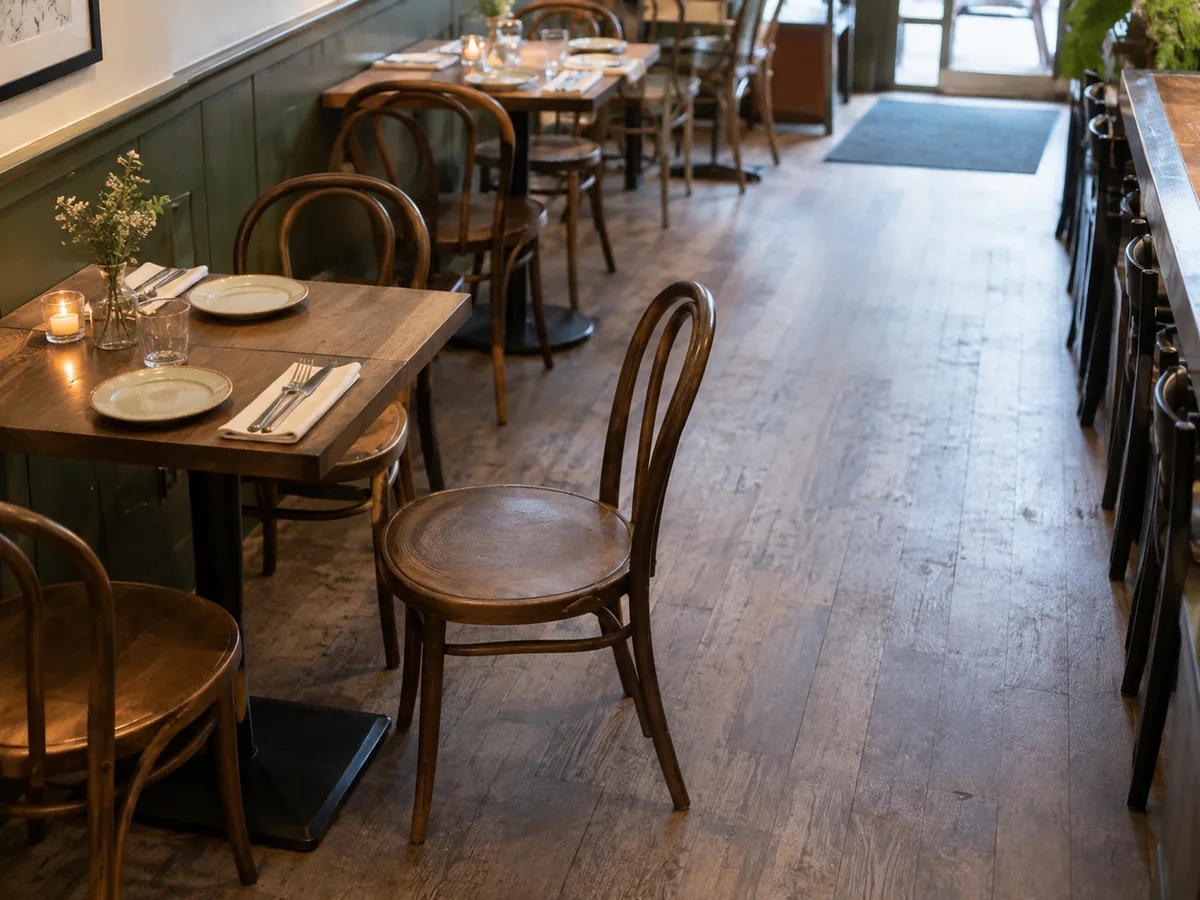
Bugholzstühle sind Stühle mit gebogenen Holzteilen. Klassisches Bugholz entsteht, indem Massivholz mit Dampf erhitzt und anschließend über einer Form gebogen wird. Typische Ausführungen sind Café- und Esszimmerstühle, Armlehnstühle, Schaukelstühle und Hocker. Bei einigen neueren Stühlen kommt stattdessen gebogenes Sperrholz zum Einsatz; andere greifen lediglich die Formensprache von Bugholzmöbeln auf.
Was sind Bugholzmöbel?
Der wesentliche Unterschied liegt im Material: Klassisches Bugholz besteht aus einem gebogenen Massivholzteil, während Formsperrholz aus verleimten Holzlagen besteht, die unter Druck in Form gebracht werden. Ähnlich aussehende Stühle können daher unterschiedlich konstruiert sein.
Im 19. Jahrhundert trug Michael Thonet dazu bei, Bugholzmöbel in einem reproduzierbaren Verfahren für größere Stückzahlen herzustellen. Das Victoria and Albert Museum erläutert, wie sich Holz durch Dampfbiegen und den Einsatz von Metallbändern formen ließ. Auch Thonet erläutert das Verfahren in seiner Geschichte der Bugholzmöbel.
Ein als “Thonet-Bugholzstuhl” bezeichneter Stuhl kann ein Original sein oder lediglich in einem ähnlichen Stil gefertigt sein. Die Bezeichnung “Thonet-Stil” belegt nicht wer den Stuhl hergestellt hat, wie alt er ist, ob das Design lizenziert ist oder mit welchem Verfahren das Holz gebogen wurde.
Bugholzstuhl-Typen: Welche Form passt zu Ihren Räumen?
Wählen Sie den Stuhl nach dem vorgesehenen Einsatz aus – nicht nur nach seiner Optik. Ähnlich geschwungene Rückenlehnen finden sich bei Essstühlen, Armlehnstühlen, Hockern und Schaukelstühlen. Sitzhöhe, Gesamtmaße und Pflegeanforderungen unterscheiden sich jedoch.
Stuhlform und Sitzmaterial sind getrennt zu betrachten. Ein Bistro- oder Essstuhl kann mit Holzsitz, Rohrgeflecht oder Polsterung ausgestattet sein. Rohrgeflecht und Polsterung bezeichnen Sitzoptionen, keine eigenständigen Gestellformen. Prüfen Sie auch die Gestellkonstruktion: Traditionell dampfgebogenes Massivholz, gebogenes Sperrholz und Materialkombinationen sind nicht gleichzusetzen.
| Stuhltyp oder Sitzoption | Typischer Einsatzbereich | Wichtigstes Merkmal | Was ist zu prüfen? |
|---|---|---|---|
| Bugholzstuhl für Bistro und Café | Cafés, zwanglose Restaurants und Frühstücksräume | Klassische, offene Café-Optik; vor der Bestellung tatsächliche Stuhlbreite und Eigengewicht prüfen | Prüfen Sie Sitzfläche und gelockerte Verbindungen sowie den Platzbedarf hinter dem Stuhl, wenn dieser besetzt ist. |
| Bugholz-Essstuhl | Restaurants und Esstische | Sitzhöhe für Esstische und geschwungene Rückenlehne | Stimmen Sie die tatsächliche Sitzhöhe und den Rückenlehnenwinkel auf den Tisch ab. |
| Bugholz-Armlehnstuhl | Hotelrestaurants und Restaurantbereiche mit Lounge-Charakter | Zusätzliche Unterstützung für den Oberkörper | Prüfen Sie, ob die Armlehnen unter die Tischplatte passen und der Stuhl in der verfügbaren Breite ausreichend Platz findet. |
| Bugholzstuhl mit Rohrgeflecht (Sitzvariante) | Traditionelle Bistros und anspruchsvolle Interieurs | Luftiges Geflecht an Sitzfläche oder Rückenlehne | Prüfen Sie, ob die Sitzfläche aus Naturrohr oder synthetischem Geflecht besteht, wie sie gereinigt werden kann und ob eine Reparatur möglich ist. |
| Gepolsterter Bugholzstuhl (Sitzvariante) | Längere Mahlzeiten und Gastronomiebereiche | Weich gepolsterte Sitzfläche | Klären Sie Bezugsstoff oder anderes Bezugsmaterial, Polsterfüllung und Reinigungsmethode sowie die Austauschbarkeit des Sitzes. |
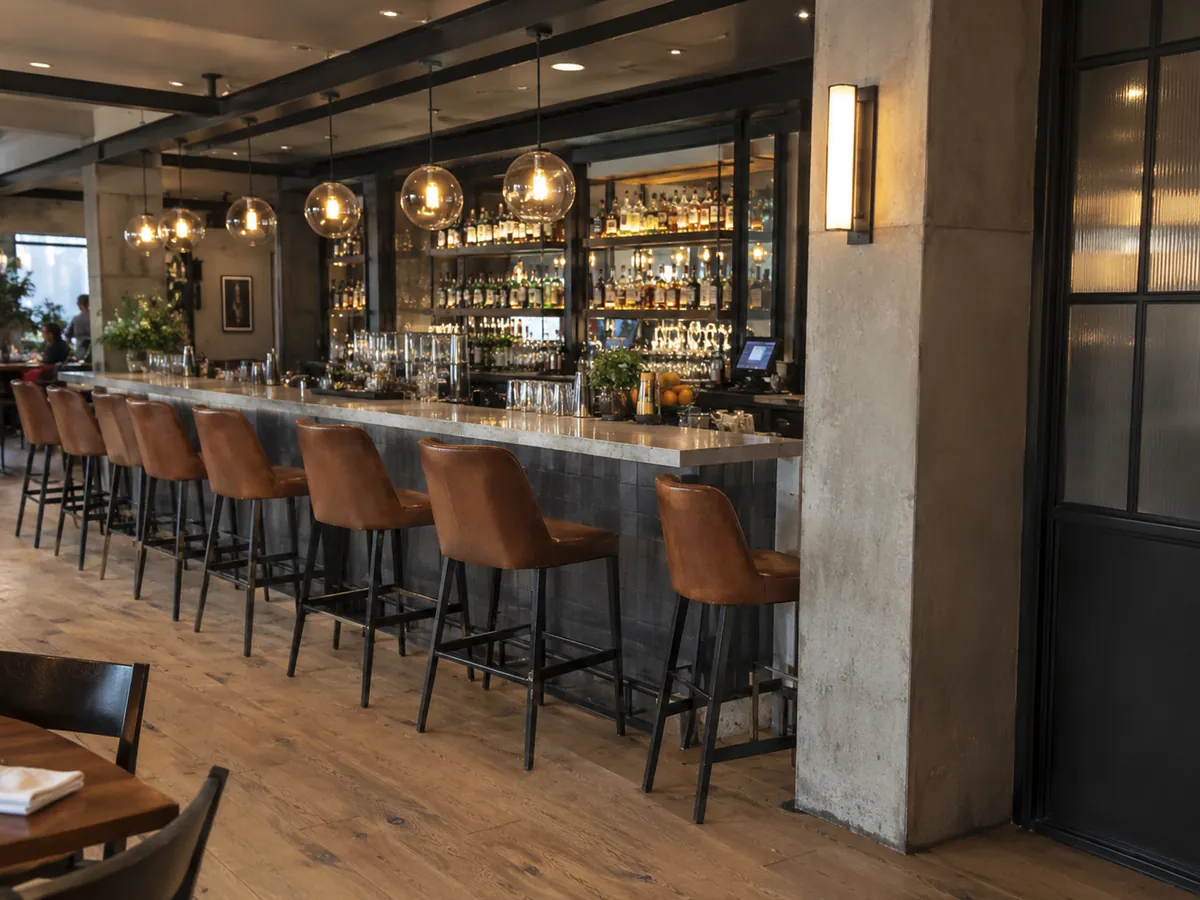
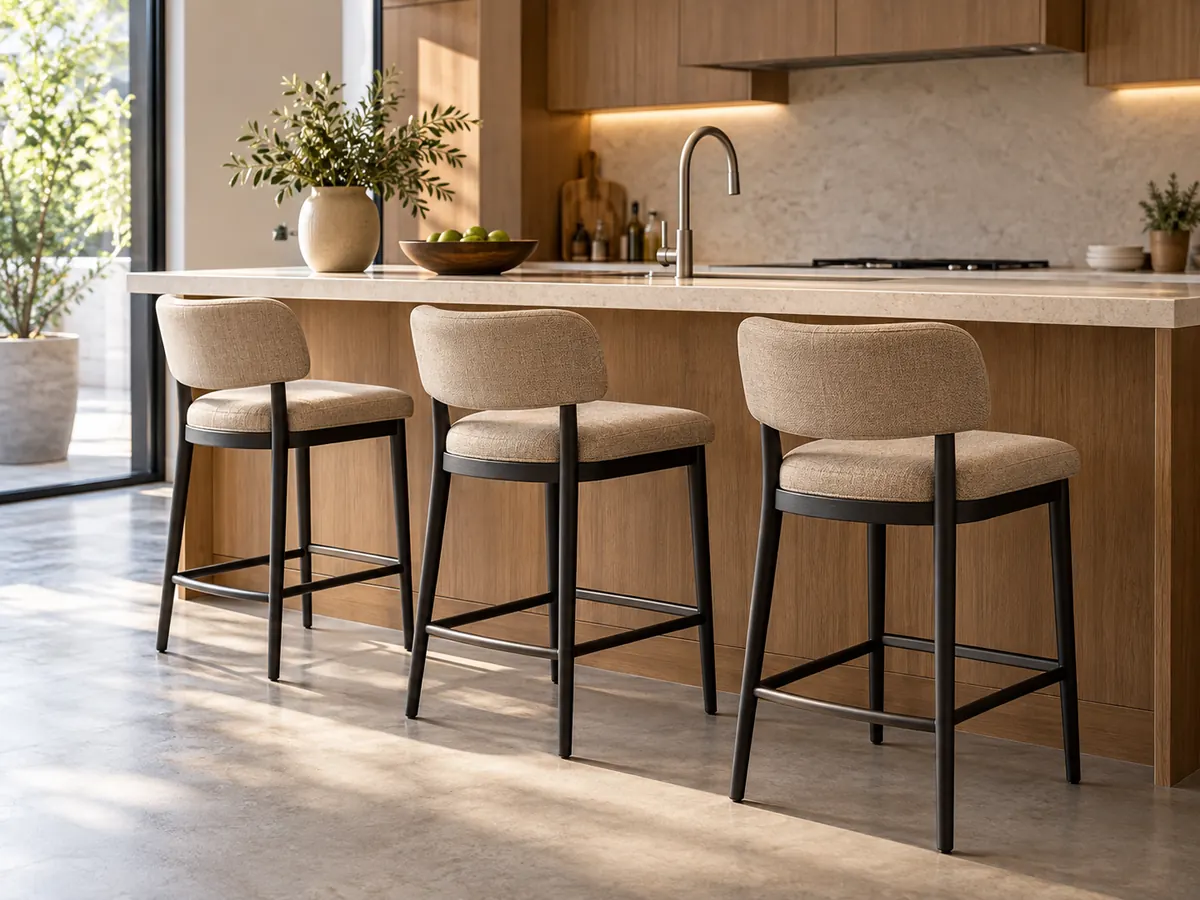
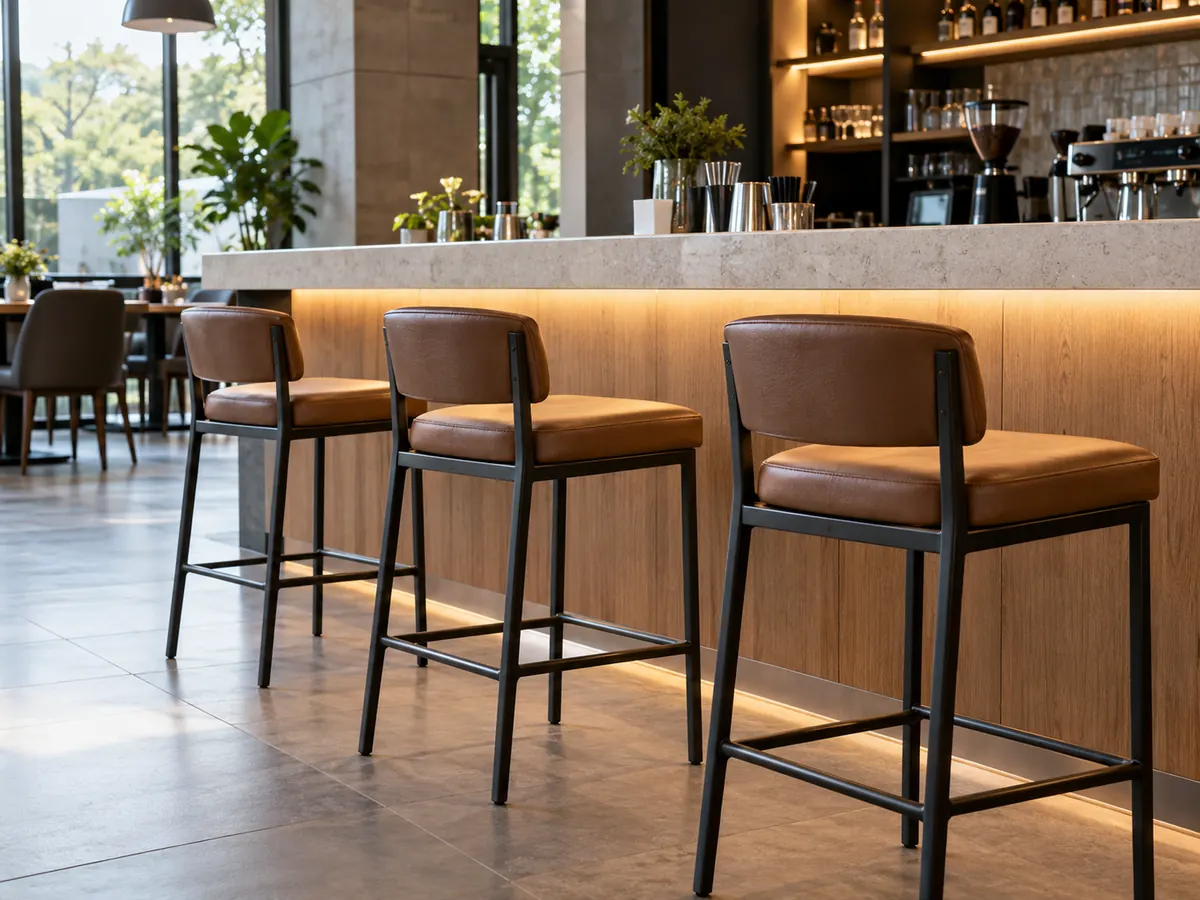
| Bugholz-Barhocker / Thekenhocker | Bartheken und Cafétheken | Geschwungene Rückenlehne für erhöhte Sitzhöhen | Prüfen Sie die Sitzhöhe, die Höhe und Position der Fußstütze sowie den verfügbaren Knieraum unter der Theke. |
| Bugholz-Schaukelstuhl | Wohnbereiche, historisch geprägte Interieurs und ausgewählte Loungebereiche | Schaukelbewegung durch gebogene Gestellelemente | Für übliche Restauranttische ist dieses Modell nicht unsere Standardempfehlung. Verwenden Sie es nur in geeigneten Lounge- oder historisch geprägten Bereichen und prüfen Sie zuvor den Platzbedarf, den Bewegungsraum beim Schaukeln, das Kipprisiko und den vorgesehenen Verwendungszweck des jeweiligen Stuhls. |
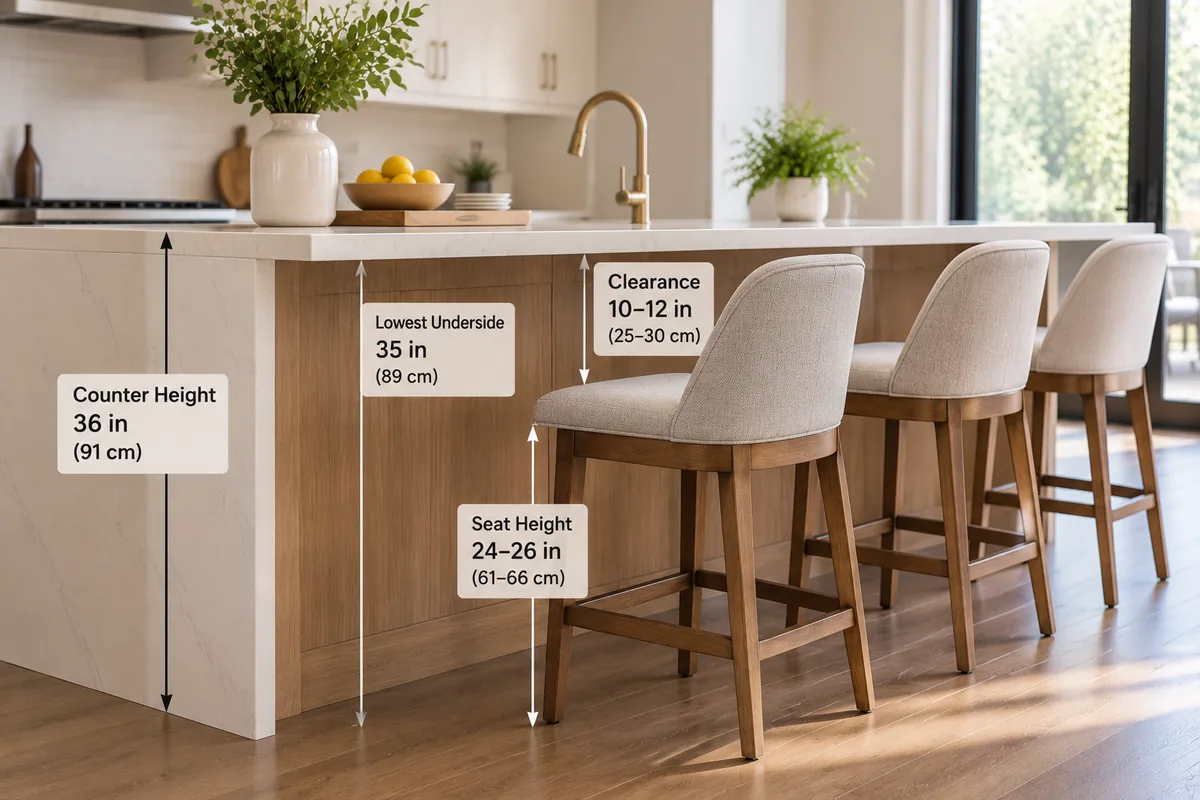
Bestellen Sie keinen Barhocker für eine niedrigere Theke, nur weil die Rückenlehne optisch passt. Messen Sie die fertige Thekenhöhe und den freien Raum darunter. Vergleichen Sie diese Maße anschließend mit der tatsächlichen Sitzhöhe und der Position der Fußstütze. Eine Ausführung, bei der die Füße keinen Halt finden oder der Knieraum zu knapp ist, kommt nicht infrage.
Ein alter Bugholzstuhl kann wie eine neue Replik aussehen, doch Verbindungen, frühere Reparaturen und Erhaltungszustand können sich erheblich unterscheiden. Wenn Sie ein Restaurant einheitlich bestuhlen möchten, wählen Sie zunächst ein Modell, das dauerhaft konsistent nachbestellt werden kann. Eine gemischte Gruppe alter Stühle erschwert häufig Wartung und Ersatzbeschaffung. Benötigt ein Betrieb später passende Ersatzstühle, empfiehlt sich ein klar definiertes Neumodell; die freigegebenen Referenzen für Oberfläche und Material sollten zusammen mit der Bestellung dokumentiert werden.
Bugholzkonstruktionen: Massivholz, Formsperrholz und Gestelle in Bugholzoptik
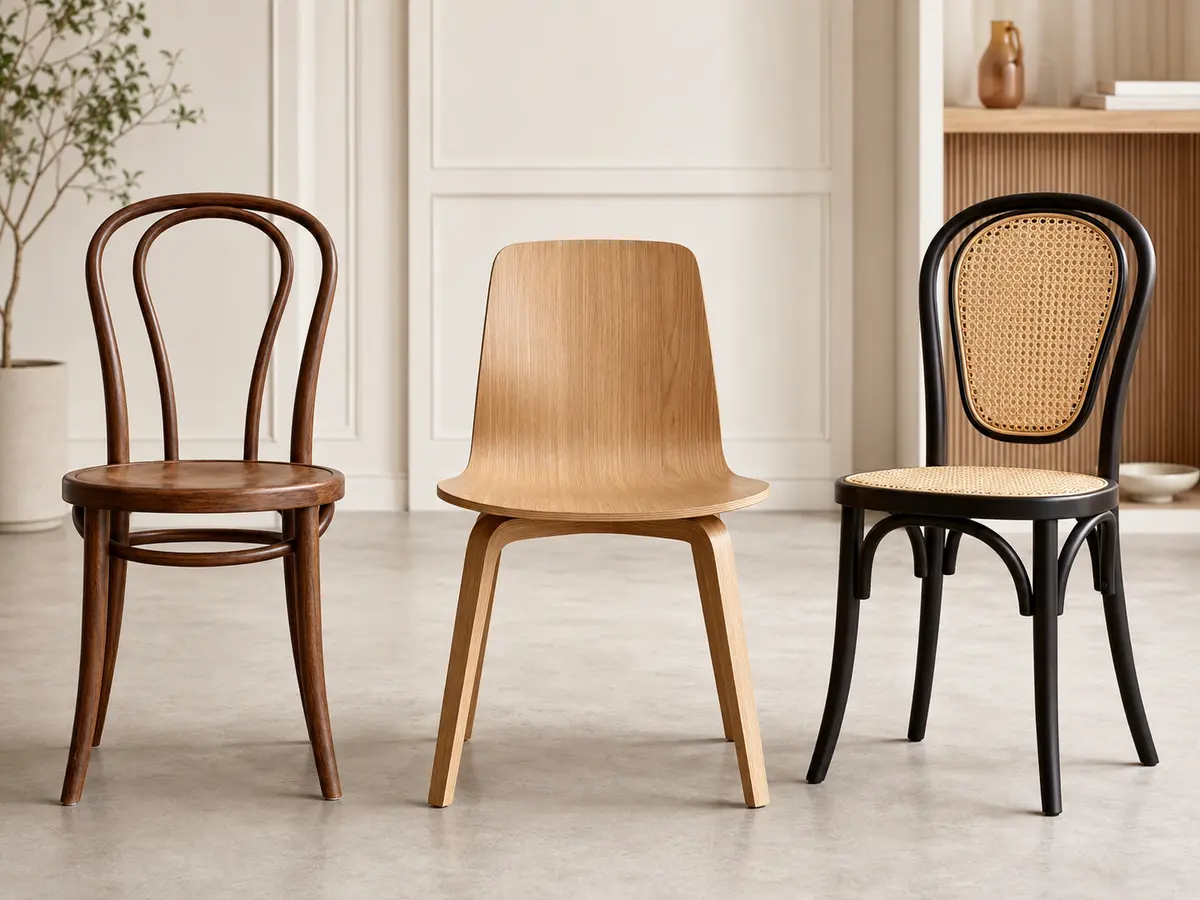
Zwei Stühle können dieselbe geschwungene Kontur haben und dennoch konstruktiv völlig unterschiedlich aufgebaut sein. Manche Rundungen entstehen durch das Biegen eines einzelnen Massivholzteils. Andere werden aus dünnen, in Form gepressten Holzlagen gefertigt, aus Holz herausgesägt oder durch das Verbinden mehrerer Materialien erzeugt. Diese Begriffe beschreiben Konstruktionsweisen, keine drei klar voneinander abgegrenzten Stuhlarten: Ein Stuhl kann mehrere davon kombinieren.
| Konstruktionsart | Herstellung der Rundung | Typische Möbelbauteile | Unterscheidungsmerkmale |
|---|---|---|---|
| Gebogene Massivholzteile | Ein massives Holzteil kann dampfgebogen, in Form gesägt oder mit anderen Massivholzteilen verbunden werden. Auch dünne Massivholzlamellen lassen sich zu einer Rundung formverleimen. | Rückenbügel, Armlehnen, Stuhlbeine, Seitenrahmen und Schaukelkufen | Ein tatsächlich gebogenes Bauteil, eine verleimte Krümmung, eine ausgesägte Krümmung und eine aus verbundenen Einzelteilen hergestellte Krümmung weisen unterschiedliche Faserverläufe und Verbindungen auf. |
| Formsperrholz | Dünne Holzfurniere werden miteinander verleimt und in einer Form verpresst, häufig unter Wärme und Druck. | Konturierte Sitzflächen, Rückenlehnen, einteilige Sitzschalen und umlaufende Rückenlehnen | Das gebogene Bauteil besteht aus miteinander verleimten Schichten und nicht aus einem einzigen Stück Massivholz. |
| Gestelle in Bugholzoptik oder Mischkonstruktionen | Gebogenes Sperrholz, ausgesägte Holzteile, Metallbauteile und Polsterungen lassen sich zu einer von Bugholz inspirierten Kontur kombinieren. | Moderne Caféstühle, gepolsterte Esszimmerstühle und Sitzmöbel im Materialmix | “Bugholzoptik” beschreibt das Erscheinungsbild, bezeichnet jedoch kein bestimmtes Formgebungsverfahren. |
Krümmungen aus Massivholz: dampfgebogen, schichtverleimt, ausgesägt und gefügt
Massivholz lässt sich auf vier grundlegende Arten in eine gekrümmte Form bringen. Entscheidend ist dabei nicht einfach, von welcher Baumart das Holz stammt. Vielmehr kommt es darauf an, ob das Holz selbst gebogen, aus Lamellen aufgebaut, in Form ausgesägt oder durch Verbindungen zusammengesetzt wurde.
- Dampfgebogenes Massivholz: Durch Wärme und Feuchtigkeit wird ein massives Holzbauteil biegsamer, sodass es um eine Form gebogen und dort fixiert werden kann, bis es seine Form beibehält. Bei engen Radien kann ein Biegeband aus Metall helfen, die Dehnung an der Außenseite des Holzes zu begrenzen. Es dient lediglich als Biegehilfe und ist kein eigenständiger Holzwerkstoff. Die Holzfasern verlaufen durchgehend entlang des gebogenen Bauteils, statt für einen Bogen durchtrennt zu werden.
- Schichtverleimtes Massivholz: Mehrere dünne Massivholzleisten werden über einer Form gebogen und miteinander verleimt. Das Ergebnis kann wie ein einziges starkes, gebogenes Bauteil wirken, weist zwischen den Leisten jedoch Leimfugen auf. Auf diese Weise lassen sich geschwungene Armlehnen, Zargen und Rahmenteile herstellen, ohne ein einzelnes starkes Holzstück biegen zu müssen.
- CNC-gefräste Rundungen aus Massivholz: Eine Maschine fräst die Rundung aus dem Massivholz. Dadurch erhält das Bauteil seine geschwungene Kontur, ohne dass das Holz tatsächlich gebogen wird. Bei engen Radien kann die Maserung quer zur Form verlaufen, statt ihr zu folgen. Daraus ergeben sich andere statische Eigenschaften als bei einem dampfgebogenen Bauteil.
- Zusammengesetzte Massivholz-Rundungen: Mehrere kürzere Teile werden geformt und miteinander verbunden, sodass ein größerer Bogen entsteht. Eine sorgfältig geglättete Oberfläche kann die Rundung durchgehend erscheinen lassen, obwohl der Rahmen Verbindungsstellen oder Befestigungselemente enthält.
Diese Verfahren finden sich bei gebogenen Rücken- und Armlehnen, Stuhlbeinen, Seitenrahmen, optisch durchgehenden Stuhlbügeln sowie bei Schaukelstuhlkufen, also den Schienen mit Bodenkontakt. Eine gebogene Kufe bestimmt den Schaukelverlauf mit; eine geschwungene Rücken- oder Armlehne verändert die Form und die Kontaktpunkte des Stuhls. Für sich allein lässt keines dieser Merkmale Rückschlüsse auf Komfort oder Stabilität zu.
Warum Buche so häufig verwendet wird: Buche ist eng mit den historischen Thonet-Kaffeehausstühlen und ihren dampfgebogenen Rahmen verbunden. Auch Esche, Eiche, Ulme, Nussbaum und andere Holzarten werden für Möbel mit Rundungen verwendet. Die Holzart allein lässt jedoch nicht erkennen, ob ein bestimmtes Bauteil dampfgebogen, ausgefräst oder zusammengesetzt wurde. Maserungsverlauf, Fehlstellen, Holzfeuchte, Materialstärke und Formgebungsverfahren beeinflussen, welche Formen möglich sind. Thonets Darstellung des Massivholzbiegens erläutert die Funktion von Dampf, Metallband und geformten Bauteilen aus Buche.
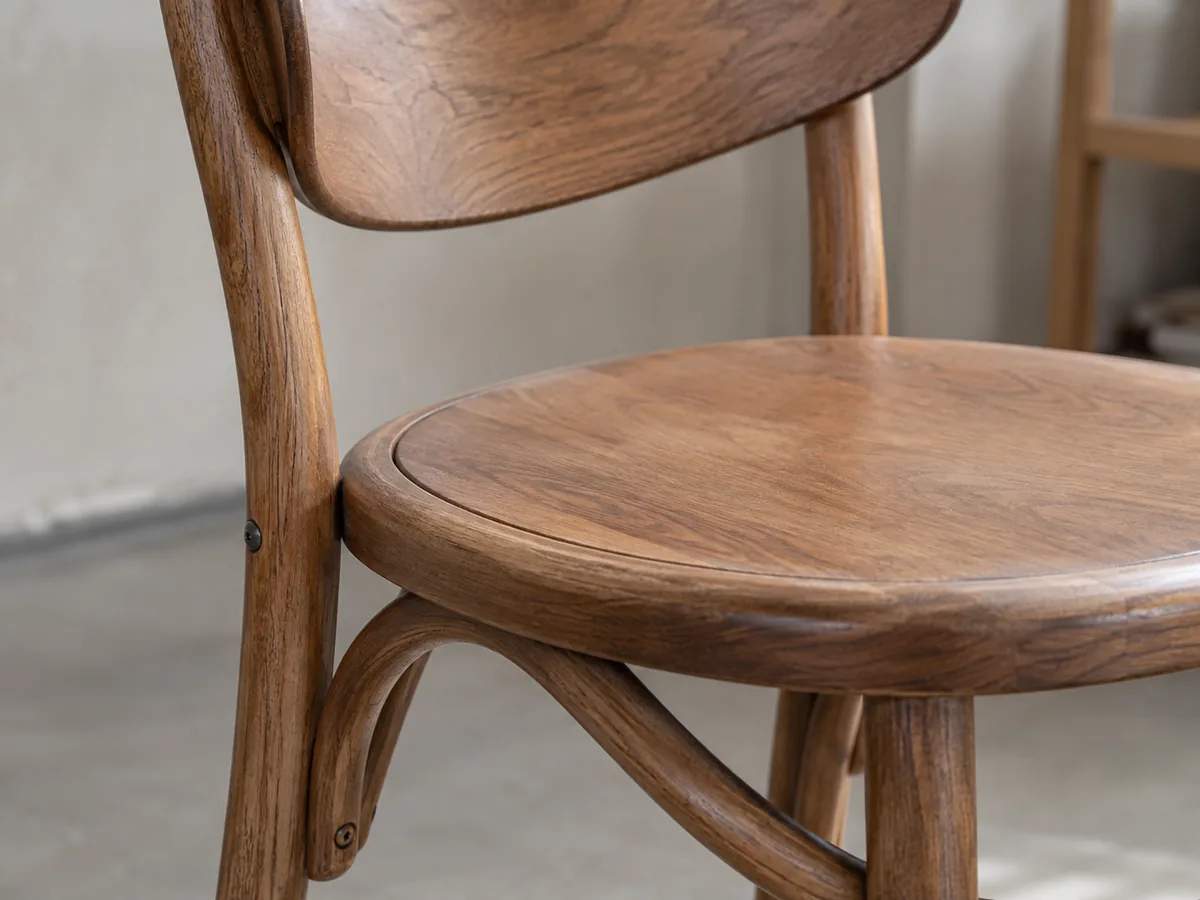
Formsperrholz: geschwungene Sitze, Rückenlehnen und Sitzschalen
Während beim Massivholzbiegen ein Bauteil verformt wird, entsteht ein geschwungenes Formsperrholzteil aus dünnen Holzblättern, sogenannten Furnieren. Die Furniere werden mit Klebstoff geschichtet und in einer Form verpresst. Wärme und Druck können dazu beitragen, dass sich die Schichten fest miteinander verbinden und die Form dauerhaft halten. Das fertige Formteil kann eine leichte Wölbung oder eine ausgeprägte dreidimensionale Kontur aufweisen.
Verschiedene Krümmungsarten bei Formsperrholz: A einfach gekrümmte Platte ist hauptsächlich in eine Richtung gebogen, etwa wie eine sanft geschwungene Rückenlehne. Eine mehrfach gekrümmte Schale ist in mehrere Richtungen gebogen, sodass Sitzfläche oder Rückenlehne nach oben und zu den Seiten verlaufen können. Ein dickeres, schichtverleimtes Sperrholzbauteil kann stattdessen Teil einer gebogenen tragenden Rahmenkonstruktion sein. Eine komplexere Krümmung ist nicht automatisch komfortabler oder langlebiger; entscheidend sind weiterhin die endgültige Geometrie und die übrige Konstruktion des Stuhls.
Verschiedene Möbelteile aus Formsperrholz: Bei separat geformten Sitzflächen und Rückenlehnen kommen zwei Formteile zum Einsatz. Eine einteilige Formsperrholzschale verbindet Sitzfläche und Rückenlehne in einem einzigen Formteil. Eine seitlich herumgezogene Schale ist um die Seiten der Rückenlehne herumgebogen, während eine gepolsterte Formsperrholzschale mit einer Polsterung und Stoff oder einem anderen Bezug versehen ist. Bei gepolsterten Stühlen können die Holzlagen vollständig verdeckt sein.
Sperrholz wird auch anhand seiner Furniere und Oberflächen beschrieben. Je nach Konstruktion können Birken-, Buchen-, Pappel-, Eukalyptus- oder Mischfurniere zum Einsatz kommen. Eine Platte mit Eichen- oder Nussbaumdeckfurnier zeigt dieses Holz an der Oberfläche, ohne dass der Kern aus dem entsprechenden Massivholz bestehen muss. Das dekorative Deckfurnier und die darunterliegenden Schichten beschreiben unterschiedliche Merkmale derselben Platte.
Die Formsperrholzsitz des Eames Institute provides a historical example of shaped veneer furniture. The USDA Forest Service Wood Handbook chapter on wood-based composites explains plywood and other layered wood materials in more technical detail.
Bentwood-Style Frames: Mixed Materials and Curved Designs
im Bugholz-Stil describes a chair’s visual language, not one fixed manufacturing process. A rounded café-chair silhouette can be made using cut wooden parts, a molded plywood back, metal legs, an upholstered shell or a mixture of these components. That does not make the chair inferior or a counterfeit; it means the appearance alone cannot identify the construction.
- Wood and metal: A curved wooden seat or back can sit on steel legs or a metal side frame. The support structure and the visible curve are separate parts of the design.
- Plywood and upholstery: A molded plywood shell may be covered with padding and fabric, giving a soft, continuous outline while hiding the shaped layers beneath.
- Decorative curves and a separate frame: A shaped arm, back or trim piece can create a bentwood-inspired look while other members provide the chair’s structural support.
Cane, fabric and leatherette describe a woven surface or upholstery covering; they do not, on their own, identify how the wooden frame was shaped. Likewise, a chair with a curved back can contain solid wood, plywood and metal at the same time.
How can you tell the constructions apart? Visible plywood edges may show bonded layers, solid-wood grain can help explain a curved member, and joint lines may reveal a frame made from several pieces. Paint, veneer and upholstery can hide all three. The clearest distinction is the construction of each component—not the overall outline of the finished chair.
How to Make a Bentwood Chair: The Traditional Process
A traditional bentwood chair is made by softening solid wood, bending it into shape, drying it and assembling the parts. Dry wood cannot simply be forced into a tight curve without a greater risk of damage. The steps below explain the traditional method; they do not mean every YeZhi Furniture chair uses this process.
- Choose the wood. Select a suitable species with the required size and grain direction. Do not use pieces with cracks, knots or other defects that would weaken the bend.
- Prepare the parts. Cut or turn the wooden pieces to the sizes and shapes needed before bending. Leave enough material for the final shape and joints.
- Soften the wood with steam or hot moisture. Heat and moisture make the wood easier to bend. The time needed changes with the wood species and thickness, so there is no single steaming time for every chair.
- Bend the wood with support. When the method calls for it, a steel backing band helps limit stretching on the outside of the bend. Shape the piece around its form, then look for visible fibre damage before moving it to the next stage.
- Hold the curve while the wood dries. Keep the part in its form until it is ready for the next operation. After release, check for cracks and springback—the curve partly straightening—and compare the shape with the approved reference before assembly.
- Trim and assemble. Drill, form or finish joints and connect the back, seat, legs and reinforcing parts according to the chair design.
- Finish and check the chair. Apply the agreed finish and fit the seat and floor glides. Compare size, joint fit, stability on a flat floor and surface quality with the approved sample. Hold any chair that fails the written acceptance requirements for review.
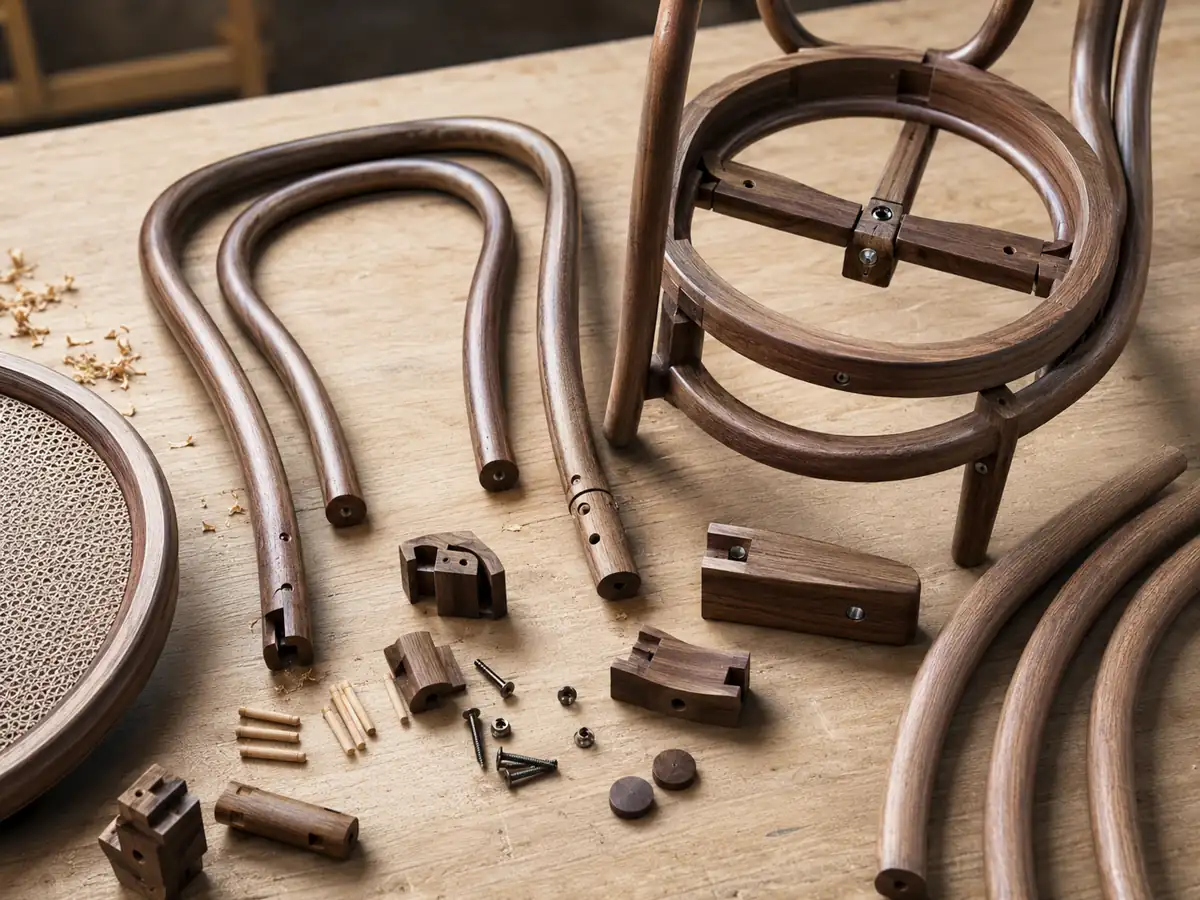
For a commercial order, approve the curved parts and joints on a finished sample. If an original Thonet design is required, confirm maker and design rights separately.
Are Bentwood Chairs Comfortable?
Ja. A well-sized bentwood chair can be comfortable for a café visit or a restaurant meal. The curved back alone is not enough. Check whether the back supports the sitter, whether the seat is wide and deep enough, whether the front edge presses into the legs, how high the table is and how long guests will sit.
| Seating situation | Preferred starting option | What comfort or cleaning issue to check |
|---|---|---|
| Quick coffee or short casual meal | Contoured wood seat or firm cane seat | Easy to move between guests; check whether the front seat edge feels comfortable and the back supports the sitter. |
| Extended restaurant dining | Contoured seat with suitable padding | Improved soft contact; upholstery cleaning and replacement become important. |
| Hotel breakfast / mixed guest groups | Chair with a supportive back and seat dimensions checked against the approved sample | Try the chair with people of different sizes. A photo cannot show how the seat and back will feel. |
| Bar or counter seating | Correct-height stool with a usable footrest | A soft seat will not compensate for an incorrect footrest or seat height. |
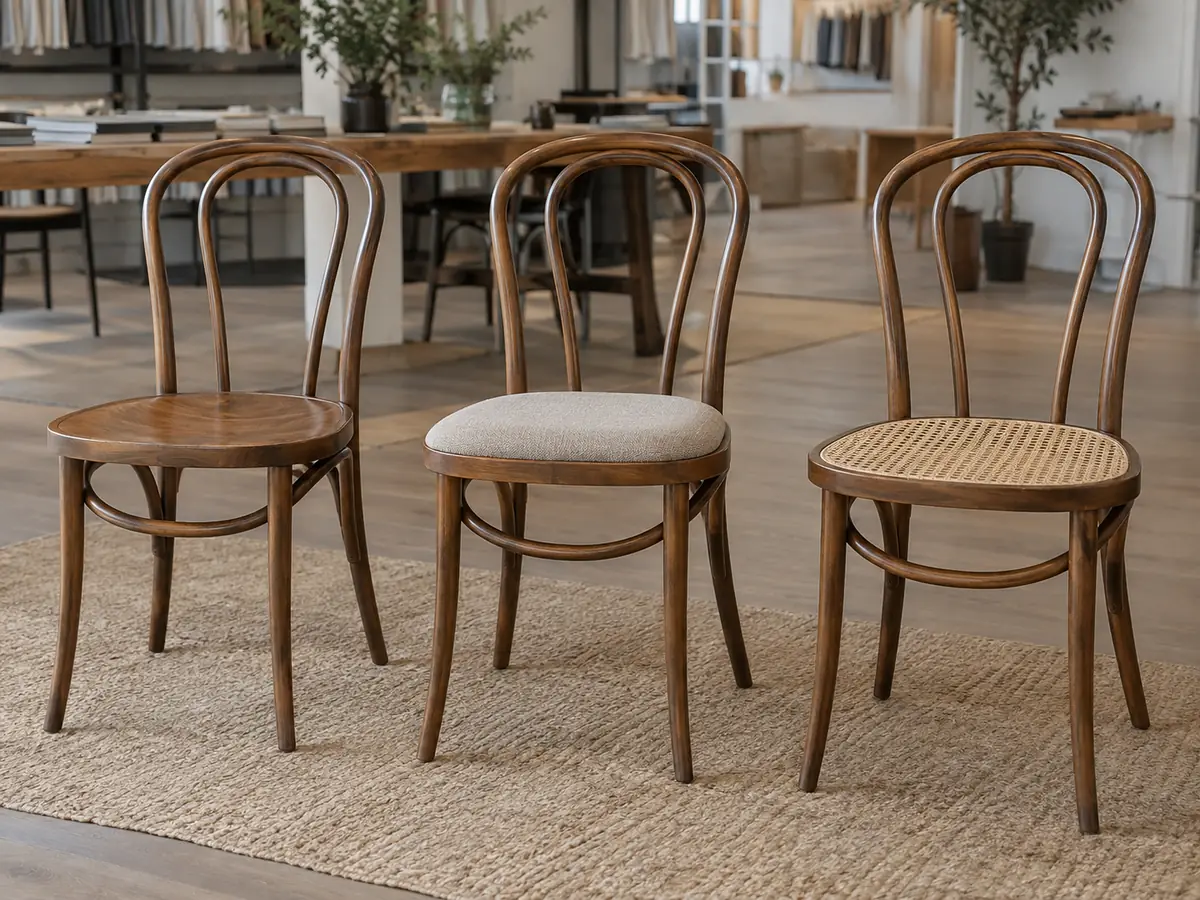
Wood, cane or upholstered seat?
Wood seats can be practical when chairs need to be cleaned and moved often, but their shape and finish still matter. Cane seats look lighter and can have some give, but natural cane needs suitable cleaning and care. Upholstered seats have a layer of padding and a covering, so they are usually the first option to compare for longer meals. Check how the covering is cleaned or replaced.
A bentwood chair pad or removable cushion may make a firm seat more comfortable. Before ordering many pads, sit on one and check that it stays in place, does not change the usable seat size and can be removed for cleaning. A cushion should not be used to hide a damaged or loose seat.
If guests stay for long meals and staff clean seats frequently, check comfort and cleaning on the same sample. Start with a supportive seat covered in a material approved for the venue’s cleaning method. If the covering cannot handle the required routine, reject that upholstery option even if it feels comfortable during a short trial. Do not assume natural cane can tolerate repeated soaking.
Vor der Produktion, test each sample at the real table or a matching mock-up. Have people of different sizes sit down, stand up and move the chair. Record seat-edge pressure, back support, arm-to-table contact and space behind an occupied chair. Reject a frame that fails table fit or comfortable entry and exit before selecting upholstery. Thicker padding cannot correct the wrong seat height or knee clearance.
Bentwood Chair Dimensions and Table Fit
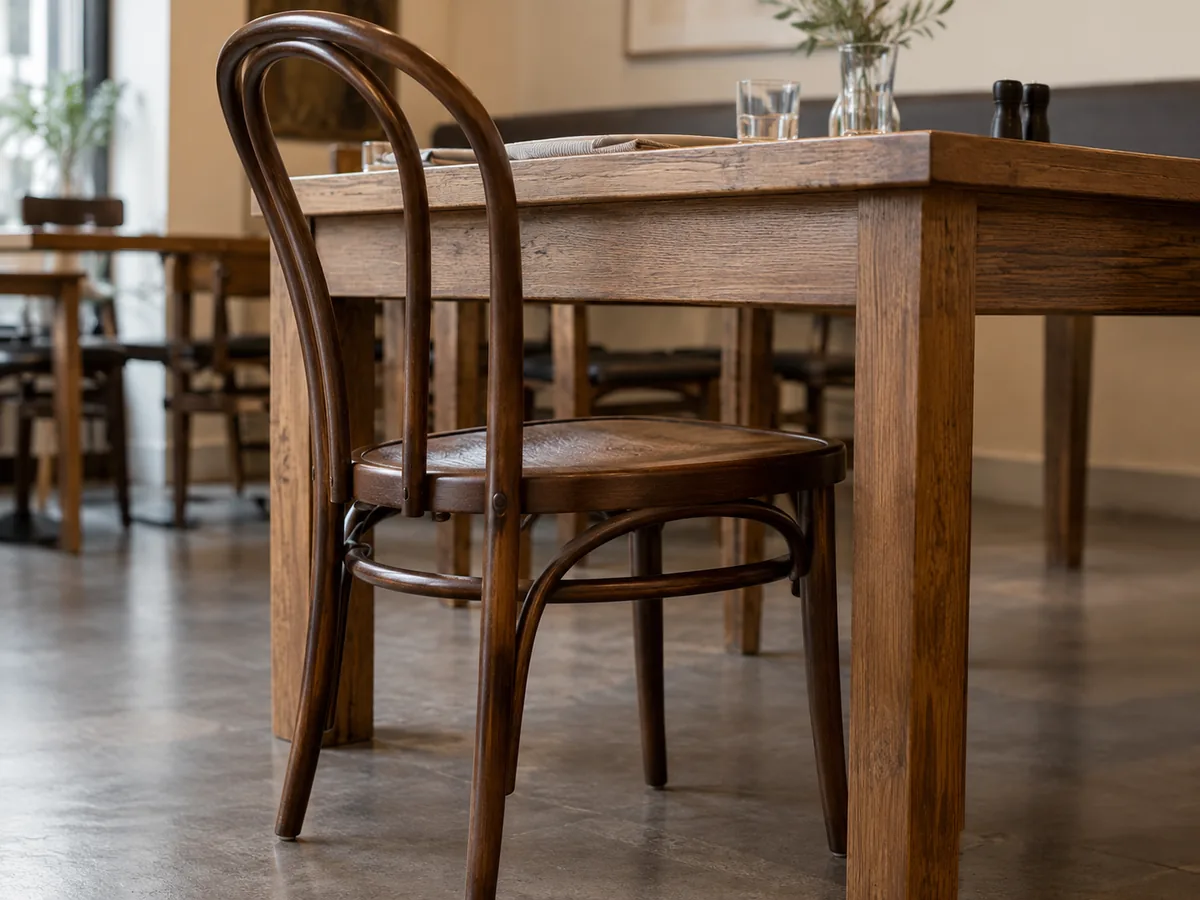
For an initial dining-room layout, you can start with a chair seat height of about 17–19 Zoll / 43–48 cm and a dining table height of about 28–30 Zoll / 71–76 cm. These numbers are for planning only. They are not the measurements of a specific YeZhi chair, and they do not prove that an aisle meets accessibility rules. Measure the real chair with a person seated, allow for chair pull-out and staff movement, and check required clear paths against the local project drawings and applicable rules. Do not use the planning range as a finished seating layout.
For a model-level comparison, DC218 has a published seat height of 17,7 in / 45 cm, while CR215 has a published seat height of 17.8 in / 45.2 cm. These are model specifications, not general bentwood standards. CB190 does not publish a seat height; check its table fit against the approved drawing or sample.
| Messung | Warum das wichtig ist | Mögliche Probleme |
|---|---|---|
| Seat height to tabletop | Controls dining posture and reach | Guests sit too low or high. |
| Overall chair width and leg spread | Controls seats per table and neighbouring clearance | Planned seating quantity cannot fit. |
| Space behind a chair when someone is seated | Controls circulation when people are seated | Service or required access route becomes obstructed. |
| Arm height and table apron | Determines whether an armchair can tuck under the table | Arms collide with the table structure. |
| Counter height and footrest position | Controls comfort for counter stools and bar stools | Legs lack support despite a correctly shaped back. |
An armchair can meet the seat-height target and still hit the table apron (the support panel below the tabletop). At the intended floor and table position, check seat-to-table height, arm or frame clearance below the apron, and the passage behind an occupied chair. For CB190, obtain seat height, usable seat width and depth, and needed frame-clearance dimensions from an approved drawing or sample; overall chair height cannot replace them. If the chair obstructs the table or required passage, change the chair, table or layout before locking the seating count.
How Much Do Bentwood Chairs Cost?
The table compares selected U.S. public listing examples checked in October 2026, in US dollars per chair unless stated otherwise. These figures show the prices advertised for particular models or options, not typical market ranges, verified transaction prices, delivered prices or YeZhi Furniture factory quotations. The ends of each range come from a small set of listings, not a market-wide price study. Cane and upholstered seating are options that can overlap with dining chairs, bistro chairs and armchairs.
| Bentwood chair type | Observed U.S. listed price examples | Main factors that change the price | Example listings |
|---|---|---|---|
| Bugholzstuhl für Bistro und Café | US$173–$212 each | Solid-wood species, back design, basic seat or padded seat, finish, and order quantity. | Restaurant-Möbel; Cafe Tables |
| Bugholz-Essstuhl | US$183–$203 each | Frame design, wood and bend construction, seat finish, upholstery options, and order size. | Restaurant-Möbel |
| Bugholz-Armlehnstuhl | US$306–$358 each | Additional arm parts, frame dimensions, construction, seat material, cane or padded options, and finish. | Restaurant-Möbel; American Hospitality |
| Bentwood chair with a cane seat or back | US$345–$595 each | Caned back only versus cane on both seat and back, handwork, frame wood, maker and finish. | American Hospitality; Williams Sonoma / TON |
| Upholstered bentwood dining chair | US$367–$399 per chair in one listed configuration | Foam, fabric or vinyl grade, seat versus seat-and-back upholstery, and approved cleaning or fire requirements. | American Hospitality (base retail US$345 + listed upholstery options US$22–$54) |
| Bentwood bar stool | US$205.50–$271 each | Seat height, back and footrest design, solid wood versus plywood, upholstery, and quantity discounts. Counter-height versions must be quoted at the correct height. | Moda Seating; Cafe Tables |
| New bentwood rocking chair | US$389 in one new-chair listing | Rocker-rail geometry, frame wood, seat material, finish, and overall size. Rockers are not interchangeable with standard dining chairs. | Amish Traditions |
| Vintage bentwood chair or rocker | US$150–$1,695 in selected asking-price examples | Verified maker and age, originality, condition, repairs, provenance, design rarity and shipping. Actual sold prices can be much lower or higher. | Chairish café chair; Chairish rockers |
How to read these prices: Each row describes a particular chair type or seat option, not a guaranteed price bracket. A new steam-bent solid-wood chair, moulded-plywood chair and mixed-frame lookalike may all have a similar outline but different production costs. Compare the same construction, seat material, finish and quantity. Check any retailer’s latest listing before using a number in a budget; additional examples are shown in the Moda Seating bentwood collection. For vintage chairs, compare completed sales of similar items before estimating value; an asking price does not prove a chair’s market value.
Here is a shipping-cost example, not a live quote. Chair A costs US$65, plus US$28 per chair for packing and freight, making US$93. Chair B costs US$73, plus US$16 for packing and freight, making US$89. Chair B has the lower subtotal even though its chair price is higher. These are limited subtotals, not final landed costs. Compare the same chair configuration, quantity, trade term (EXW, FOB or CIF) and destination. Include duties, taxes, port charges, inland transport and any agreed damage allowance. Mark unquoted costs as not included, not zero.
Sind Bugholzstühle robust genug für Restaurants?
Yes, some bentwood and bentwood-style chairs are suitable for indoor restaurants. But the name “bentwood” does not tell you how strong a chair is or whether it has passed a test. Check the size of the frame parts, curved sections, joints, screws, seat support, finish, floor glides and the environment where the chair will be used. For required tests, check the evidence for the exact model.
ISO 7173:2023 describes ways to test the strength and durability of chairs and stools. It does nicht mean that every YeZhi chair has passed the test. If your project requires test results, check that the report names the actual chair model and configuration and meets the project requirements. If a required report is unavailable or does not cover the selected model and configuration, do not treat the requirement as passed. Resolve the evidence requirement in the project specification before approving that model, or choose a configuration with acceptable documentation.
If a chair develops a structural crack, separated load-bearing wood layers or an unsafe moving joint, stop using it until its condition has been assessed. A damaged foot glide can be checked separately, but replacing a glide or tightening one screw does not prove that a damaged frame is safe.
If stacking is essential, use only a model with confirmed stacking instructions and an approved limit. For frequent wet cleaning or outdoor use, approve the exact seat, finish and environment specification; appearance alone does not establish suitability.
For routine care, see our restaurant chair cleaning guidance and our guide to chair lifespan and wear. If a chair wobbles or its joints loosen, inspect the cause before adding a cushion or replacing the foot glide.
Compare Three YeZhi Furniture Dining Chairs
The three YeZhi Furniture models below help you compare curved plywood, cane with a wooden surround, and upholstered plywood with a metal frame. They are not verified traditional steam-bent solid-wood chairs. Choose them for their confirmed materials, dimensions and fit, not simply because they resemble classic Bentwood. If your project requires traditional steam-bent solid wood, send us that requirement before quotation so construction and model availability can be checked.
DC218 Esszimmerstuhl aus schwarzem Sperrholz

DC218 uses contoured plywood-based seat and back components with shaped wood parts and visible metal supports. Depending on the approved configuration, the seat and back surfaces may be exposed plywood or upholstered. Specify both surfaces and finishes before comparing quotes; the product photograph does not lock the final materials. It is a chair option to compare for indoor cafés and restaurants. Published size: W17.7 × D19.7 × H32.9 in / W45 × D50 × H83.5 cm; seat height 17.7 in / 45 cm. Minimum order quantity (MOQ) for the standard model is 20 pcs.
CR215 Esszimmerstuhl aus Walnussholz mit Rohrgeflecht

CR215 has a cane seat and back with a walnut-tone wooden surround and steel legs. Compare CR215 for indoor dining when the venue can follow the care requirements for natural cane. If staff routinely soak seats, use steam cleaning or leave seating damp for long periods, do not select this cane configuration as the default. Start with a wipe-clean alternative and confirm its exact finish and cleaning instructions before ordering. Published size: W17.2 × D21.3 × H32.2 in / W43.6 × D54.1 × H81.8 cm; seat height 17.8 in / 45.2 cm. The standard model MOQ is 20 pcs. Walnut-tone describes the colour; it does not prove the chair is made from solid walnut or that its frame is steam-bent.
CB190 Esszimmerstuhl mit geschwungener Rückenlehne

CB190 has an upholstered seat, a curved plywood back with upholstery, and a steel sled-style frame. It is worth comparing when you want padded seating. Published overall size: W18.7 × D22.2 × H30.9 in / W47.6 × D56.5 × H78.5 cm. The published product page does not specify seat height, seat width or seat depth. Do not approve CB190 for a particular table based on overall height. Lock those three seat measurements against the table drawing and approved product specification before ordering. The published standard MOQ for CB190 is 20 pcs; deep customization normally starts around 100 pcs per configuration. Confirm the selected upholstery and frame finish in the quotation.
| Wenn Sie | Start by comparing | Check before ordering |
|---|---|---|
| A shaped plywood seat and back for indoor dining | DC218 | Confirm the approved plywood or upholstered surface, finish and table fit. |
| A natural cane look for dry indoor dining | CR215 | Confirm cane cleaning rules; compare another seat if routine wet cleaning is required. |
| An upholstered curved-back dining chair | CB190 | Confirm seat height, width and depth from the approved drawing; published overall height is not seat height. |
You can also explore our Kollektion von Restaurantstühlen aus Holz, Restaurant-Stuhlkollektion und wood bar stool options for other shapes and materials.
What to Check Before Ordering Bentwood Chairs Wholesale
For bulk orders, confirm the model, materials, dimensions and approved sample before final quotation.
- Confirm the frame material. Tell us whether you need traditional steam-bent solid wood, plywood, shaped solid wood or a mixed frame, and which wood species is required.
- Confirm the dimensions. Give us the seat height, overall chair width and depth, back and arm dimensions, and the table or counter drawing.
- Choose the seat. Tell us whether it should be wood, cane or upholstered, whether you need a pad, and which colour, cleaning and maintenance requirements apply.
- Check the sample. Inspect the joints, finish, floor contact, bends and seat attachments. Sit on the chair and note any movement or discomfort.
- Tell us which tests your project requires. If a report is required, it must cover the chair model and configuration you are ordering. A report for a different chair is not a substitute.
- Confirm the sample, packing and reorder details. Record the approved sample, quantity by model and finish, protective packaging and carton size. Ask whether replacement floor glides or seat components are available for the specific model, and document any agreed finish reference and repeat-order matching requirements. Do not assume identical materials will remain available indefinitely.
| Order item | Our standard starting terms |
|---|---|
| Regular wholesale MOQ | Starts from about 15 pcs per model/SKU; specific models can have higher minimums. |
| Full OEM / custom order (a new design or configuration) | Usually from about 100 pcs per design or configuration. |
| Serienfertigung | About 30 days as a production planning reference after order confirmation. For the selected model, confirm when the schedule starts; published DC218 and CR215 terms require the deposit and final order approvals before production timing is locked. Shipping transit is separate from production time. |
| Complex / custom work | Usually about 35–45 days or according to the agreed project. |
| Zahlung | Payment by bank transfer (T/T): 30% deposit and 70% balance before shipment. |
| Trade and freight | EXW, FOB or CIF shipping terms. Sea freight can be arranged as part of a shared container (LCL) or a full container (FCL), as appropriate. |
| Standardgarantie | 1 year, with the final warranty coverage and exclusions shown on the proforma invoice (the order document issued before payment). |
A model-specific MOQ takes priority over the general 15-piece starting point. Sample lead time is confirmed separately for the selected model.
Production and packing checks
Before bulk production, approve the model and configuration, drawing with agreed tolerances, material and finish references, sample, seat or cane details, and packing specification. Inspect chairs against these references: dimensions, surfaces, joints, screws, glides, stability on a flat floor, and carton protection and labels.
For each model, finish and seat configuration, record the approved drawing and sample revision, inspected batch, number of chairs checked under the agreed inspection plan, and differences found. Release, correct or hold affected items against the written acceptance criteria. A single approved sample does not prove batch-wide consistency. If a strength, durability or fire test is required, confirm the report covers that model and configuration. A visual check is not a test result.
Confirm whether chairs arrive assembled or in separate parts (knock-down), units per carton, final outside carton dimensions, and protection for curved backs, cane, upholstery and seat edges. Separate shipment in parts does not mean a chair is stackable after assembly; require model-specific stacking instructions.
Compare carton dimensions with doors, lift openings and tight turns on the delivery route. Agree on a safe temporary storage area and who will assemble the chairs, where, and how assembly defects will be recorded. Use the confirmed carton volume (CBM) to compare freight options.
On receipt, count cartons against the packing list and inspect visible damage before unpacking. Photograph damaged cartons, labels and affected chair parts, keep the packing materials, and compare the delivered model and finish codes with the order documents. Report discrepancies through the agreed order contact and claim procedure.
Get the Right Bentwood-Style Chair for Your Project
For a project quotation, send us these details:
- Chair model or reference drawing and the type of venue.
- Table height, required chair and seat dimensions, frame and seat materials, finish or upholstery code.
- Quantity for each model and finish, plus any approved sample, test standard or packing requirement.
- Preferred EXW, FOB or CIF trade term, destination country and port, and target arrival date.
We will review the selected configuration, MOQ and quotation basis before confirming an offer.
Häufig gestellte Fragen
How can you tell if a chair is steam-bent solid wood or bent plywood?
Review the model’s material specification and ask which curved parts are made from solid wood and which from bonded wood layers. An exposed edge may show plywood layers, but a covered or painted edge cannot prove how the chair was made. If traditional steam bending matters, ask for construction evidence for that specific model rather than relying on its silhouette.
Are all bentwood chairs stackable?
No. A curved frame does not prove that a chair is designed for stacking. Check the selected model’s stacking instructions and approved limit. Armrests, wider backs and upholstery may change how chairs fit together. If daily stacking is essential, reject models without confirmed stacking information.
How long does it take to make bentwood furniture?
Traditional steam bending has no fixed chair-making time: preparation, heating, bending, drying and finishing vary by part. YeZhi bulk-order production planning is separate—about 30 days for standard orders and usually 35–45 days for complex/custom work after the required approvals, excluding shipping. This does not mean every YeZhi model is steam-bent.
Further Reading
- Victoria and Albert Museum — Thonet and the invention of bentwood furniture (historical manufacturing development).
- Thonet — Bentwood (how solid wood is bent with a steel support strap).
- Philadelphia Museum of Art — Model No. 14 Chair (historic café-chair construction and design).
- ISO 7173:2023 — Test methods for chair and stool strength and durability (this is a standard reference, not proof that a YeZhi chair passed).