Commercial Dining Chair Height Guide
Quick answer: standard dining chair seat height usually falls around 17-20 inches / 43-51 cm. For most 28-30 inch / 71-76 cm dining tables, 18-19 inches / 46-48 cm is the safest starting range.
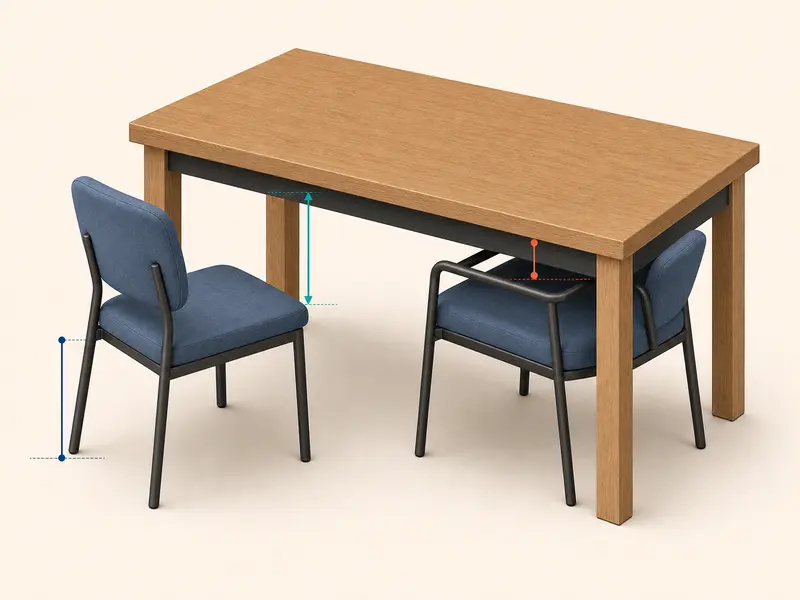
But do not buy dining chairs from seat height alone. The real fit depends on tabletop height, apron bottom height, cushion thickness, arm height, and whether the chair can slide fully under the table.
If you searched dining chair height, you are probably not asking how tall the backrest is. You want to know whether the chair will actually fit your table.
This guide gives you the practical ranges, the two fit checks, and the buying mistakes that cause bad chair and table matches in homes, restaurants, cafes, hotels, and commercial dining projects.
What Is the Standard Dining Chair Height?
In furniture sizing, dining chair height usually means seat height: the distance from the floor to the top of the seat.
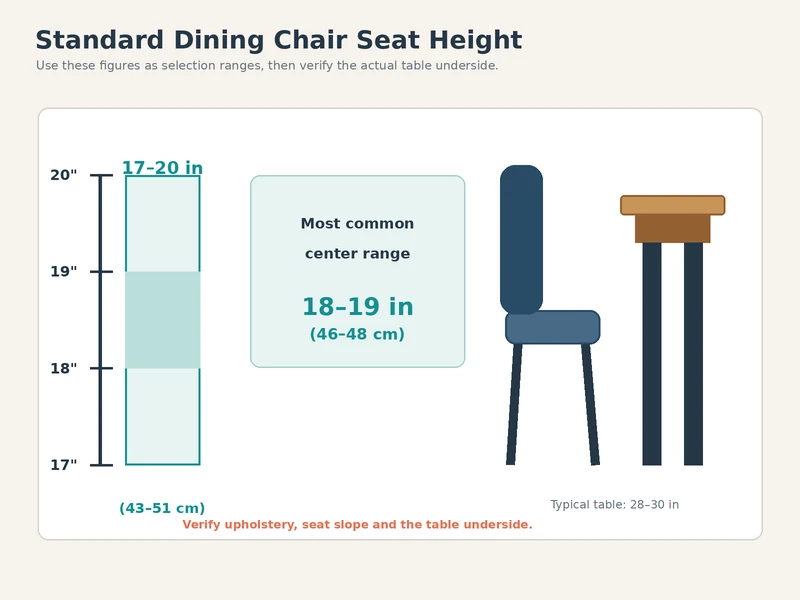
A practical starting range for standard dining chairs is approximately 17-20 inches / 43-51 cm. For standard dining tables around 28-30 inches / 71-76 cm high, 18-19 inches / 46-48 cm is usually the safest center range.
Key takeaway: treat seat height as a starting filter, not a final answer. A chair can have the “right” seat height and still fail if the table has a low apron, thick top, stretcher, or high armrests.
Fast Dining Chair Height Table
| Dining Table Height | Starting Seat Height | Must Check Before Buying |
|---|---|---|
| 28 in / 71 cm | 17-18 in / 43-46 cm | Low apron and thigh clearance |
| 29 in / 74 cm | 18-19 in / 46-48 cm | Cushion thickness and underside height |
| 30 in / 76 cm | 18-20 in / 46-51 cm | Arm height, apron bottom, and legroom |
These are practical starting ranges, not universal standards. Upholstery, seat slope, table thickness, and apron depth can change the real fit.
Dining Table and Chair Height Difference: Use Two Checks
Most online rules collapse chair fit into one number. That is where bad purchases start.
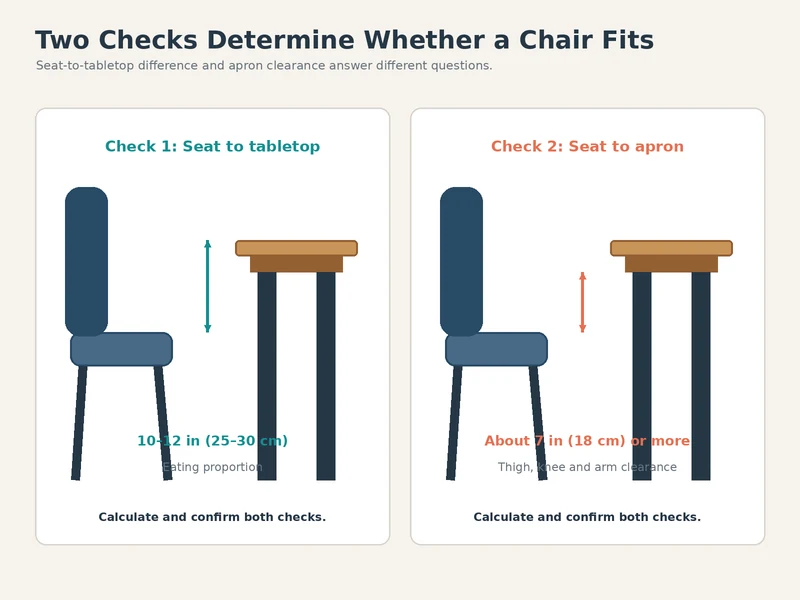
Check 1: Seat-to-Tabletop Difference
This check tells you whether the chair and table are proportionally matched for eating.
Formula: tabletop height – seat height
A common starting target is approximately 10-12 inches / 25-30 cm between the seat top and the top surface of the table.
Check 2: Seat-to-Lowest-Obstruction Clearance
This check tells you whether thighs, knees, and armrests can actually fit under the table.
Measure from the floor to the lowest obstruction under the table. This may be the apron bottom, metal frame rail, stretcher, crossbar, or bottom of a thick tabletop.
Formula: lowest obstruction height – seat height
As a practical fit check, retain about 7 inches / 18 cm or more between the seat and the lowest obstruction. More clearance may be needed for thick upholstered seats, taller users, or long sitting time.
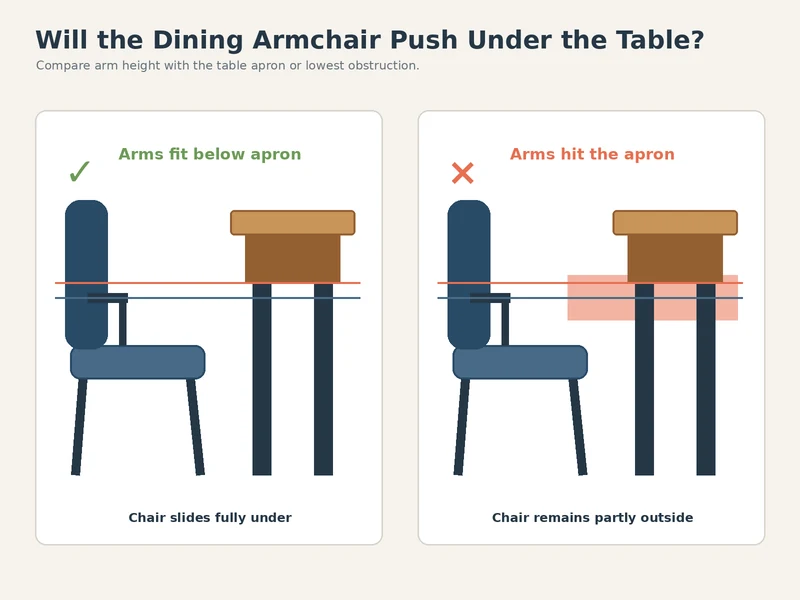
For armchairs, separately confirm that the armrest is lower than the apron bottom. If the arm is too high, the chair will not push in fully.
How to Measure Dining Chair Height the Right Way
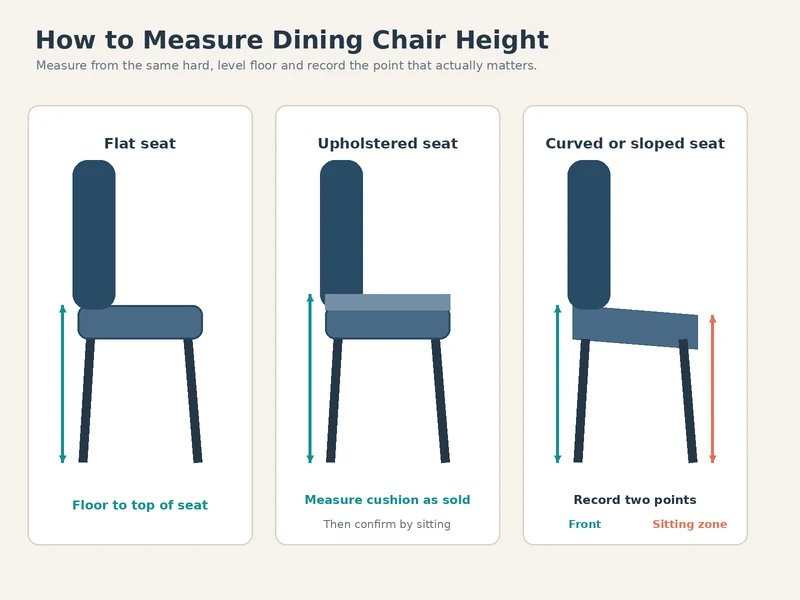
Step 1: Measure Seat Height
- Put the chair on a hard, flat floor.
- Measure from the floor straight up to the top of the seat where the user actually sits.
For upholstered seats: measure to the top of the cushion as sold. Then test the real fit if possible, because cushion compression changes the effective sitting height.
For curved or sloped seats: record two numbers: front seat height and sitting-zone height. This prevents a bad comparison between a flat 19-inch seat and a sloped 19-inch seat.
Step 2: Measure the Table’s Real Underside Height
Measure from the floor to the lowest obstruction under the table. If there are several obstacles, record the lowest one. That is the part your legs will hit first.
Step 3: Calculate Both Fit Checks
Tabletop height difference = tabletop height – seat height
Start with 10-12 inches / 25-30 cm.
Apron clearance = apron bottom height – seat height
Aim for about 7 inches / 18 cm or more, then confirm the fit by sitting in the chair.
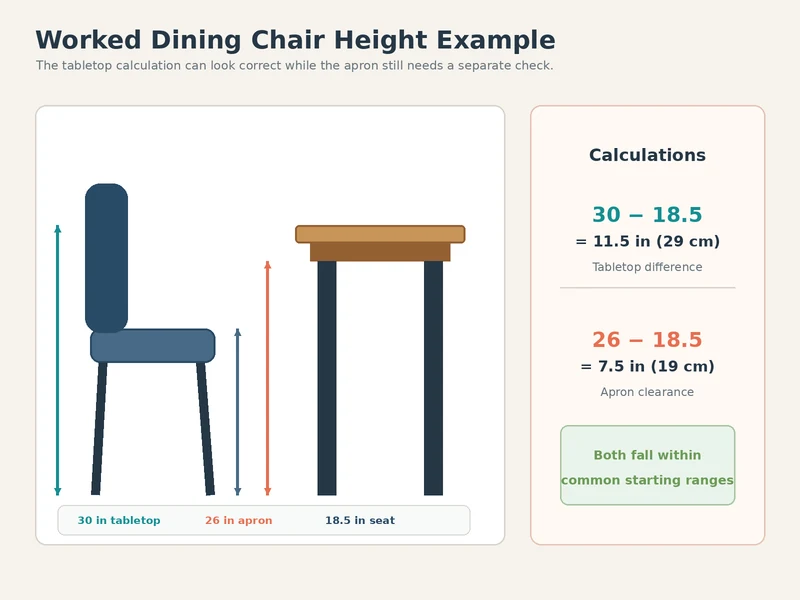
Worked Measurement Example
- Tabletop height: 30 inches / 76 cm
- Apron bottom height: 26 inches / 66 cm
- Chair seat height: 18.5 inches / 47 cm
The tabletop height difference is 30 – 18.5 = 11.5 inches / 29 cm.
The apron clearance is 26 – 18.5 = 7.5 inches / 19 cm.
This works on paper. Still check thigh clearance, cushion compression, armrest height, and whether the chair slides fully underneath.
Pro tip: if you are buying from spec sheets, ask for a drawing that labels exactly where seat height, arm height, tabletop height, and apron bottom height are measured.
For Commercial Projects, Do Not Approve Chair Height From One Number
For restaurants, cafes, hotels, and distributors, the risk is not only comfort. The risk is buying 80 or 300 chairs that do not match the table package.
Before confirming a bulk order, check these five items:
- Ask for a dimensioned drawing with seat height, arm height, width, depth, and footprint.
- Confirm the seat-height measurement point, especially for upholstered or sloped seats.
- Measure the table underside, not only the tabletop height.
- Test 1-2 samples with the real table when project risk is high.
- Lock the approved spec before repeat orders, so later batches do not drift.
This is where many “standard height” purchases fail. The number looks right. The dining set still feels cramped.
Chair Height for 28-, 29-, and 30-Inch Dining Tables
Most standard dining tables are around 28-30 inches / 71-76 cm high. You can estimate seat height by subtracting the target tabletop difference, then verify the underside clearance.
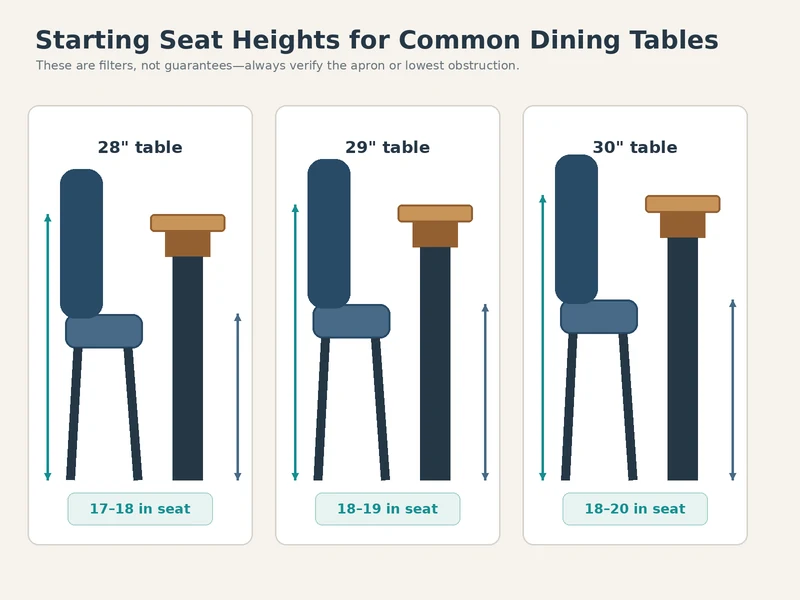
- 30-inch / 76 cm table: usually starts with an 18-20 inch / 46-51 cm seat, if the underside is not low.
- 29-inch / 74 cm table: often works with an 18-19 inch / 46-48 cm seat.
- 28-inch / 71 cm table: often works with a 17-18 inch / 43-46 cm seat.
Example: a 30-inch / 76 cm tabletop may suggest an 18-20 inch / 46-51 cm seat. But if the apron bottom is only 25 inches / 64 cm above the floor, a 20-inch / 51 cm seat leaves only 5 inches / 13 cm of clearance. That is likely too tight.
18-Inch vs 19-Inch Dining Chair Seat Height: Which Is Better?
18 inches / 46 cm is usually safer for low aprons. 19 inches / 48 cm can feel easier to sit and stand from, but only when the table underside gives enough clearance.
- Choose 18 in / 46 cm when the table has a low apron, thick top, or uncertain underside clearance.
- Choose 19 in / 48 cm when the table underside is generous and the buyer wants a slightly higher sitting position.
Do not argue over one inch in isolation. That one inch only matters after you check the table underside.
Why Aprons, Thick Tops, and Stretchers Break Standard Math
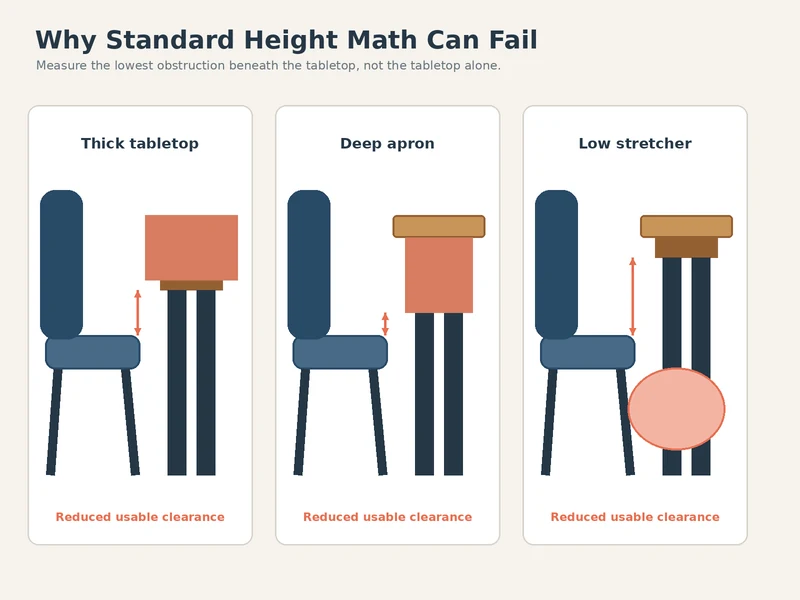
Most buying guides assume a clean table underside. Real tables often are not that kind.
- A thick tabletop reduces underside height.
- An apron reduces it further.
- A stretcher can create a knee collision point.
- Armchairs may fail even when armless chairs fit.
For related space planning, YeZhi’s guide on restaurant seating capacity is a useful companion resource.
Dining Chair Arm Height: Will the Chair Push Under the Table?
If your chair has arms, seat height is not the only constraint.
- Arm height: floor to highest point of the arm.
- Table underside: floor to lowest obstruction.
If arm height is higher than the table underside, the chair will not push in fully. That is often the real reason a dining set feels cramped.
If you are comparing chairs for a restaurant, cafe, hotel, or commercial dining project, browse YeZhi’s commercial restaurant chair collection. Compare the seat height, arm height, overall width, overall depth, and footprint before confirming a bulk order.
Does the ADA Specify a Standard Dining Chair Height?
No. The ADA does not establish one standard seat height for movable dining chairs.
For dining areas covered by the ADA, at least 5% of seating and standing spaces at dining surfaces must comply with applicable accessibility requirements. Accessible dining-surface tops must generally be 28-34 inches / 71-86 cm above the finished floor and provide the required clear floor space plus knee and toe clearance.
These are accessibility requirements for the dining surface and user approach, not a universal dining-chair sizing rule. Always verify current federal, state, and local requirements for the specific project.
FAQ
What is the average dining chair seat height?
Most dining chair seat heights fall around 17-20 inches / 43-51 cm. For standard dining tables, 18-19 inches / 46-48 cm is the safest center range.
How high should a dining chair be compared to the table?
Start with about 10-12 inches / 25-30 cm between the seat top and the tabletop surface. Then separately check the underside or apron clearance. As a practical fit check, keep about 7 inches / 18 cm or more between the seat and the lowest obstruction.
How do you measure dining chair height?
Measure from the floor to the top of the seat. For curved or sloped seats, record both front seat height and sitting-zone height.
Should seat height be measured with the cushion compressed?
Use the listed seat height as a starting point, but confirm the effective seated height by test-sitting when possible. Cushion compression varies by foam, construction, and body weight.
What seat height works best for a 30-inch dining table?
For a 30-inch / 76 cm table, start with an 18-20 inch / 46-51 cm seat height. If the table has a low apron or thick top, move toward the lower end and check actual underside clearance.
What should commercial buyers confirm before bulk orders?
Confirm the dimensioned drawing, seat height measurement point, arm height, table underside clearance, sample fit, and approved spec pack. Do not approve a bulk chair order from one seat-height number.
Next Steps
If you are choosing chairs to match an existing table, measure two numbers first: table underside height and your target seat height range.
For project seating, send YeZhi the table drawing, chair quantity, target seat height, arm height requirement, material preference, and use scene. YeZhi can help compare commercial dining chair options before bulk production.
Sources and editorial note: this guide uses general furniture-sizing ranges and accessibility references, including U.S. Access Board ADA guidance for dining surfaces. These figures are starting points, not universal product standards. Always confirm the current dimensioned drawing and approved sample before placing a bulk order.
Last updated: July 4, 2026.