If you’ve ever googled space between dining chairs, you’ve probably seen 24 inches pop up.
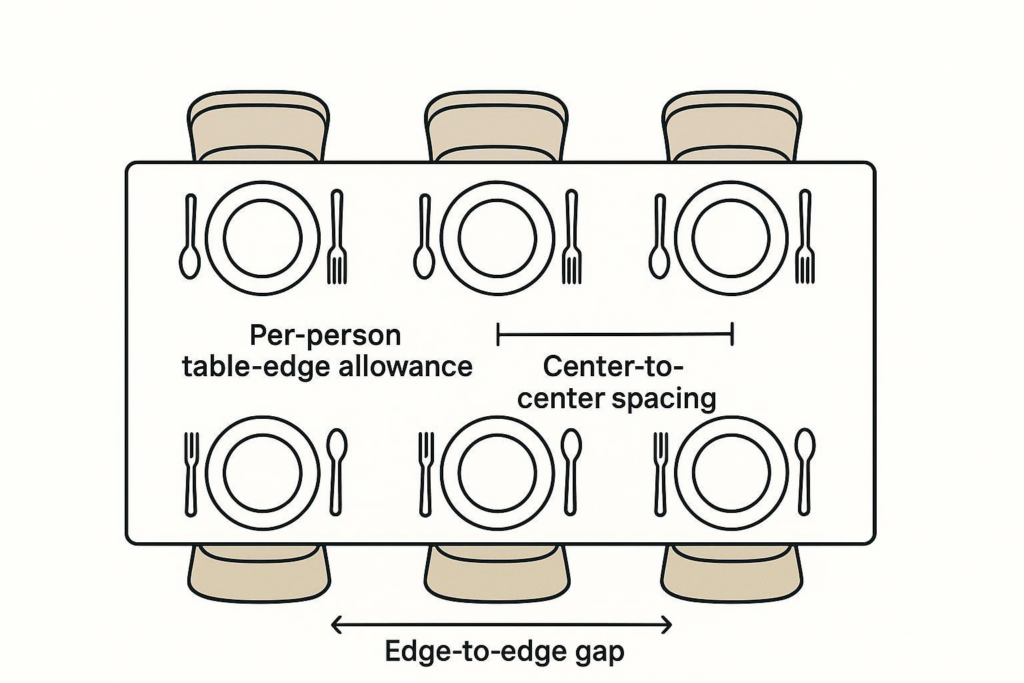
Here’s the catch: in most home-furnishing guides, 24 inches is not “24 inches of empty air between chair edges.” It’s usually the table-edge allowance per person. In plain English, how much table edge each diner gets so they’re not bumping elbows.
Once you separate the numbers people are mixing together, the problem becomes straightforward:
- How much table edge is each person getting?
- How wide is your chair at its widest point?
- What clear gap does that leave between chairs?
This guide gives you a starting range, then shows you exactly how to calculate it for your table and chairs.
Space between dining chairs: 3 measurements people confuse
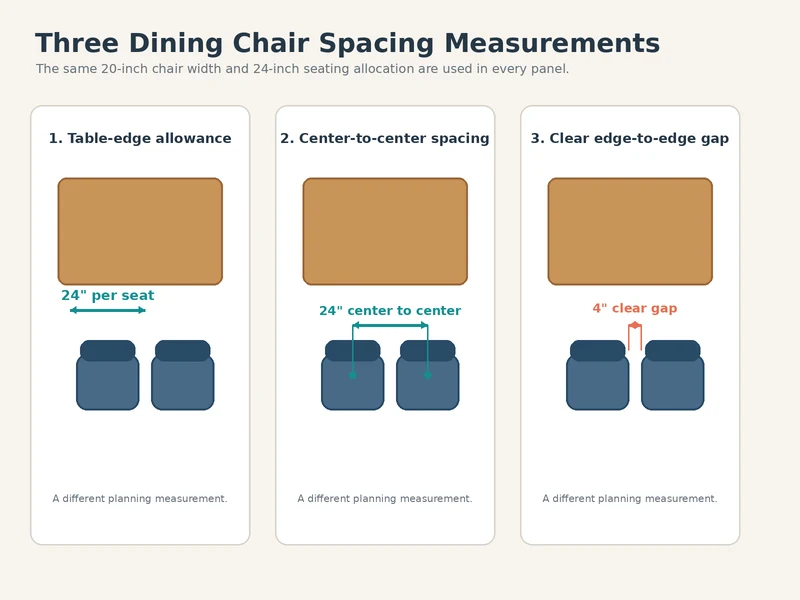
When someone asks about dining chair spacing, they’re usually referring to one of these three measurements.
1) Table-edge allowance per person
This is the amount of table edge length each person gets.
A widely repeated rule of thumb is 24 inches per seat. Bassett frames it this way in its Complete Guide to Table Sizes.
This number is mainly for: How many people can sit along one side of my table?
2) Center-to-center spacing (seat-to-seat)
This is the distance from the center of one seat to the center of the next.
If you divide a long, straight table edge into equal “seat zones,” your center-to-center spacing often ends up close to your per-person table-edge allowance. That’s one reason “24 inches” gets repeated so often.
3) Edge-to-edge gap (the real clear space between chairs)
This is what most people are picturing: the visible clear space between the widest parts of two adjacent chairs.
And the widest part might be:
- the arms (armchairs)
- the curve of an upholstered back
- splayed legs
- a wide seat shell
If you measure only the seat cushion, you can end up with chairs that look fine in specs and still collide in real life.
Key Takeaway: Most “24-inch” advice is about allocation per person, not the air gap between chair edges.
How far apart should dining chairs be?
For home dining rooms, evaluate two measurements separately: the table-edge allowance per person and the actual clear gap between adjacent chairs.
Table-edge allowance per person
- 20–22 inches (51–56 cm): An occasional or holiday squeeze.
- 24 inches (61 cm): A common everyday starting point.
- 28–30 inches (71–76 cm): Better for wide chairs, armchairs, or longer meals.
Clear edge-to-edge gap between chairs
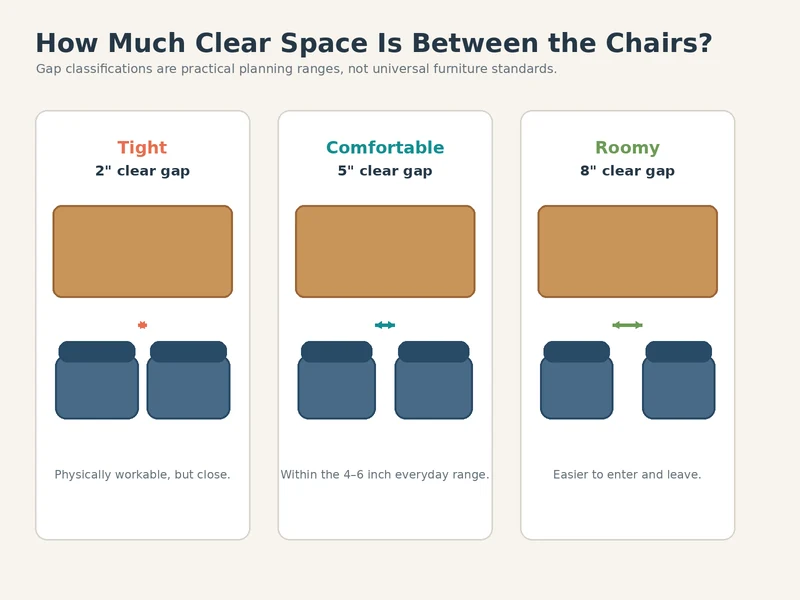
- About 2 inches (5 cm): Physically workable but tight.
- About 4–6 inches (10–15 cm): Comfortable for many standard armless chairs.
- More than 6 inches (15 cm): Roomier and easier to enter or leave.
Do not assume that a 24-inch allowance automatically creates a 4–6-inch gap. The result depends on the chair’s widest overall dimension. For example, a 24-inch allowance leaves 6 inches beside an 18-inch chair but only 2 inches beside a 22-inch chair.
How to calculate space between dining chairs (the simple method)
If you’re placing same-size chairs in a straight line along a rectangular table edge, this is the cleanest way to compute the real gap.
Step 1: Measure the Usable Seating Length
Do not automatically use the full tabletop length. Measure the section where the chairs can actually be centered without being blocked by table legs, corner positions, a pedestal, or other base components.
Then calculate:
Per-person allowance = usable seating length ÷ number of chairs
Use 24 inches (61 cm) per person as a common starting target. Consider 28–30 inches (71–76 cm) for wide chairs, armchairs, or more spacious dining.
For example, if the usable section between obstructions measures 72 inches (183 cm) and you want three chairs:
72 ÷ 3 = 24 inches (61 cm) per chairends increasing allowance (up to 30 inches per person) in its dining table clearance guide.
Step 2: Measure your chair’s widest overall width
Measure the maximum width, not just the seat.
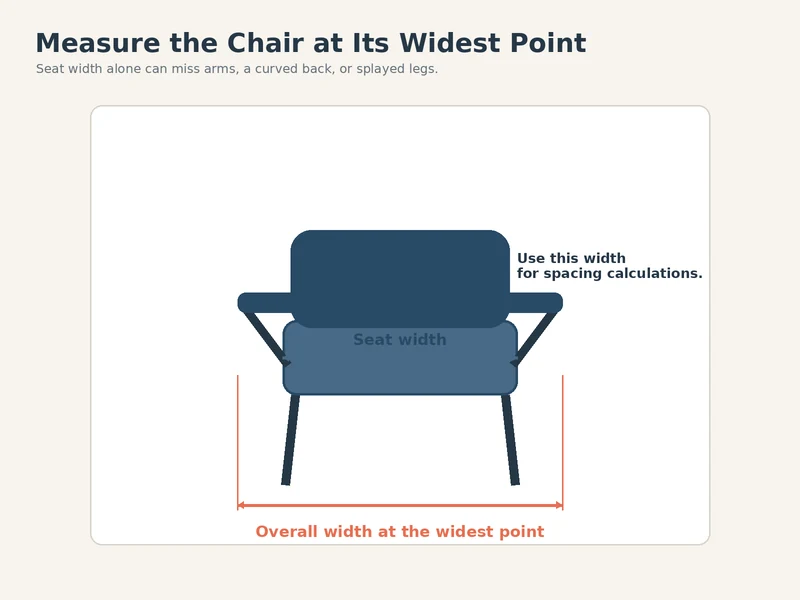
If you’re shopping online, look for “overall width” in the specs. If you’re measuring a chair you already own, measure the widest point across the chair.
Step 3: Use this formula
FFor same-width chairs centered evenly along one straight table edge:
Approximate center-to-center spacing = usable seating length ÷ number of chairs
Approximate edge-to-edge gap = center-to-center spacing − chair overall width
This shortcut assumes that:
- All chairs have the same overall width.
- The chairs are evenly centered.
- Table legs and base components do not interrupt the seating positions.
- No chair needs additional corner clearance.
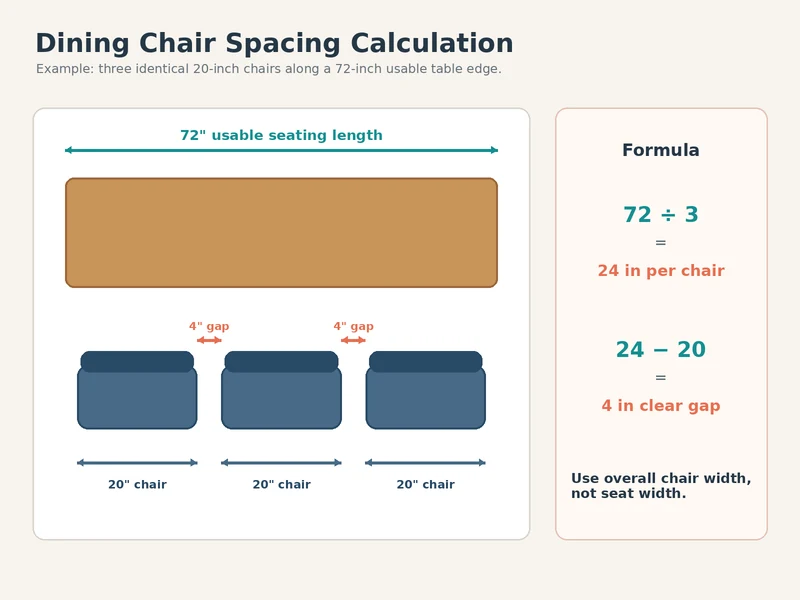
For example, three 20-inch (51 cm) chairs placed evenly along a 72-inch (183 cm) usable edge produce:
72 ÷ 3 = 24 inches (61 cm) center to center
24 − 20 = 4 inches (10 cm) of clear space between adjacent chairs
Example A: 24″ allowance + 18″ chair
- Per-person allowance: 24″
- Chair overall width: 18″
- Edge-to-edge gap: 24 − 18 = 6″
Six inches usually feels like normal breathing room for standard armless chairs.
Example B: 24″ allowance + 22″ chair
- Per-person allowance: 24″
- Chair overall width: 22″
- Edge-to-edge gap: 24 − 22 = 2″
Two inches is workable, but tight.
Dining chair center to center spacing (and why it’s useful)
Sometimes you’ll see advice expressed as dining chair center to center spacing instead of a clear gap. The relationship is simple:
- Center-to-center spacing = chair overall width + edge-to-edge gap
This is helpful when you’re laying out chairs symmetrically (especially for long tables) and you want consistent visual spacing.
A quick mini calculator (common chair widths)
Use this table as a quick check for same-width chairs arranged evenly along an unobstructed straight table edge. The figures do not account for table legs, corner positions, mixed chair widths, or extra end clearance.
| Chair overall width | If you allow 24″ per person | If you allow 30″ per person |
|---|---|---|
| 17″ | 7″ clear gap | 13″ clear gap |
| 18″ | 6″ clear gap | 12″ clear gap |
| 19″ | 5″ clear gap | 11″ clear gap |
| 20″ | 4″ clear gap | 10″ clear gap |
| 22″ | 2″ clear gap | 8″ clear gap |
| 24″ | 0″ clear gap | 6″ clear gap |
Chairs with arms: expect to bump into problems sooner
Armchairs aren’t just extra comfort. They’re often the widest part of the chair.
If you’re mixing chair types, one practical approach is to use armchairs only at the ends of a rectangular table, and use narrower side chairs on the long edges.
If you’re shopping and want a reference for what “standard” chair sizes look like, YeZhi’s guide to standard dining chair dimensions is a good baseline.
The table base can limit you more than the tabletop
Even if your tabletop is long enough, the base can block chairs.
Check your usable seating width (legs, pedestal, apron)
Two common problems:
- Table legs sit where a chair needs to slide in.
- An apron or stretcher steals knee room, forcing chairs to sit slightly off-center.
If you want a quick refresher on table height and chair fit (seat height vs table height), YeZhi’s restaurant table dimension guide has a straightforward overview.
Mixed chair widths (end chairs + side chairs)
If you are mixing chair widths, do not use one average chair width.
Use this process:
- Measure the usable seating length.
- Add together the overall widths of all chairs.
- Subtract the total chair width from the usable seating length.
- Divide the remaining space among the gaps and any end clearances you want to keep.
Mixed-width example
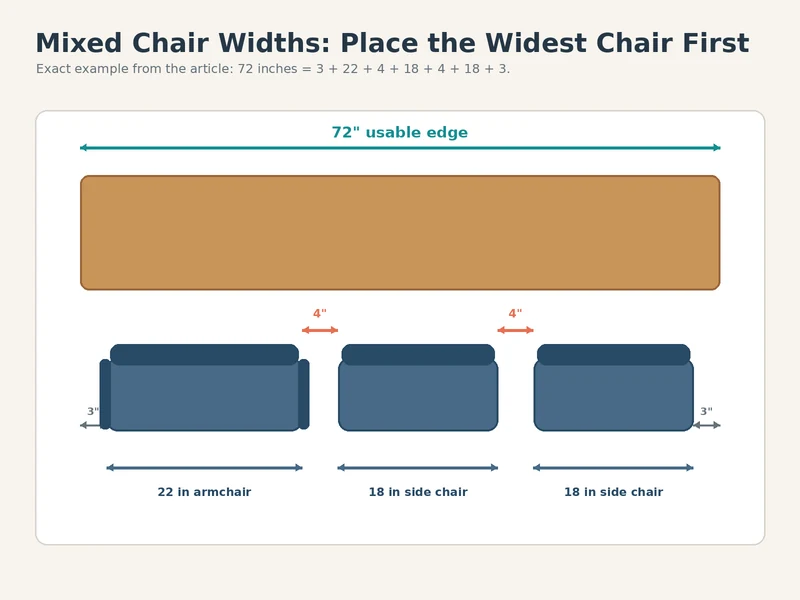
Suppose a 72-inch (183 cm) usable edge holds:
- One 22-inch (56 cm) armchair.
- Two 18-inch (46 cm) side chairs.
Total chair width:
22 + 18 + 18 = 58 inches (147 cm)
Remaining space:
72 − 58 = 14 inches (36 cm)
If you keep 3 inches (8 cm) at each end, 8 inches (20 cm) remain for the two internal gaps:
8 ÷ 2 = 4 inches (10 cm) between chairs
Place the widest chairs first, then distribute the remaining clearance around the narrower chairs.
Round table chair spacing: why perimeter math can mislead you
Round tables invite the classic shortcut:
Table circumference ÷ 24 inches = estimated number of seats
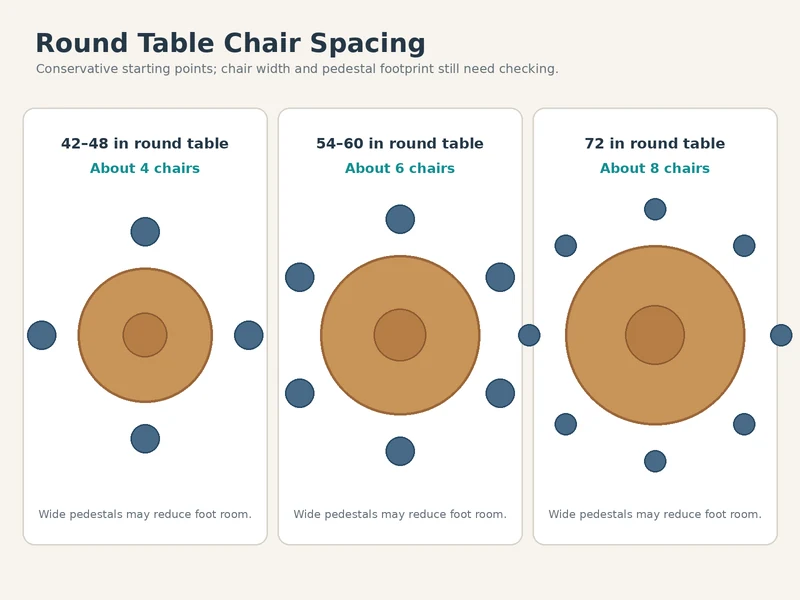
Use this only as an initial estimate. The usable space narrows toward the center, and chair backs, armrests, splayed legs, place settings, and the table base can reduce actual capacity.
For comfortable everyday planning, use these conservative starting points:
- 42–48-inch (107–122 cm) round table: about 4 chairs.
- 54–60-inch (137–152 cm) round table: about 6 chairs.
- 72-inch (183 cm) round table: about 8 chairs.
A pedestal base may make chair placement easier, but a wide pedestal can still interfere with feet. Before buying, mark the tabletop diameter on the floor and place full-size paper templates where each chair will sit.
Don’t confuse chair-to-chair spacing with space per person at the dining table
One last clarity point:
- Space per person at the dining table is the linear edge allowance (often 24 inches per seat).
- Space between dining chairs is the edge-to-edge gap after you account for chair width.
If you treat them as the same thing, you’ll either overbuy table length or end up with chairs that constantly knock into each other.
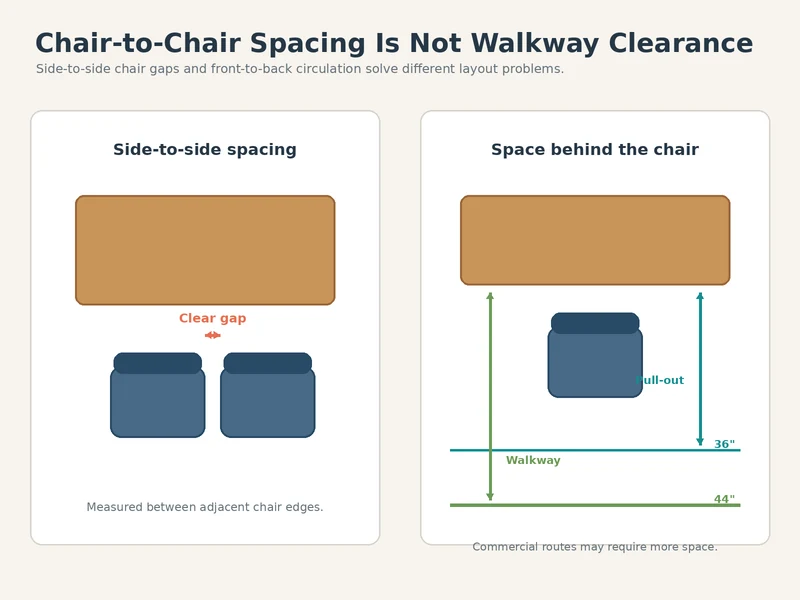
Don’t confuse chair-to-chair spacing with space behind the chair
This article is about the side-to-side spacing between chairs along the same table edge.
A different question is clearance behind chairs (table to wall) so people can pull out and stand up.
Measure the space behind the chair from the table edge to the nearest wall, cabinet, or obstruction.
- Allow approximately 36 inches (91 cm) where chairs need to pull out but no regular walkway passes behind seated diners.
- Allow approximately 44 inches (112 cm) where people need to walk normally behind occupied chairs.
These figures address front-to-back circulation, not the side-to-side spacing between adjacent chairs. Commercial projects may require additional clearance for service routes and applicable accessibility rules.
Common mistakes that make spacing feel worse than the math
- Using seat width instead of overall width
- Forgetting that arms need breathing room
- Treating “24 inches” as the air gap between chair edges
- Planning for the maximum number of chairs instead of the seats you’ll use daily
Quick checklist before you buy dining chairs
- Pick your per-person allowance: ~24″ standard, ~28–30″ if you want roomy seating
- Measure chair width at the widest point (arms/back/legs)
- Check whether your edge-to-edge gap lands in a comfort tier you can live with
- Sanity-check the table base (legs/apron/pedestal)
- If you’re mixing chairs, map the widest chairs first
Next steps
If you want to double-check a chair before you order it, use this simple process:
- Get the chair’s overall width (widest point)
- Choose your per-person allowance
- Subtract to estimate the clear gap
When comparing options for a restaurant, café, hotel, or furniture collection, browse YeZhi’s commercial restaurant chair collection. Before confirming a bulk order, request the overall width, seat width, footprint, arm height, and dimensioned drawing for each model.
FAQ
Does “24 inches” mean space between chair edges or chair centers?
In most consumer guides, it’s best to treat 24 inches as space per seat at the table edge, not empty space between chair edges.
What’s a comfortable space between dining chairs?
A few inches of clear gap is usually the difference between “fine” and “annoying.” Lamon Luther suggests a tight-to-roomy range in its table spacing guidelines (linked above).
How far apart should dining chairs be for 20-inch chairs?
If your chair is 20″ wide overall:
- At 24″ per person, you’ll have ~4″ of clear gap.
- At 30″ per person, you’ll have ~10″ of clear gap.
What is a reasonable minimum space between dining chairs?
If you’re squeezing, you can sometimes make ~2″ of clear gap work. It’s tight, but workable for short meals.
How much space do you need behind a dining chair?
That’s separate from chair-to-chair spacing. A common baseline is roughly 36″ around the table so chairs can pull out and people can move behind seated diners.
Sources and Editorial Note
This guide uses general furniture-planning ranges published by Bassett Furniture, Lamon Luther, 2Modern, and NKBA-related planning guidance. These figures are starting points, not universal furniture or building standards.
YeZhi Furniture is a commercial furniture supplier. Links to YeZhi articles and product pages are included to help wholesale and project buyers continue their research. Always confirm current product drawings, overall chair dimensions, table-base dimensions, and approved samples before placing a bulk order.
Last updated: June 16, 2026.