If you’re searching for standard dining chair dimensions, you’re probably not looking for “one magic number.” You’re trying to answer a more practical question:
Will this chair be comfortable for real people, slide under this specific table (apron, legs, and all), and still leave enough space to move around?
This guide gives you the common size ranges and a repeatable fit-check system used by designers, woodworkers, and hospitality buyers.
Quick reference: common dining chair dimensions (in + cm)
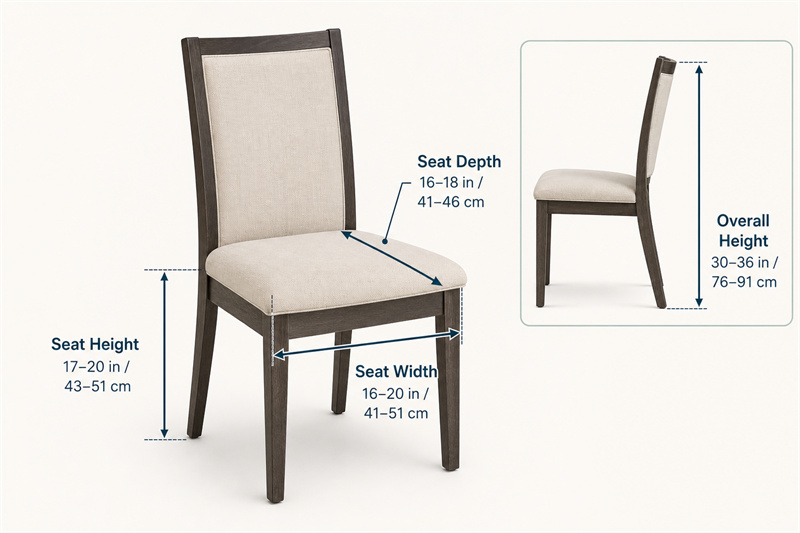
These are common selection ranges rather than universal standards. For standard 28–30-inch (71–76 cm) dining tables, many dining chairs have a seat height of approximately 17–20 inches (43–51 cm), with 18–19 inches (46–48 cm) being a particularly common starting point. Upholstery compression, armrests, table aprons, and the intended users can change the best fit.
| Measurement | Common range | Notes |
|---|---|---|
| Seat height (floor → top of seat) | 17–20 in (43–51 cm) | Many “standard” chairs land here; some retail guides broaden this depending on style and cushioning.Wayfair’s dining chair sizing guide |
| Seat width (usable sitting width) | 16–20 in (41–51 cm) | Arms/back flare may make overall width bigger than seat width. |
| Seat depth (front edge → where seat meets back) | 16–18 in (41–46 cm) | A common comfort band for dining chairs.Picket & Rail’s standard dining chair dimensions overview |
| Overall height (floor → top of back) | ~30–36 in (~76–91 cm) | High-back styles can exceed this; overall height matters less for table fit. |
| Standard dining table height | 28–30 in (71–76 cm) | Typical US dining tables fall in this band.Bassett Furniture’s table size guide |
Key Takeaway: Use “standard dimensions” as a filter, then confirm fit by checking table underside/apron clearance, leg spacing, and your room’s pull-out/walkway space.
The one clearance number that prevents most table-fit mistakes
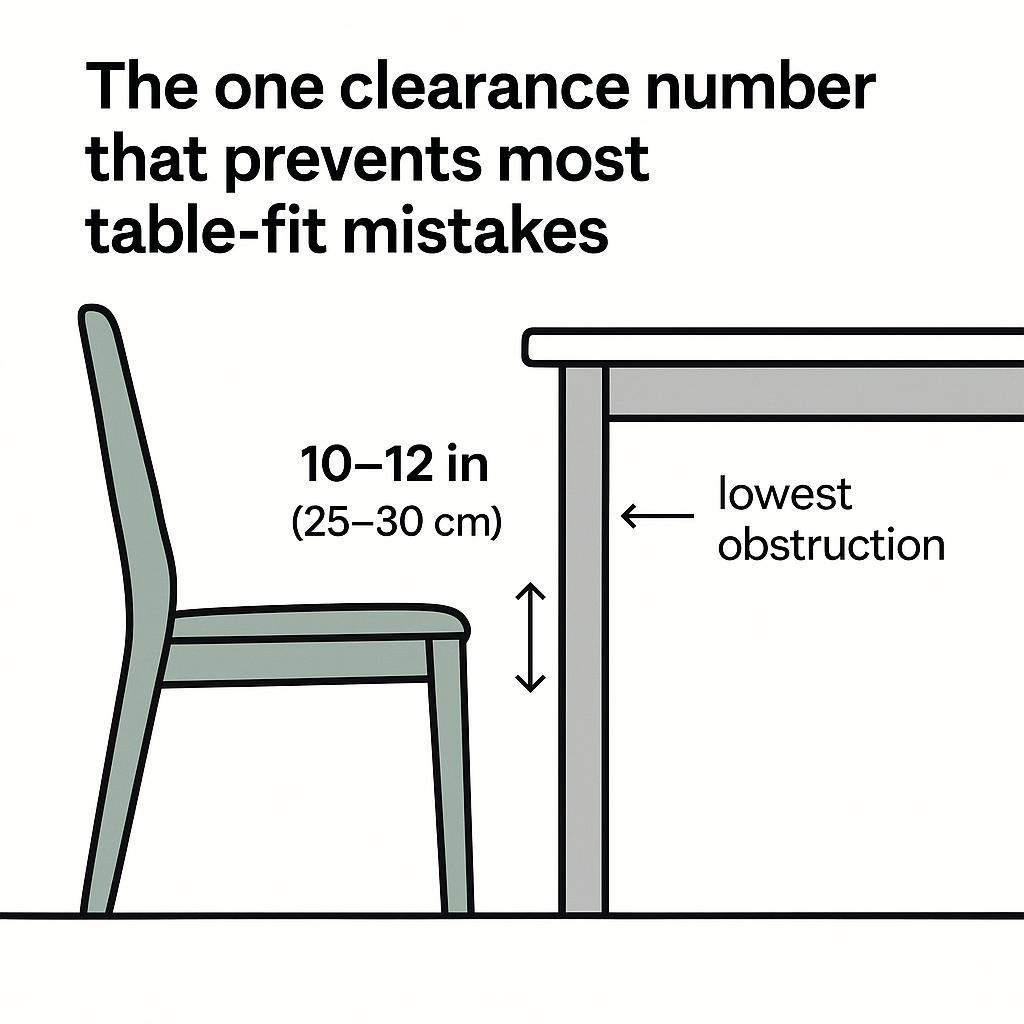
Most comfort guidance converges on 10–12 inches (25–30 cm) between the top of the seat and the underside of the table (or the bottom of the apron—whichever is lower).
Brian Benham’s rule of thumb is straightforward: aim for 10–12 inches seat-to-underside clearance, with 11–12 inches preferred when possible.Brian Benham’s table-and-chair height guidelines
Why “table height” can mislead you
A table can be “standard height” and still feel cramped if it has:
- a deep apron/skirt
- low-mounted stretcher supports
- decorative rails underneath
So don’t measure to the tabletop. Measure to the lowest obstruction under the table.
Unified measurement system (so everyone measures the same way)
If you’re comparing spec sheets (or creating them), ambiguity is the enemy. Here’s a clean system that separates seat, overall, and footprint.
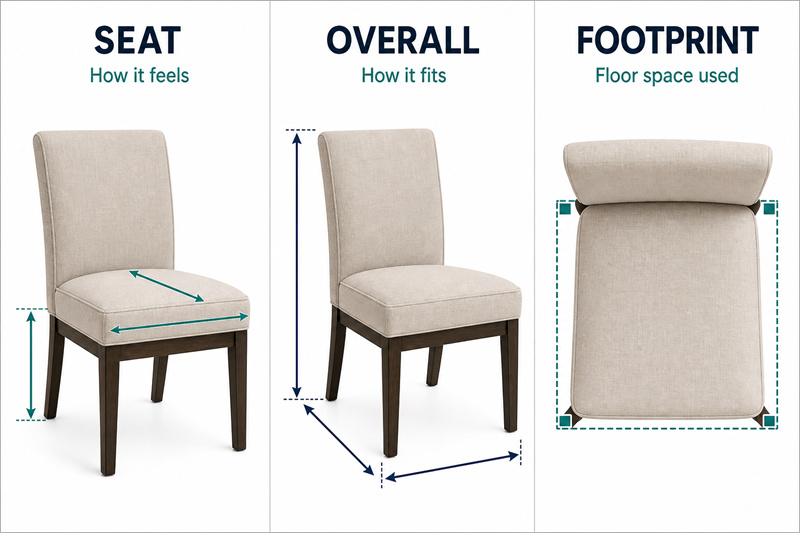
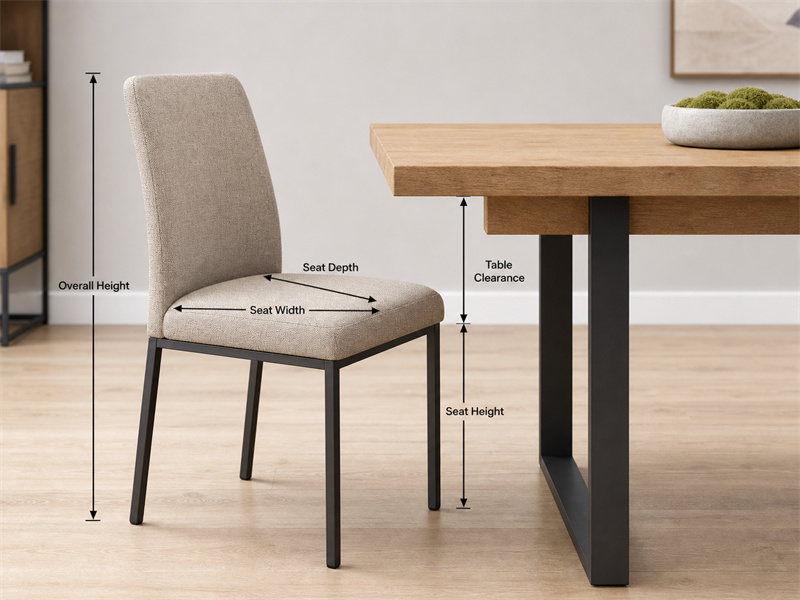
Seat dimensions (how the chair feels to sit in)
- Seat height: floor → top of the seat (for upholstered chairs, consider the compressed sit height).
- Seat width: left-to-right usable sitting area.
- Seat depth: front edge → where the seat meets the back.
Overall dimensions (how the chair fits around other objects)
- Overall width: the widest point—often arms, sometimes the backrest flare.
- Overall depth: the furthest front point → the furthest back point (legs/back can extend beyond the seat).
- Overall height: floor → top of the back.
Footprint (how much floor space the chair occupies)
- Footprint width/depth: outermost leg-to-leg dimension on the floor.
Pro Tip: For space planning and hospitality layouts, overall width/depth and footprint usually matter more than seat width/depth.
The 3-layer fit framework: chair-to-user → chair-to-table → table-and-chair-to-room
Instead of guessing from “standard size,” run these checks in order.
Layer 1: Chair-to-user (comfort and posture)
Use the ranges as a starting point:
- Seat height (17–20 in / 43–51 cm) covers most adults for standard dining tables.
- Seat depth (16–18 in / 41–46 cm) is a common comfort band.
If you’re specifying for commercial use, consider your guest mix:
- deeper seats can feel relaxed but may not suit shorter guests
- very shallow seats can feel perch-like for longer stays
Layer 2: Chair-to-table (will it slide under, and will knees clear?)
This is where most “standard” mistakes happen.
Step A — Check seat-to-underside clearance
- Measure seat height (floor → seat top).
- Measure your table’s underside height (floor → lowest obstruction).
- Subtract: underside height − seat height.
Target: 10–12 in (25–30 cm) for comfort.
Worked Fit Example
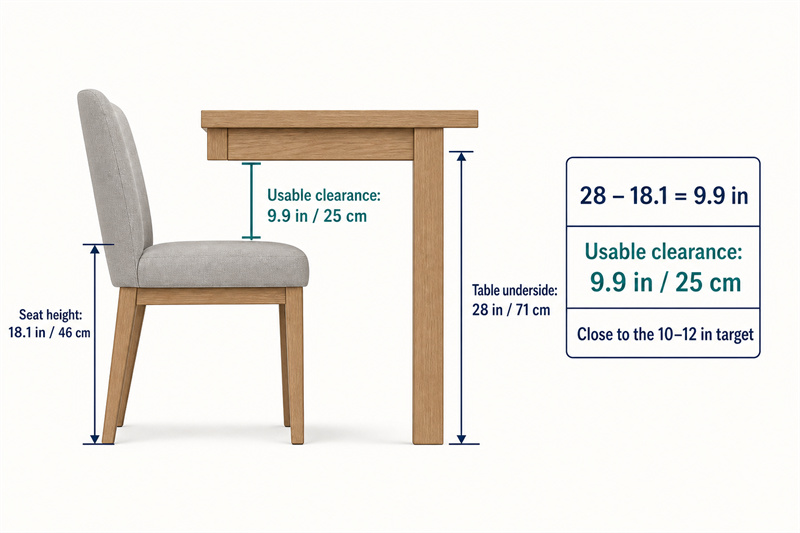
Suppose a chair specification lists an 18.1-inch (46 cm) seat height, and your table’s lowest apron point measures 28 inches (71 cm) from the floor.
28 − 18.1 = 9.9 inches (25 cm) of usable vertical clearance.
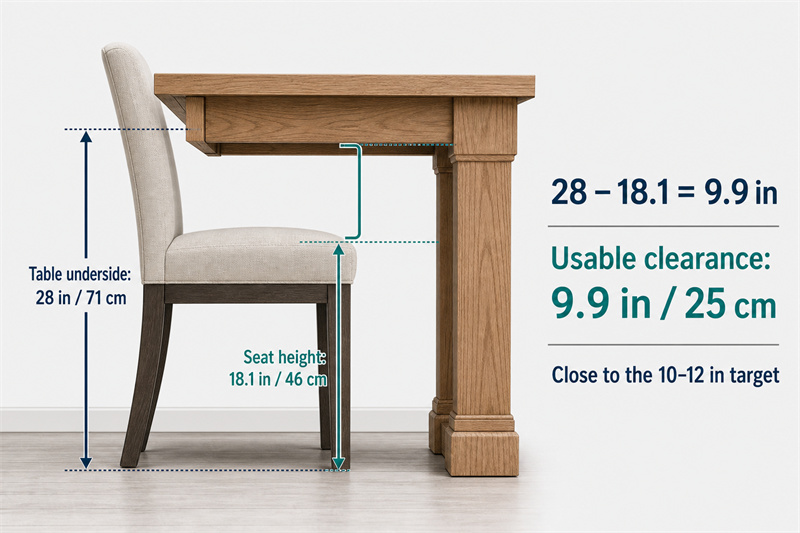
That result sits close to the commonly recommended 10–12-inch range. However, the chair still needs separate checks for armrest height, overall width, table-leg spacing, and upholstery compression before it can be considered a confirmed fit.
Step B — Check armrest height (if applicable)
Even if knees clear, arms can block slide-in.
- Measure arm height (floor → top of arm).
- Compare to the table’s underside/apron bottom.
If the arm is higher than the underside/apron, the chair won’t push in fully.
Step C — Check table leg spacing (the “net opening”)
For rectangular tables with four legs, the usable chair space is often limited by:
- the distance between legs, not the tabletop length
- the leg angle or decorative base details
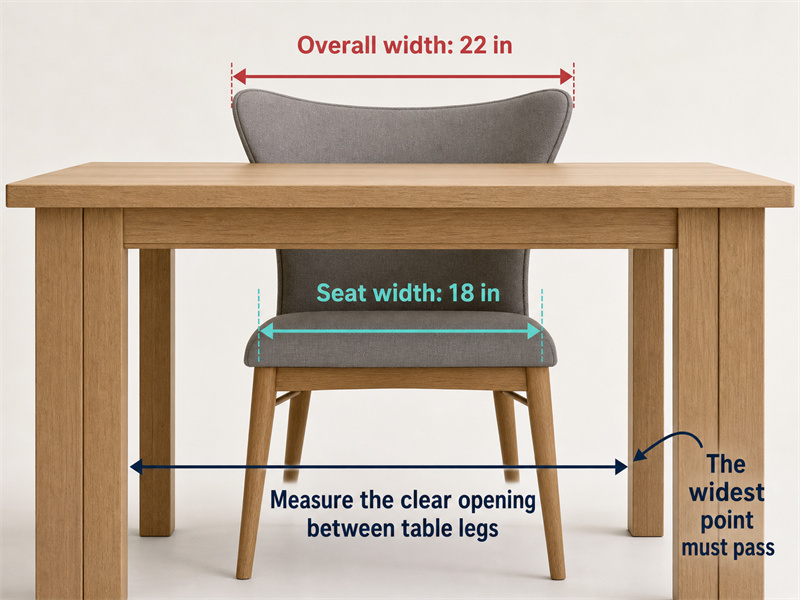
Measure the clear opening between legs at the height where the chair’s widest point needs to pass.
⚠️ Warning: A chair’s seat width can be 18 in, but the overall width might be 22 in because the back flares—enough to ruin a tight leg opening.
Layer 3: Table-and-chair-to-room (pull-out and circulation)
You don’t just need space to “fit” the chair—you need space to use it.
Measure circulation space from the table edge, not from the chair back:
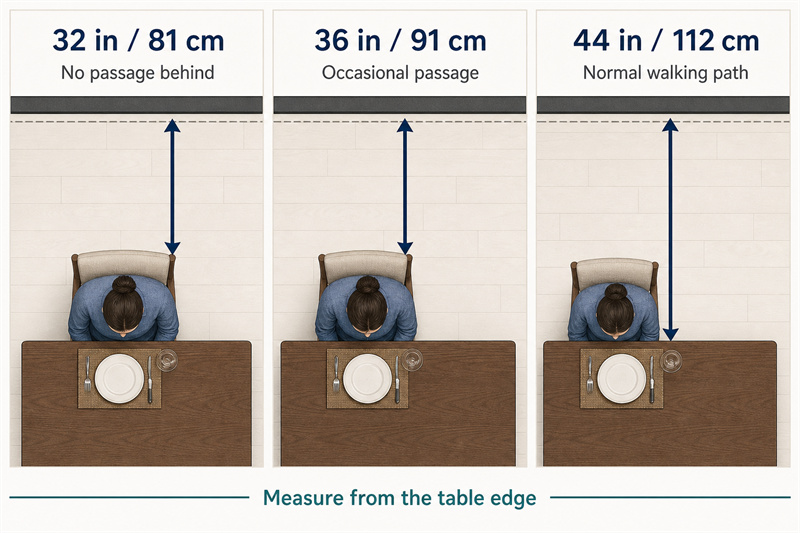
- Allow about 32 inches (81 cm) where no one needs to pass behind a seated diner.
- Allow at least 36 inches (91 cm) where someone may occasionally edge past.
- Allow about 44 inches (112 cm) where people need to walk normally behind occupied chairs.
Commercial layouts, service routes, local accessibility requirements, and wheelchair circulation may require more space.
How many inches of table edge does one chair need?
This is where people confuse chair width with space per diner.
As a practical starting point, allow approximately 24 inches (61 cm) of table edge per diner. Increase this to around 26–30 inches (66–76 cm) when chairs are wide, have arms, or are intended for longer dining sessions.
Do not automatically allocate 30–32 inches to every chair. Instead, compare the chair’s overall width with the clear space between table legs and add enough side clearance for elbows and entry.
In real projects, the right number depends on:
- whether chairs have arms
- how long people will sit (quick café meal vs. banquet)
- the table leg positions and corner clearances
Why “standard dining chair dimensions” can still lead to a bad purchase
If you only compare seat height/width/depth, you can still get burned by:
- Apron/skirt depth reducing legroom
- Arm height blocking slide-in
- Backrest rake + flare increasing overall depth/width
- Upholstery compression changing seat height in real use
- Published dimension order (W×D×H vs W×H×D) causing spec comparison errors
The fix is simple: ask for (or create) a spec sheet that includes seat, overall, footprint, and key clearances.
Video: quick visual example of fit and clearance
A light procurement checklist (useful for hospitality projects)
If you’re buying for restaurants, cafés, or hotels, “standard size” is not enough. Before you commit, request:
- a dimensioned drawing that labels seat vs overall vs footprint
- the measurement method (where each dimension starts/ends)
- confirmation of the table underside height you’re pairing with
- arm height (if any)
- packing method and carton dimensions for logistics planning
If you are sourcing chairs for a restaurant, café, hotel, furniture collection, or commercial project, start by comparing YeZhi Furniture’s commercial chair collection and café furniture options. Review each model’s seat height, overall width, overall depth, arm height, and footprint before requesting samples or confirming a bulk order. For broader product selection, see Types of Chairs. If you’re modeling capacity and traffic flow, restaurant seating capacity can help frame spacing decisions.
FAQ
What are standard dining chair dimensions?
Most standard dining chairs fall around 17–20 in (43–51 cm) seat height, 16–20 in (41–51 cm) seat width, and 16–18 in (41–46 cm) seat depth. Many guides present these as ranges rather than fixed numbers.Eureka Ergonomic’s dining chair dimension guide
What’s the standard dining chair seat height for a 30-inch table?
For a standard 30-inch (76 cm) dining table, an 18–19-inch (46–48 cm) seat height is a reliable starting range. Do not calculate from the tabletop alone.
Measure from the floor to the lowest point underneath the table, then subtract the chair’s seat height. Aim for approximately 10–12 inches (25–30 cm) of usable vertical clearance. A 20-inch seat may work with a thin, open tabletop, but it can feel cramped beneath a deep apron.
Will dining chairs fit under my table?
They fit if (1) the seat-to-underside clearance is in a comfortable range (often 10–12 in), (2) arms (if any) clear the apron/underside, and (3) the chair’s overall width fits between table legs where needed.
Seat width vs overall width: which one matters?
Seat width affects comfort; overall width determines whether chairs collide with table legs, each other, or room circulation. For space planning and capacity, use overall width.
Next steps
If you want to sanity-check a specific chair against a specific table, measure two numbers first:
Table underside height (to the lowest obstruction), and clear opening between table legs. With those, you can quickly confirm whether a “standard” dining chair will actually fit.
Sources and Editorial Note
This guide uses general sizing and space-planning ranges published by NKBA, Bassett Furniture, Wayfair, Picket & Rail, and other furniture-planning references. These figures are starting points, not universal product or building standards.
YeZhi Furniture supplies commercial seating. Links to YeZhi product and category pages are included to help wholesale and project buyers compare relevant products. Product dimensions must still be confirmed from the current specification sheet before ordering.
Last updated: June 16, 2026.