Quick Answer
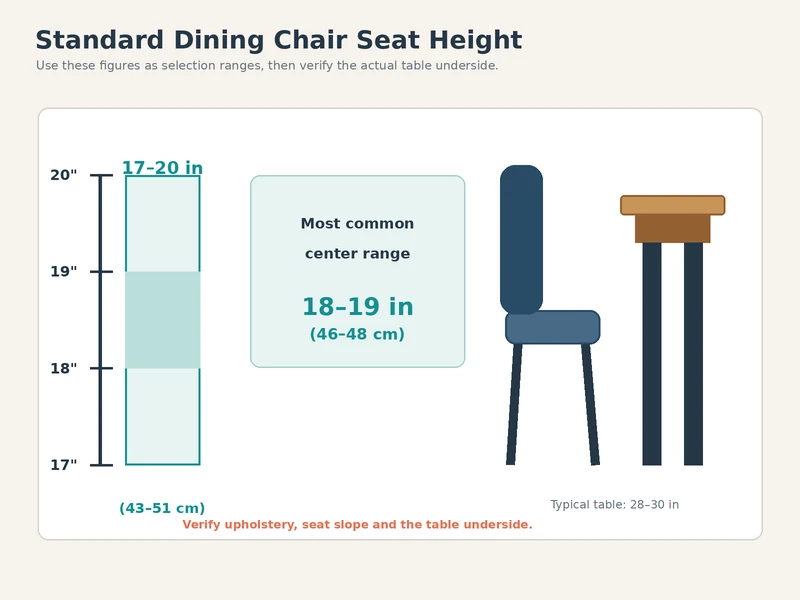
Most dining chair seat heights fall around 17–20 in / 43–51 cm. For a typical 28–30 in / 71–76 cm dining table, we recommend starting around 18–19 in / 46–48 cm.
That is only the first check. Before you approve a chair, also measure the table’s lowest underside obstruction, confirm the chair’s real seat-height measurement point, and check arm height if the chair has arms. For a commercial order, the safest decision is the chair-and-table combination that passes all of those checks—not the chair with the most “standard” number.

When someone asks us for the best dining chair height, we do not start with overall chair height. We start with seat height: the distance from the floor to the sitting surface. Then we compare that number with the actual table.
This matters even more in restaurants, cafés, hotels and furniture programs. A chair can look correct on a specification sheet and still feel cramped if the table has a deep apron, thick top or low rail. An armchair can also have a suitable seat height but fail to push under the table because the arms are too high.
What Is a Common Dining Chair Seat Height?
A useful planning range is 17–20 in / 43–51 cm. Within that range, 18–19 in / 46–48 cm is a practical starting point for many standard dining-height tables.
We treat these numbers as selection ranges, not universal standards. Upholstery thickness, seat slope, the table structure and the intended users can all change the final choice.
| Dining table height | Practical seat-height starting range | What can change the choice |
|---|---|---|
| 28 in / 71 cm | 17–18 in / 43–46 cm | Low apron, thick top, upholstered seat |
| 29 in / 74 cm | 18–19 in / 46–48 cm | Underside rail, cushion compression, user preference |
| 30 in / 76 cm | 18–20 in / 46–51 cm | Apron depth, arm height, seat slope, legroom |
Seat Height Is Not Overall Chair Height
Dining chair specifications often show width, depth and overall height together. The overall height usually measures to the top of the backrest. It does not tell you where the person sits.
For chair-to-table fit, record at least these dimensions:
- Seat height: floor to the sitting surface.
- Overall width and depth: useful for table spacing and floor planning.
- Arm height: required for an armchair that needs to slide under the table.
- Tabletop height: floor to the top surface.
- Lowest underside height: floor to the lowest apron, rail, frame or thick underside.

Match Dining Chair Height to the Table With Two Separate Checks
The easiest mistake is to use one “ideal gap” for everything. We recommend using two different checks because they answer different questions.
Check 1: Seat to Tabletop
Tabletop height − seat height gives the vertical difference between the sitting surface and the top of the table.
A common planning target is around 10–12 in / 25–30 cm. This is useful for shortlisting a chair, but it does not prove that the user’s legs will clear the structure below the tabletop.
Check 2: Seat to the Lowest Underside Obstruction
Lowest underside height − seat height tells you the real space available above the seat before the user reaches an apron, rail, stretcher or thick tabletop structure.
We do not recommend treating one fixed apron-clearance number as a universal pass/fail rule. The required space changes with seat compression, user size, table construction and how long the seating will be used. Measure the real obstruction, then verify the chair-and-table combination with a drawing or sample when the project risk is high.
Our Recommendation
Use 18–19 in / 46–48 cm as the default seat-height shortlist for many 28–30 in / 71–76 cm tables. Change that recommendation when the table has a low apron, thick top, low support rail, armchair interference, a thick upholstered seat or a non-standard table height.
How to Measure Dining Chair Height Correctly
The measurement must match the part of the seat where the user actually sits. This is simple on a flat wood or metal seat, but upholstered and sloped seats need more care.
- Place the chair on a hard, level floor.
- Measure vertically from the floor to the top of the seat. Do not measure along a leg or at an angle.
- For upholstery, record the uncompressed seat height shown in the approved specification. If comfort or clearance is critical, also test the chair because foam compresses in use.
- For a curved or sloped seat, record the front height and the main sitting-zone height. This avoids comparing two chairs that both say “18.5 inches” but place the user differently.
- Measure the table separately. Record the tabletop height and the lowest point under the top.

Chair Height for 28-, 29- and 30-Inch Dining Tables
The table below is a fast shortlist, not a substitute for measuring the underside. It is most useful when you are comparing standard dining-height chairs before you have a physical sample.
For a 28 in / 71 cm table
Start around 17–18 in / 43–46 cm. A lower table gives you less vertical room, so a deep apron or thick tabletop can quickly make a taller seat feel tight.
For a 29 in / 74 cm table
Start around 18–19 in / 46–48 cm. This is a useful middle range for many dining layouts, but still check the underside structure.
For a 30 in / 76 cm table
Start around 18–20 in / 46–51 cm. The taller end can work when the underside is open. A low apron may move the practical choice toward the lower end.
18-Inch vs 19-Inch Dining Chair Height
The difference is only 1 in / 2.5 cm, but it changes both fit calculations.
- An 18 in / 46 cm seat leaves 1 in / 2.5 cm more vertical space below the same table structure than a 19 in / 48 cm seat.
- A 19 in / 48 cm seat reduces the seat-to-tabletop difference by 1 in / 2.5 cm compared with an 18 in / 46 cm seat.
So the better choice is not “18 is safer” or “19 is more comfortable” in isolation. The better choice is the one that matches the actual table, seat construction and project use.
Why Standard Height Math Fails in Real Projects
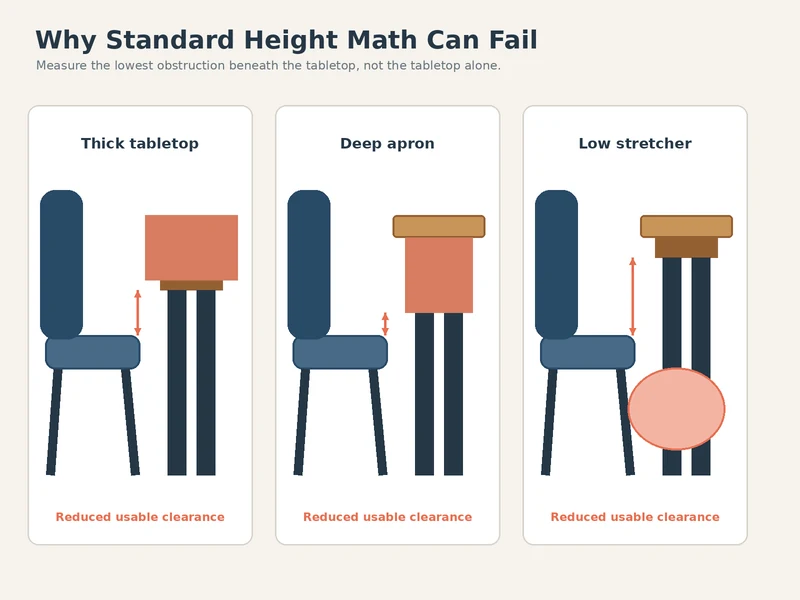
Most height charts assume a simple open underside. Commercial tables often have more structure. The important question is not only the top height—it is where the first collision point sits.
- Deep apron: reduces vertical space above the chair seat.
- Thick tabletop or frame: can lower the usable underside even when the tabletop height looks normal.
- Support rail or stretcher: can create a knee or leg interference point.
- Upholstered seat: changes the user’s effective sitting position when compressed.
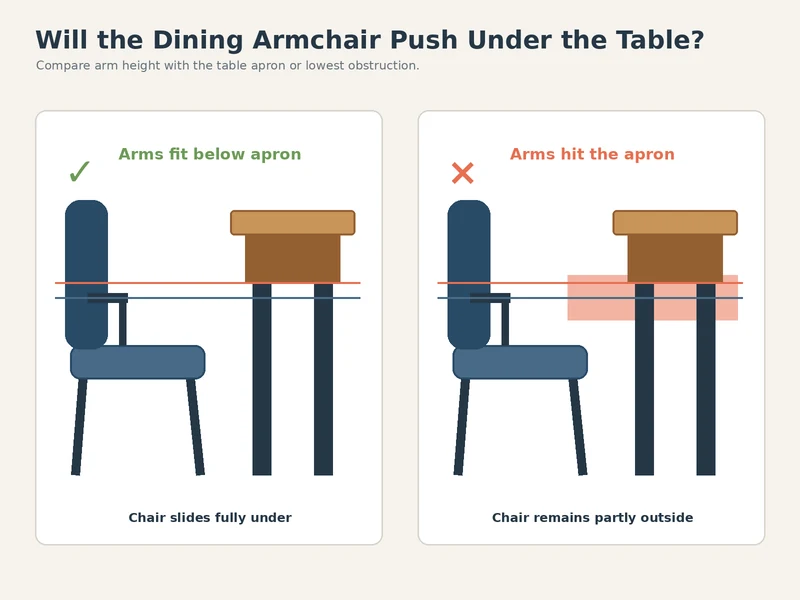
- Armrests: can stop the chair from sliding under the table even when seat height is correct.
Dining Chair Arm Height: Will the Chair Push Under the Table?
For an armchair, measure from the floor to the highest point of the arm. Then compare it with the table’s lowest underside point in the path where the chair will slide in.
If the arm is higher than that obstruction, the chair cannot tuck fully under the table. This can reduce aisle space and make the table footprint larger than expected.
Verified YeZhi Dining Chair Height Examples
To show how close dining-height chairs can be while still needing different fit checks, here are three current YeZhi models with model-specific seat heights.
| Model | Verified seat height | Structure | Project check |
|---|---|---|---|
| DC218 Black Plywood Dining Chair | 17.7 in / 45 cm | Armless dining chair | Confirm table height and under-table clearance. |
| DC-A17 Antique Brass Upholstered Arm Dining Chair | 18.1 in / 46 cm | Upholstered armchair | Arm height is not recorded in the supplied dimension drawing, so send the table/apron drawing when tuck-under clearance is critical. |
| MD308 Gray Metal Dining Chair | 18.5 in / 47 cm | Compact armless metal chair | Confirm tabletop height, underside clearance, apron depth and leg position. |
You can also compare more current models in our dining chair collection. If the table is being sourced at the same time, review the current dining table range and lock the two specifications together.
Before a Commercial Dining Chair Order, Lock These Measurements
- Tabletop height from finished floor.
- Lowest underside height at the apron, rail, frame or other obstruction.
- Chair seat height with the measurement point defined.
- Arm height for armchairs.
- Seat construction—flat, sloped, curved or upholstered.
- Chair width, depth and leg footprint for the floor plan.
- Actual chair-and-table sample fit when one mismatch would affect a large order or repeated rollout.
Before Production
For a restaurant, hotel, café or furniture program, send us the table drawing or the five key measurements: tabletop height, lowest underside height, table-leg spacing, target chair seat height and arm height if applicable. We can review the combination before the chair specification is locked.
What If You Need a Custom Seat Height?
A seat-height change is not just a number on a drawing. It can affect leg geometry, sitting angle, table fit, overall proportions and packing. We therefore review it as a custom configuration rather than assuming the standard model can simply be made taller or shorter.
Full OEM or deeper configuration changes normally start around 100 pieces per design or configuration. The exact requirement depends on the model and requested change, so the quotation and approved drawing control the final specification.
Accessibility: Do Not Use ADA as a Dining Chair Height Rule
The ADA does not set one standard seat height for movable dining chairs. For covered dining areas, the 2010 ADA Standards require at least 5% of seating and standing spaces at dining surfaces to comply with Section 902. Section 902 sets requirements for the dining surface, including a top height of 28–34 in / 71–86.5 cm and required clear floor, knee and toe space. See the official 2010 ADA Standards for Accessible Design.
That is an accessibility requirement for the dining surface and approach. It should not be converted into a universal chair-seat-height claim. Project teams should also check the rules that apply in their local jurisdiction.
Dining Chair Height FAQ
What is the standard height of a dining chair?
When people say “dining chair height,” they usually mean seat height. A common planning range is about 17–20 in / 43–51 cm, with 18–19 in / 46–48 cm a useful starting point for many standard dining tables.
How high should a dining chair be for a 30-inch table?
For a 30 in / 76 cm table, start around 18–20 in / 46–51 cm. Then check the lowest underside obstruction. A deep apron or thick top can make the higher end unsuitable.
How much space should there be between a dining chair seat and the tabletop?
A common planning target is about 10–12 in / 25–30 cm from the seat top to the tabletop. Treat this as a starting check, not the only fit rule.
How much clearance is needed below a table apron?
There is no single apron-clearance number that works for every chair, table and user. Measure the floor-to-lowest-obstruction height, subtract the real seat height, and verify the combination. For large or high-risk orders, test the actual chair with the actual table or approve both from dimensioned drawings.
Should an upholstered dining chair be measured compressed?
Use the approved uncompressed seat height for specification control, then test the effective seated position when cushion compression could affect comfort or clearance.
What information should we send YeZhi before confirming chair height?
Send the table height, lowest underside height, apron or frame details, table-leg spacing, candidate chair model, target seat height, whether arms are required, quantity and destination. We can then review the fit and identify any dimension that needs to be locked before quotation or production.
Send Us Your Table Dimensions Before You Lock the Chair
If you are choosing dining chairs for a restaurant, café, hotel, distributor program or commercial project, send the table dimensions and the chair models you are considering. We will check the seat-height range, underside risk and arm-clearance questions before you lock the specification.
Send Your Dimensions to YeZhi Furniture