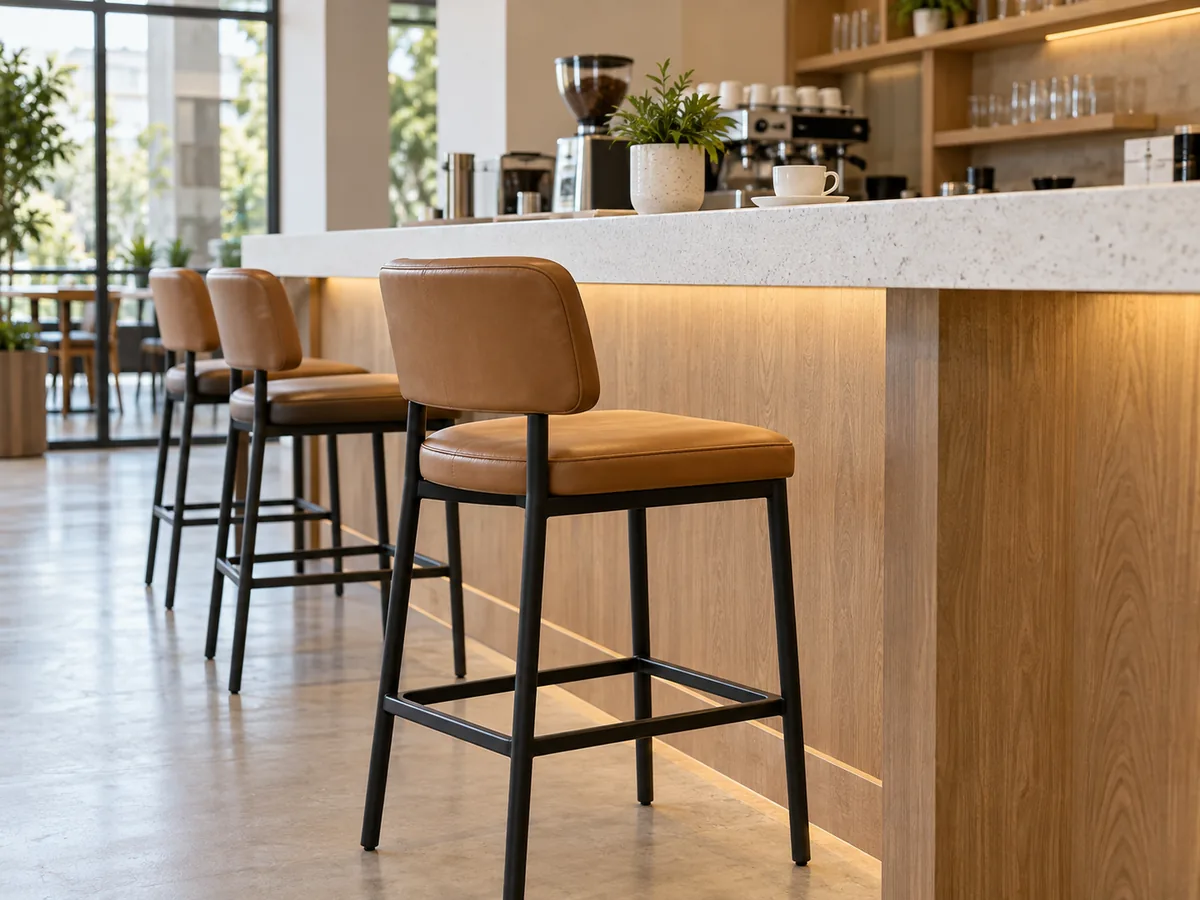
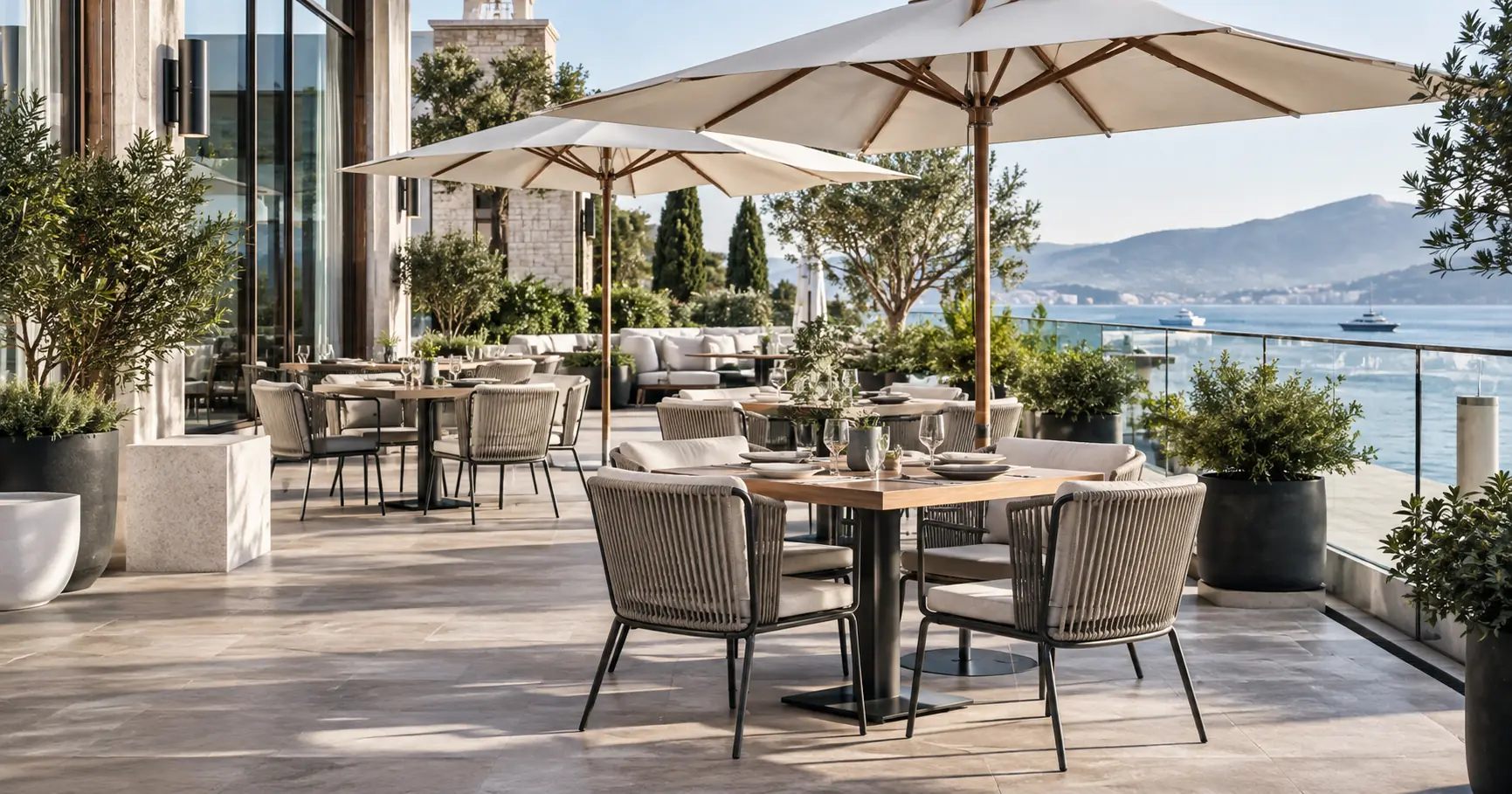
What is the best outdoor furniture for a commercial space?
The best outdoor furniture is the furniture that matches the real exposure, staff handling, maintenance routine and layout of the venue. For many restaurant, café and hotel patios where furniture is moved frequently, aluminum seating is our practical default starting point. We change that direction when wind exposure, a more sheltered wood aesthetic, additional mass, fixed placement, coastal or poolside conditions, or a different maintenance plan matters more.
Best outdoor furniture by project condition
For commercial spaces, “best” should mean best matched to the operating condition, not one universal material or style. Use this as the first shortlist, then confirm the exact model and finish against the project.
| Commercial need | Best starting direction | Why we start there | Change the choice when |
|---|---|---|---|
| Movable restaurant or café patio seating | Aluminum seating | Lower handling weight makes frequent moving and reconfiguration easier. | Wind exposure, extra mass or another finish/structure requirement matters more. |
| Wind-exposed rooftop or open terrace | Heavier, stable furniture direction | Footprint, mass and wind management can matter more than minimum weight. | Furniture is stored after service or the project uses an approved anchoring/storage strategy. |
| Covered premium hospitality zone | Suitable wood, metal or woven furniture | Shelter gives more freedom to prioritize appearance and guest experience. | Wind-driven rain, high humidity or demanding cleaning conditions increase exposure risk. |
| Fast-turnover outdoor dining | Low-maintenance, fast-draining seating | Quicker cleaning and drying reduce operating friction between service periods. | Longer guest dwell time makes upholstered comfort more valuable. |
| Lounge, resort or longer-stay seating | Outdoor lounge seating with project-matched cushions | Comfort can justify the added cleaning, drying and storage routine. | Full rain exposure or limited maintenance makes cushions difficult to operate. |
| Seasonal storage or frequent closing routines | Stackable or storage-efficient seating | It reduces storage footprint and handling time. | Stacking contact would damage the chosen finish or the model is too heavy to handle safely. |
What “best outdoor furniture” means for a commercial project
For a restaurant, café, hotel, resort, rooftop bar or furniture distribution program, we judge outdoor furniture by five questions:
- Will the material and finish match the actual exposure?
- Can the furniture survive the operating routine—moving, stacking, cleaning and daily turnover?
- Does the size work with the table, counter, aisle and floor plan?
- Can the surface be cleaned and maintained at the frequency the operation can realistically support?
- Can the final specification be repeated consistently for a bulk order or future reorder?
A consumer “best of” list can prioritize style, reviews and seasonal discounts. For a commercial order, those are secondary to project fit. A lower purchase price can become expensive if the finish is wrong for the exposure, the pieces are difficult to store, or the model cannot be repeated later. If you are planning a complete venue rather than one isolated piece, review our commercial café furniture direction.
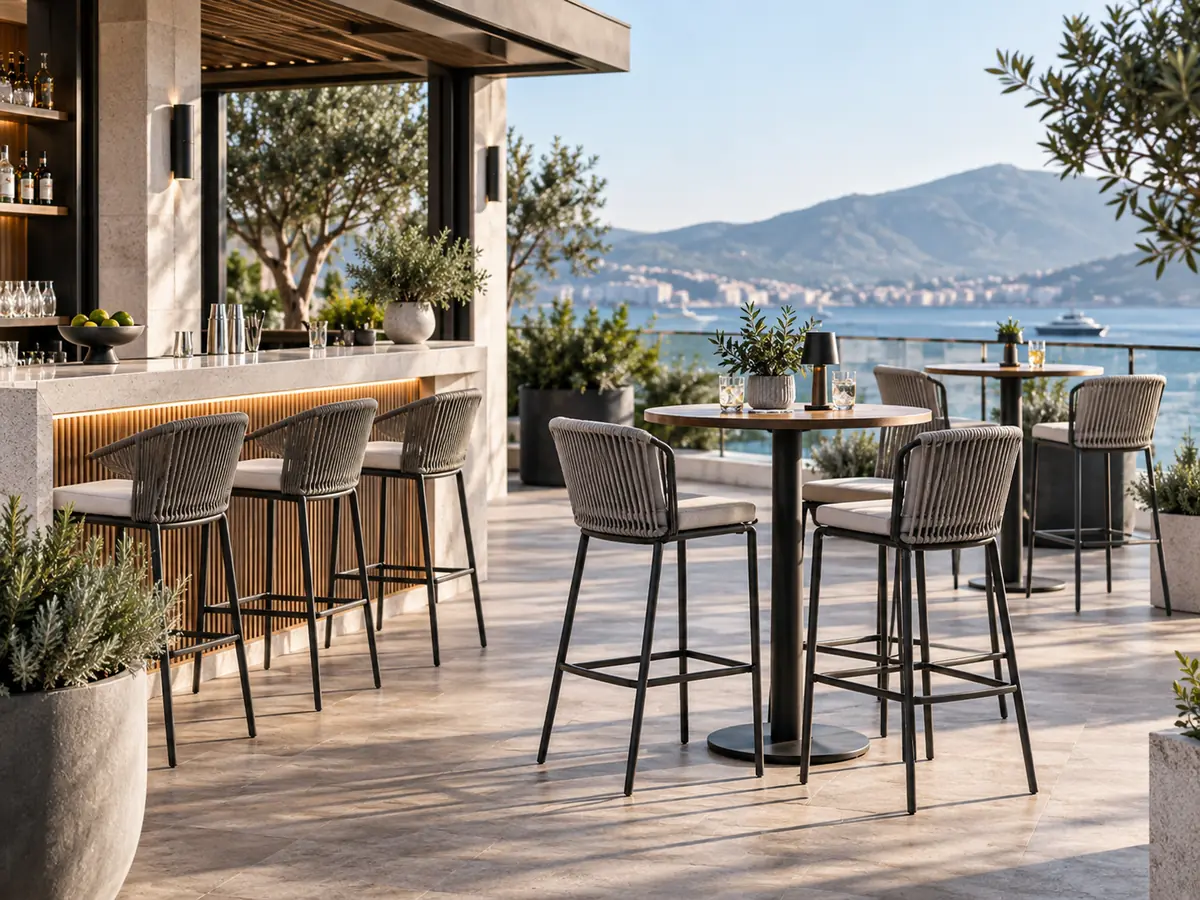
How we evaluate outdoor furniture for commercial projects
YeZhi Furniture does not use a consumer-review score to call one product “best.” We use a commercial selection sequence that separates project conditions from confirmed model facts. This helps prevent a suitable product for one patio from being treated as universally suitable outdoors.
Exposure
Covered, semi-covered, full rain/sun, coastal, poolside, rooftop, high-wind or freeze-thaw conditions.
Operating routine
Moving, stacking, cleaning, storage, daily turnover and how quickly furniture must return to service.
Material & finish
Frame material, finish system, hardware, water traps, drainage, contact points and maintenance boundary.
Fit & layout
Seat/table height, footprint, arm clearance, floor condition, circulation and the dining/bar/lounge mix.
Commercial repeatability
Quantity per SKU, sample/approval route, packing, production schedule, shipment and future reorder needs.
Final project check
We lock the exact model, dimensions, finish and project-specific details before quotation and production.
Choose outdoor furniture by exposure first
Use the exposure profile before choosing the material. The word outdoor is too broad to settle the specification by itself.
| Exposure condition | Our starting direction | What changes the recommendation | What we confirm before production |
|---|---|---|---|
| Covered terrace or veranda | Most outdoor-specified metal, suitable wood or woven directions can work. | Wind-driven rain, cleaning chemicals, high humidity. | Frame material, finish, edge protection, floor glides and maintenance. |
| Semi-covered café patio | Aluminum or properly treated steel is a practical start; selected wood can work with the right finish. | Long wet periods, direct afternoon sun, heavy stacking. | Coating system, drainage, hardware, stacking contact points and tabletop edges. |
| Fully exposed rain and sun | Favor low-maintenance frame systems and surfaces specified for repeated outdoor exposure. | Strong UV, standing water, extreme heat or cold. | Finish scope, drainage, fasteners, water traps and cleaning method. |
| Poolside | Treat it as a higher-risk environment than a normal patio. | Chlorinated water, wet users, sunscreen and frequent wash-down. | Metal/finish compatibility, hardware, fabric/foam choice, drainage and floor interface. |
| Coastal | Do not approve a standard “outdoor” description by itself. | Salt-laden air can accelerate corrosion problems. | Exact metal, coating, hardware, maintenance interval and project-specific suitability. |
| Rooftop or windy area | Stability and footprint can matter more than low weight. | Large back panels, umbrellas, uneven floors, furniture left outside. | Weight, base footprint, wind management and storage/anchoring strategy where applicable. |
| Freeze-thaw climate | Avoid transferring a warm-climate patio specification unchanged. | Trapped water and seasonal storage conditions. | Drainage, material movement, finish and storage plan. |
Best outdoor furniture materials by operating condition
| Material direction | Best starting use | Main operating advantage | Main check before approval |
|---|---|---|---|
| Aluminum | Frequently moved restaurant/café seating | Lower handling weight; no red-rust behavior of carbon steel | Finish, hardware, drainage and actual exposure |
| Coated steel | Projects needing more mass or an industrial look | Substantial feel and slim structural possibilities | Coating damage, water traps, welds and stacking contact |
| Wood | Covered/semi-covered hospitality spaces where material warmth matters | Natural visual character | Species, finish, drainage, drying and maintenance plan |
| Woven / rope | Hospitality seating where texture and comfort matter | Visual softness and design variety | Fiber type, frame, attachment, UV/water suitability and replacement strategy |
| Outdoor upholstery | Lounge/resort/longer-dwell zones | Higher comfort | Fabric, foam/drainage, removable covers, drying and storage |
Aluminum: our default starting point for movable commercial patio seating
We often start with aluminum when a restaurant or hotel needs furniture that staff will move, reconfigure or store regularly. It is lighter than comparable steel furniture and does not form red rust like carbon steel, which makes it useful for many outdoor seating programs.
That does not mean every aluminum frame is automatically suitable for every coastal, poolside or fully exposed project. Finish, structure, hardware, weld details, drainage and maintenance still matter.
- Start here when: staff handling and frequent movement matter, and the exposure is known.
- Change direction when: high wind makes additional mass desirable, the project needs a heavier industrial feel, or the environment needs a project-specific corrosion review.
Coated steel: useful when mass, stiffness and industrial character matter
Steel can be a strong commercial direction when a substantial feel, slim structure or industrial appearance is important. For outdoor use, the coating and detail design are part of the specification, not an afterthought.
A coating chip that exposes steel, a water trap around a joint, or repeated rubbing at stacking contact points can become an early maintenance problem. We therefore review exposed edges, weld areas, drainage, feet and stacking contacts rather than approving a steel chair from a color sample alone. Our aluminum vs. steel restaurant chair guide explains the material tradeoff in more detail.
Wood: best when the visual value justifies a defined finish and maintenance plan
Wood can create a warmer hospitality atmosphere that metal alone does not provide. Outdoors, species, construction, moisture movement, finish, drainage and maintenance become more important.
Woven materials and rope: specify the fiber and frame, not only the look
“Rattan look,” “rope,” or “woven” describes an appearance, not a complete outdoor specification. Fiber type, UV/water suitability, frame material, attachment method, cleaning method and replacement strategy need to match the environment.
Outdoor cushions and upholstery: use them where comfort justifies the drying and maintenance work
Cushioned seating can improve comfort in lounges, resorts and longer-stay hospitality zones, but exposed upholstery adds variables. Before production, we confirm the fabric direction, foam/drainage construction, removable-cover requirement, cleaning method, drying conditions and storage plan. For fast-turnover restaurant patios with full rain exposure, an unupholstered or fast-draining direction is often easier to operate.
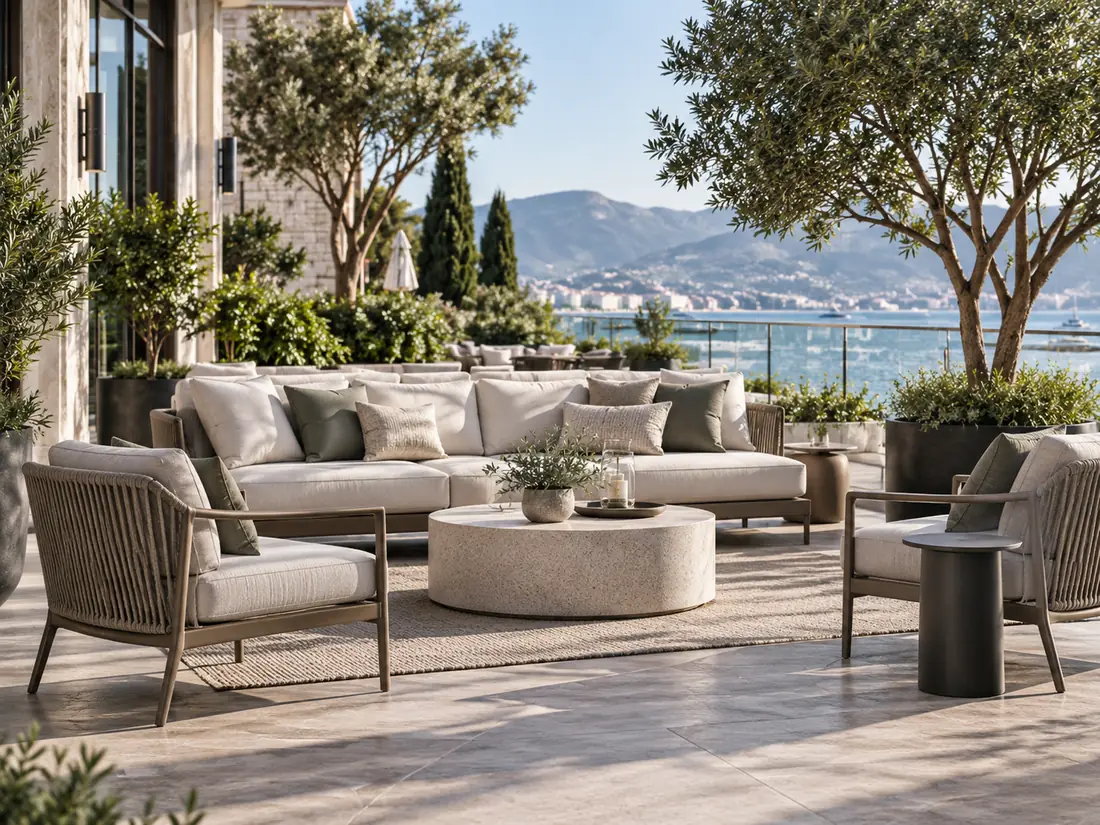
Design details that matter more than the material name
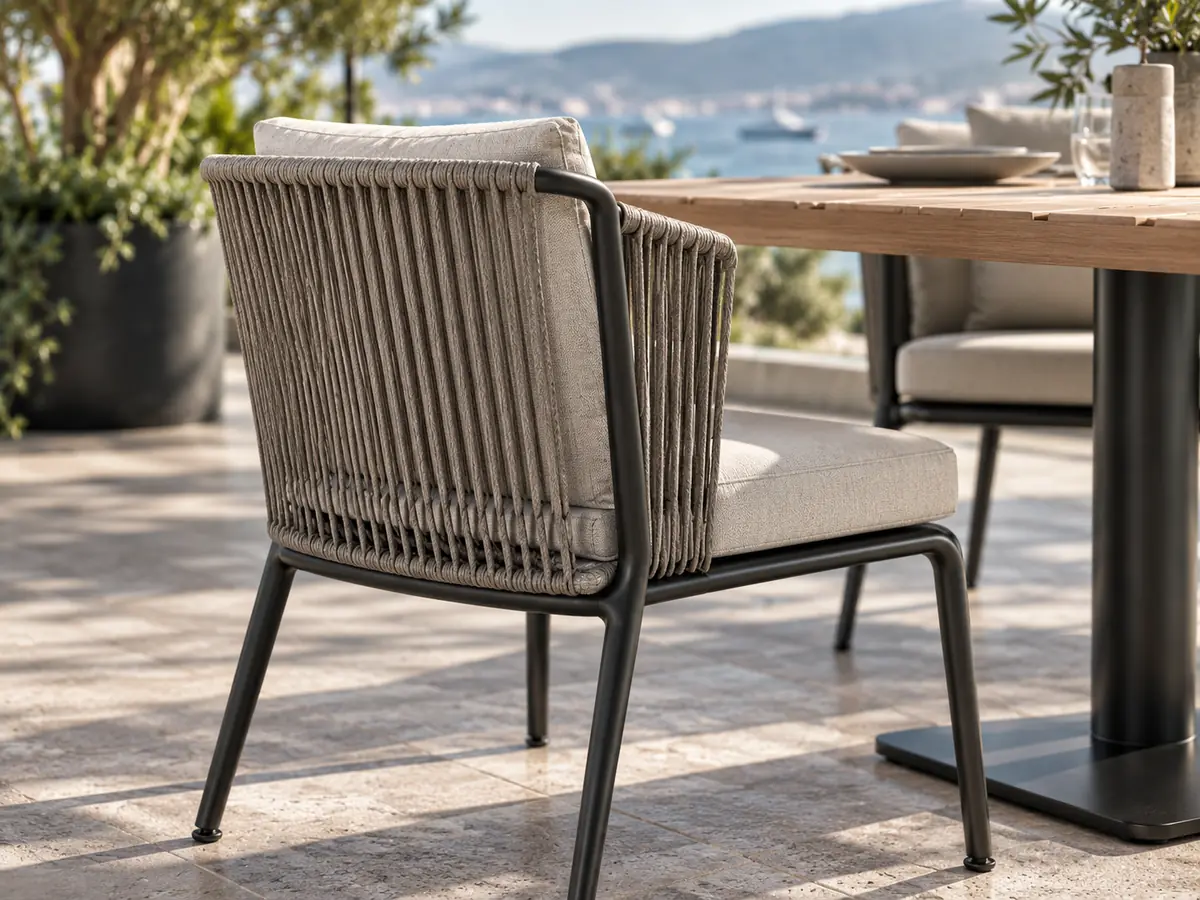
Drainage and water traps
Look for seat perforations, slatted tops, drain paths and joints that do not hold water unnecessarily. Standing water can create staining, slow drying and extra maintenance even when the base material is suitable outdoors.
Coating edges and contact points
Finish damage often begins where furniture rubs, stacks, is dragged or is hit during service. Check stacking contact points, feet, corners, weld transitions and high-touch edges.
Hardware and replaceable parts
Fasteners, glides, plugs and small protectors are easy to ignore in a showroom but important in a multi-year furniture program. Confirm the service parts that matter to the venue.
Table stability and floor interface
Outdoor floors are often sloped for drainage or less level than indoor floors. Review base geometry, footprint, adjustable glides where applicable, and the actual floor condition.
Stackability and storage
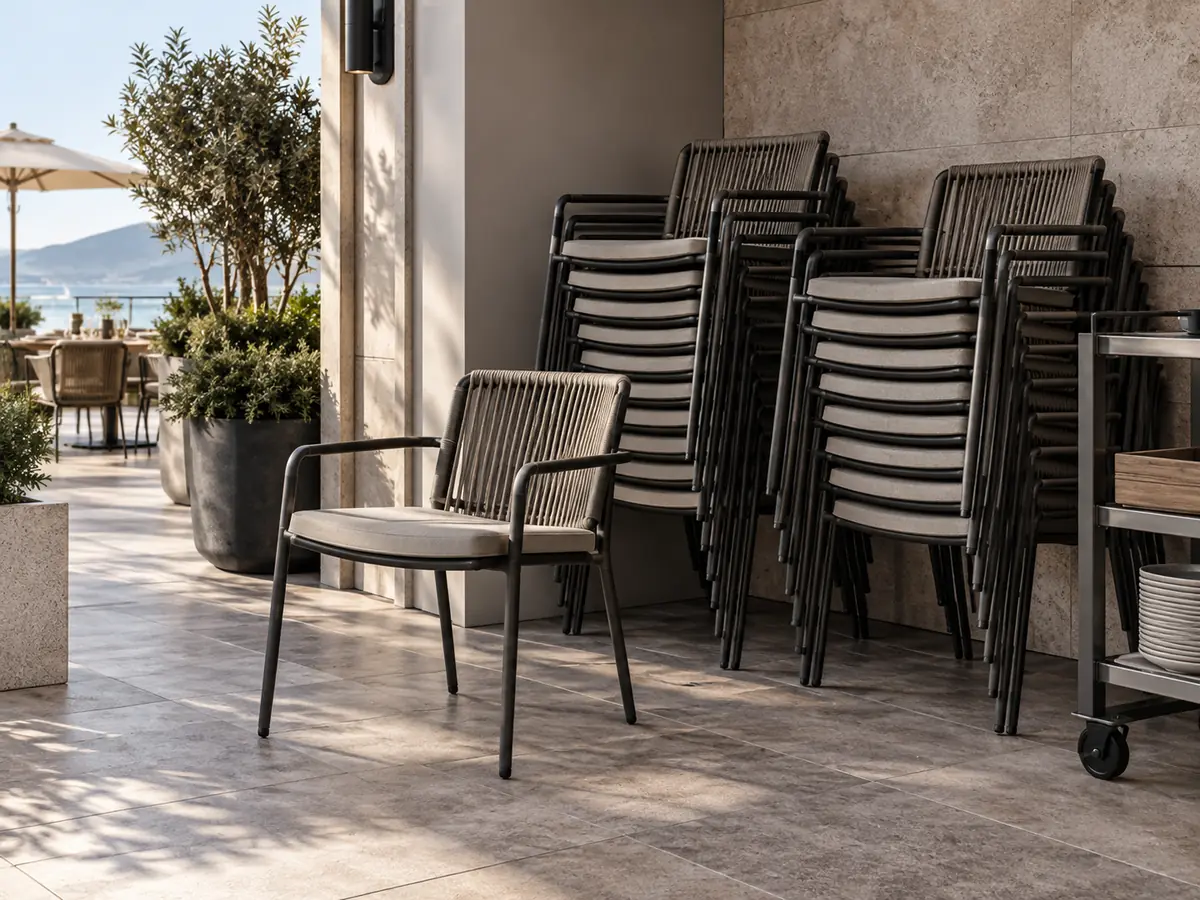
Stackable furniture can reduce storage space and speed closing routines, but stacking contact can also rub finishes. Confirm stack count, contact points, lifting method and storage area.
Fit, comfort and layout still decide whether the furniture works
Weather resistance is only one part of the decision. A commercial patio still needs correct seat height, table height, spacing, circulation and staff access.
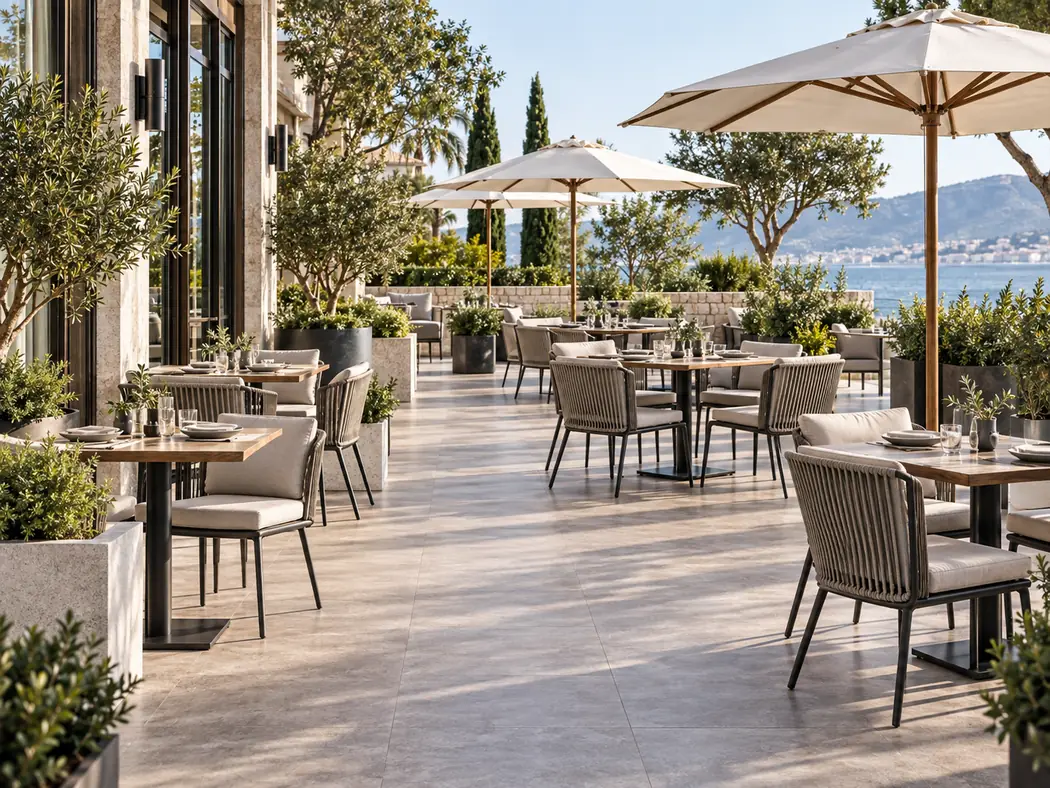
- Match dining chairs to dining-height tables and bar stools to the finished bar/counter height.
- Check arm clearance below the tabletop/apron before approving armchairs.
- Allow space for guests to pull chairs out without blocking primary circulation.
- Confirm table-base position so feet and chair legs do not conflict.
- Plan the mix of dining, bar-height and lounge zones around service style and guest dwell time.
Common outdoor furniture failures and how we reduce the risk
| Root issue | What happens next | What you may see | Commercial consequence | What to check before approval |
|---|---|---|---|---|
| Finish not matched to exposure | Surface protection degrades too quickly. | Rust staining on steel, coating damage, fading or surface change. | Early complaints, touch-up work, replacement pressure. | Define exposure first; review finish and maintenance against it. |
| Water becomes trapped | Furniture dries slowly or moisture remains at joints. | Staining, marks, persistent wet areas. | Cleaning delays and faster cosmetic deterioration. | Drain paths, slats/perforations, tube/joint details and storage position. |
| Furniture is too light or presents a large surface to wind | Wind moves the furniture. | Chairs shift, topple or must be moved frequently. | Staff workload and operational disruption. | Weight, footprint, back shape, wind management and storage plan. |
| Stacking contact is not controlled | Repeated rubbing damages surfaces. | Chips, scratches or polished contact marks. | Appearance inconsistency across a batch. | Stack method, protectors/contact points, rack and handling. |
| Wood/finish is used beyond its exposure boundary | Moisture and sunlight act on the surface. | Checking, discoloration, roughness or finish wear. | More refinishing and shorter cosmetic life. | Material, finish, drying, cover/storage and maintenance. |
| Feet/glides do not suit the floor | Uneven contact develops. | Table wobble, chair rocking or floor scratching. | Guest complaints and maintenance calls. | Floor slope/texture, glide type, adjustability and replacement plan. |
We use these risks to narrow the shortlist before the model is approved. They are not checks we save until after a style has already been chosen.
YeZhi outdoor furniture directions to shortlist
The models below are YeZhi Furniture product examples, not a universal ranking. We use them to show how a commercial shortlist should connect a confirmed product identity to a specific operating condition, a change condition and a project check.
Patio Aluminum Bar Stool Chairs Outdoor
Best for: bar-height restaurant, café or hotel patio layouts where lower handling weight is useful.
Change this choice when: high wind, extra mass, or another project-specific exposure requirement matters more.
Confirmed model facts:
Model MS-930-H75-AL · Aluminum · W56 × D53 × H109 cm / about W22.0 × D20.9 × H42.9 in · Seat height 75 cm / 29.5 in.
Project check: confirm exposure, finish, hardware, drainage and the bar/table height before final approval.
View the aluminum outdoor bar stoolIndustrial Style Rain Metal Outdoor Bar Stool
Best for: hospitality bar areas where an industrial steel look and stackable seating fit the operating routine.
Change this choice when: handling weight, aggressive exposure or another corrosion/maintenance requirement changes the project risk.
Confirmed model facts:
Model MS-BC1843-H75-ST · Steel · W52 × D50.5 × H102 cm / about W20.5 × D19.9 × H40.2 in · Seat height 75 cm / 29.5 in.
Project check: confirm the outdoor finish, stacking contact points, drainage, floor glides and maintenance plan.
View the Rain outdoor bar stoolYZ-OBT01 Round Wooden Outdoor Bar Table
Best for: covered and semi-covered café patios, hotel terraces and compact restaurant bar areas.
Change this choice when: the table will be fully exposed, the project needs a larger dining surface, or another height/finish route is required.
Confirmed model facts:
Ø60 × H108 cm / Ø23.6 × H42.5 in · Current model MOQ 20 pcs/model · Production planning about 30 days.
Project check: confirm stool height/width, lower base footprint, circulation, finish and exposure before layout approval.
View YZ-OBT01For more table formats, browse our commercial tables and commercial bar stools.
Commercial ordering with YeZhi Furniture
How to judge an outdoor furniture sale for a commercial order
A retail discount is useful only when the exact model still matches the exposure, dimensions, quantity, packing, maintenance, production schedule, freight basis and reorder needs of the project. YeZhi Furniture does not publish one universal “sale price” for all outdoor furniture; we quote the actual model, quantity, specification and shipping basis instead.
| Commercial item | YeZhi planning baseline | What can change it |
|---|---|---|
| Regular MOQ | Starts from about 15 pcs per model/SKU | Some models have a different minimum; for example, YZ-OBT01 is currently 20 pcs/model. |
| Full OEM/custom | Usually around 100 pcs per design/configuration | Scope, tooling, finish and configuration. |
| Standard production | About 30 days after order confirmation | Complex/custom programs can require about 35–45 days or a project-specific schedule. |
| Sample timing | Confirmed by model and customization | No single company-wide fixed sample lead time. |
| Payment | T/T 30% deposit + 70% balance before shipment | Project/order terms must match the final PI. |
| Trade terms | EXW / FOB / CIF | Order size, destination and agreed shipment scope. |
| Ocean shipment | LCL or FCL | Volume, packing and destination. |
| Standard warranty | 1 year | Final coverage, exclusions and remedy are confirmed in the PI/order terms. |
What we can confirm now—and what still needs project confirmation
| Can be confirmed from the selected model | Still project-specific |
|---|---|
| Model identity, listed material and verified dimensions | Suitability for the exact coastal, poolside, rooftop or fully exposed environment |
| Current listed MOQ where published | Final quantity mix, packing and shipment plan |
| Standard company commercial baselines | Sample timing, custom scope and project schedule when complexity changes |
| Available design/material direction | Exact finish, fabric, hardware, color and other approved configuration details |
This separation matters because a product page can confirm what a model is, while the project brief determines whether that exact configuration is the right choice for the intended environment.
What to send us before you request a quotation
- Venue type: restaurant, café, hotel, rooftop, pool, resort or distribution program
- Covered, semi-covered or fully exposed location
- City/country and coastal, poolside, high-wind, freeze-thaw or high-UV conditions
- Target quantity per model/SKU
- Dining, counter, bar or lounge height
- Preferred material and color direction
- Stackability and storage requirement
- Required dimensions or floor-plan constraints
- Target-market documents or accessibility requirements
- Packing, shipping mark, logo or OEM needs
- Destination port/city and target project schedule
We use this information to confirm the most suitable model direction, what changes the recommendation, and which details need to be locked before production.
Frequently asked questions
What is the best outdoor furniture material for restaurants?
For many commercial patios, aluminum is our default starting point because it is relatively light for staff handling and avoids the red-rust behavior of carbon steel. We change the recommendation when wind exposure, a heavier feel, a sheltered wood aesthetic, pool/coastal conditions or another project requirement is more important.
Is steel furniture good for outdoor restaurant use?
Yes, when the steel structure, coating, drainage, hardware and maintenance are matched to the exposure. We do not approve a steel model for every environment based only on the word “outdoor.”
Is wood outdoor furniture suitable for cafés and hotels?
Yes, especially when a warm material look is important and the exposure/maintenance plan is defined. Covered and semi-covered zones are often easier to manage. For fully exposed wood, we confirm the exact material and finish because water, sunlight, weathering and drying conditions affect finish performance.
Should I buy outdoor furniture during a sale?
Only if the discounted model still matches the exposure, dimensions, quantity, packing, maintenance and reorder needs of the project. For bulk purchasing, compare the landed and operating condition rather than the discount percentage alone.
What should I confirm before ordering commercial outdoor furniture in bulk?
Confirm the exposure, frame/material, finish, drainage, hardware, dimensions, table/seat height, floor interface, stackability, cleaning routine, sample/approval route, quantity per SKU, packing, shipment and required documents.
What outdoor furniture is best for windy commercial patios?
Start by prioritizing stability, footprint, mass and the venue’s wind-management routine rather than choosing the lightest furniture. Rooftops and open terraces can require a heavier furniture direction or an approved storage/anchoring strategy. We do not use one universal furniture weight as a safe wind rating.
What is the lowest-maintenance outdoor furniture direction for restaurants?
For many fast-turnover patios, we start with simple metal seating and fast-draining or unupholstered surfaces because they reduce drying, cover and cushion-storage work. The final choice still depends on exposure, finish, hardware, cleaning method and how the venue stores furniture.
Send us your outdoor furniture project brief
Tell us the venue, exposure, quantity per model, target dimensions/heights, material direction, storage needs, destination and schedule. YeZhi Furniture will help narrow the suitable outdoor seating/table direction and confirm the details that must be locked before quotation and production.
Request an outdoor furniture quotation