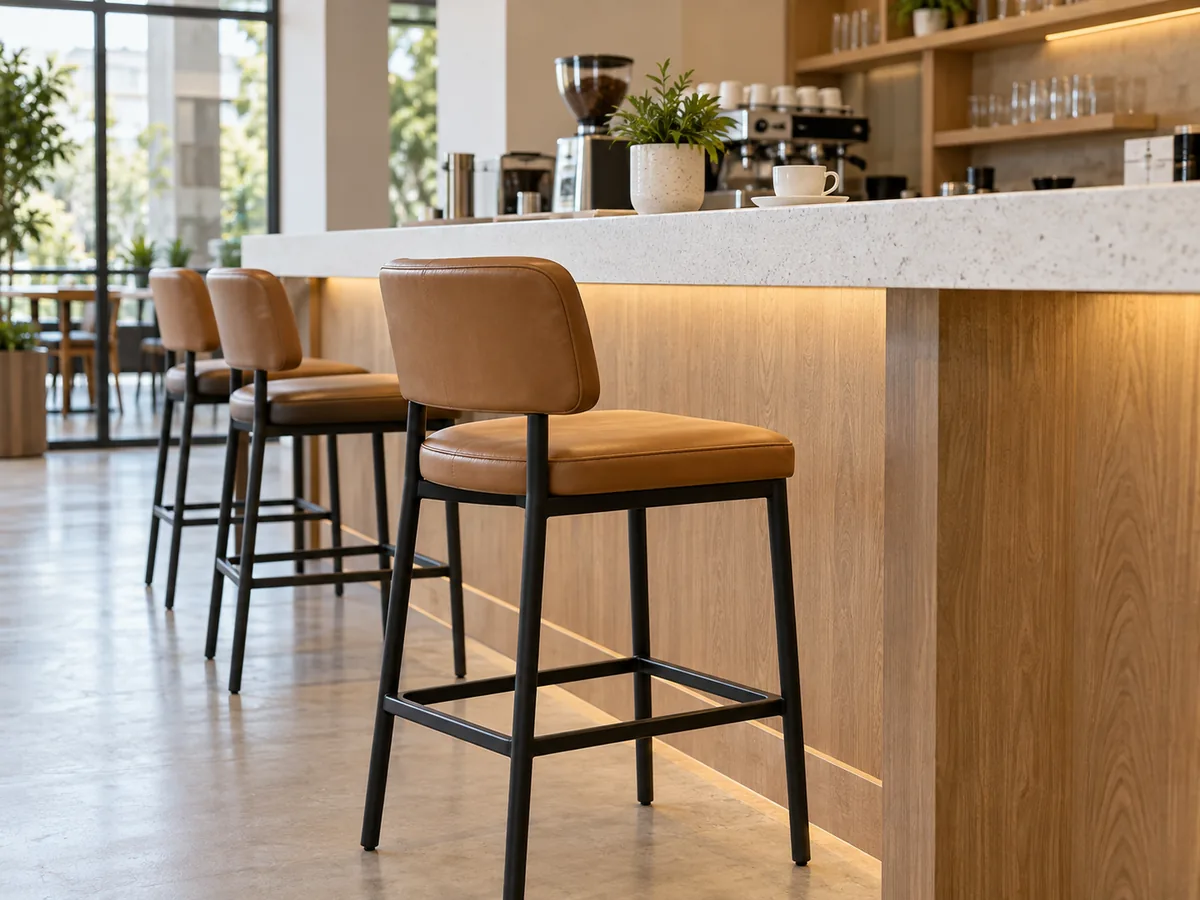
Commercial bar stools don’t “last X years” in any meaningful way.
In a busy bar or restaurant, what matters is whether the stool is still safe, stable, and economical to keep in service—not how old it is on paper. The same model can look fine for years in a hotel lobby bar, and become a recurring maintenance problem in a high-turnover venue where guests lean, drag, and step on the footrest all night.
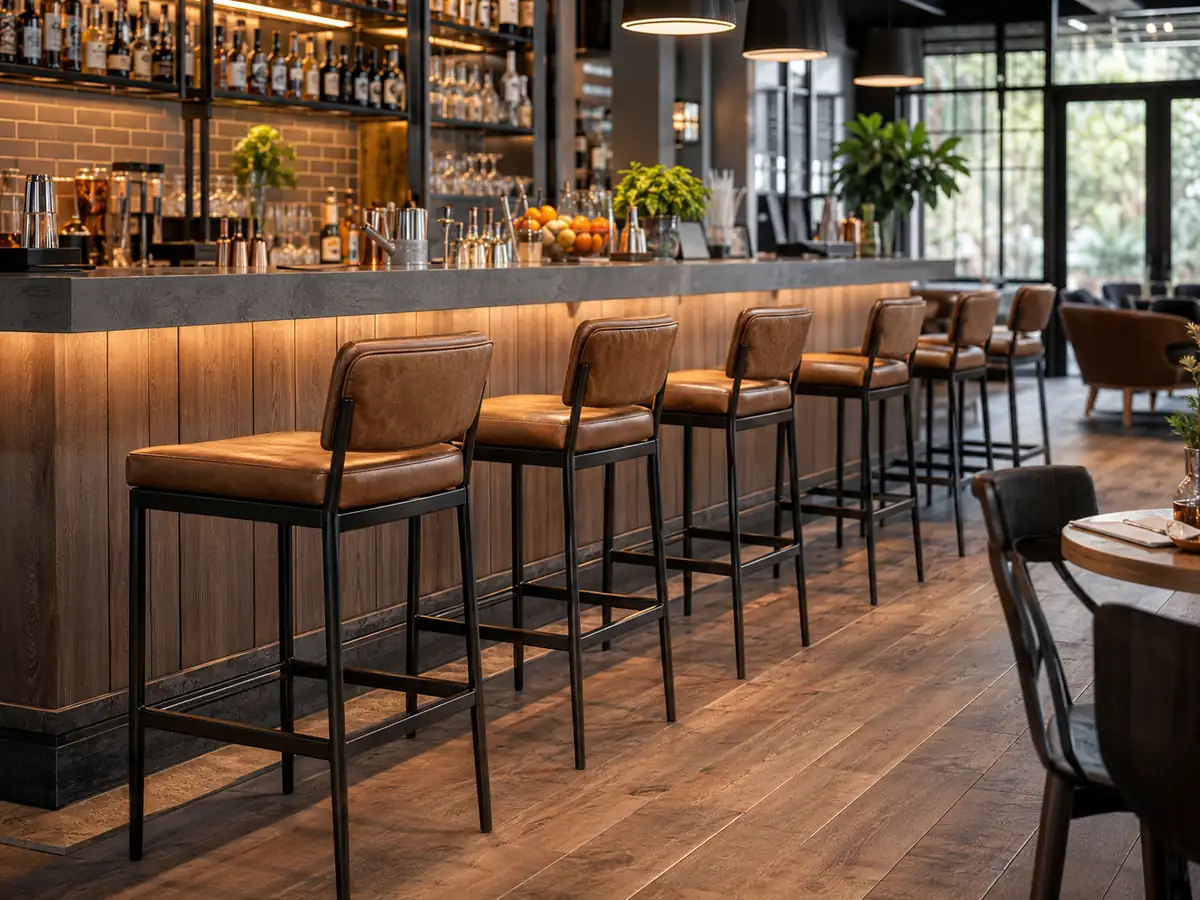
Quick answer: how long do commercial bar stools last?
A commercial bar stool’s lifespan depends on use intensity, construction, materials, maintenance, and whether damaged parts can be safely serviced.
In high-frequency hospitality settings, the practical “replacement timeline” often starts when you see repeated instability, footrest damage, fasteners that no longer hold, swivel or base failure, cracked welds, broken joints, or upholstery that can’t be kept clean. Age matters less than whether the stool is still safe, stable, cleanable, and economical to maintain.
Instead of betting on a number, use this rule:
If it’s a safety risk (wobble, cracked frame, loose footrest, failing swivel): remove it from service and replace.
If it’s a repeat repair (same fasteners loosening, same glide failures, recurring squeak/stiff swivel): plan replacement.
If it’s cosmetic only (minor scuffs, replaceable glides, light upholstery wear): monitor and maintain.
⚠️Warning: If a stool is structurally unsound, remove it from guest use immediately. Tag it “Out of Service / Do Not Use,” move it away from the bar area, record the stool ID or location, photograph the failure point, and decide whether to repair it according to manufacturer guidance or replace it. Do not return the stool to service until the cause is confirmed and the repair holds during re-check.
Commercial vs residential bar stool lifespan: why the math changes
People often search “how long do bar stools last” and get consumer answers. That’s risky if you’re buying for restaurants.
In commercial use, stools see:
higher daily cycles (more sits per day)
more lateral stress (leaning, dragging, stepping onto the footrest)
harsher cleaning chemicals and more spills
higher consequences if something fails (guest injury, downtime, liability)
If you want a clean framework for “what makes commercial seating different,” YeZhi’s breakdown in Commercial vs Residential Dining Chairs is a good companion read.

What actually drives commercial bar stool lifespan

Think in components. The stool fails when the weakest high-stress part fails.
For procurement, ask whether the exact model has commercial seating test documentation. For European non-domestic seating, EN 16139:2025 is a relevant reference for safety, strength, and durability requirements for adult non-domestic seating. However, it does not cover every lifespan variable, including upholstery-material durability, ageing, degradation, flammability, or certain mechanisms. Treat test reports as procurement evidence, not as a guarantee that a damaged stool can stay in service.
1) Use intensity (not just “years”)
A stool in a hotel lobby bar might see steady, moderate use. A sports bar stool might see constant cycling, plus guests using the footrest like a step.
Use this quick model:
Use scenario | What “wear” looks like fastest | What you should inspect first |
|---|---|---|
Light commercial (boutique café, lobby seating) | upholstery cosmetics | seat surface, stitching/seams, finish wear |
Typical restaurant bar | loosened hardware + footrest abuse | footrest attachment, wobble/fasteners, glides |
Heavy commercial (sports bar, late-night venue) | instability + swivel/base failures | footrest + swivel mechanism + base/glides + welds |
2) Footrest design and attachment

This is a bar-stool-specific failure point. Guests step onto the footrest to get in/out, and they push sideways against it.
Watch for:
footrest movement under normal hand pressure
visible separation at the joint
cracked welds on metal stools
splitting around fasteners on wood stools
sharp edges, bent tubing, or missing end caps near the footrest
A loose or cracked footrest is not just cosmetic. It changes how guests climb onto the stool and can create instability, trip points, or sharp-edge risk.
3) Wobble drivers: fasteners, joints, and glides
A “wobbly bar stool” is more than an annoyance—it’s often the first sign of structural drift.
Start with the simplest checks:
Are all floor glides present and evenly worn?
Do bolts/screws hold torque—or do they loosen again within weeks?
TablesChairsBarStools.com recommends checking glides first and tightening hardware as a common fix path in How to Avoid the 5 Most Common Problems with Restaurant Furniture (2016).
4) Swivel mechanisms and pedestal bases (when applicable)
Swivel stools can be great for guest experience, but they add moving parts.
Common “bar stool wear signs” include:
squeaking, grinding, or stiffness
uneven rotation (it “catches”)
looseness that makes the seat feel unstable
Trendler (a swivel/hardware manufacturer) covers typical issues in Troubleshooting Common Barstool Swivel Problems (2023).
5) Upholstery cracking and cleanability
In hospitality, appearance and hygiene are operational, not decorative.
If you’re seeing bar stool upholstery cracking, peeling, or seams opening, the question is often: can the surface still be cleaned to your standard without accelerating damage?
Blockhouse emphasizes that cleaning vinyl upholstery isn’t just about the cleaner—it’s also about rinsing and drying to prevent residue build-up in How to Clean Vinyl Upholstery to Reduce Plasticizer Migration (2022).
Signs you should repair, monitor, or replace bar stools
This section is the practical heart of “when to replace bar stools”—and it also maps to the search intent behind signs bar stools need replacing. Use it as a staff checklist.
Category 1: structural and safety signs (treat as stop-use)
Replace (or professionally repair only if the manufacturer allows it) when you see:
frame cracks, bent legs, or cracked welds
a footrest that is loose, separated, visibly cracked, or a bar stool footrest broken
a stool that wobbles even after glides are replaced and hardware is tightened
repeated fastener loosening that won’t hold
swivel or pedestal instability that makes the seat feel unsafe
Category 2: operational signs (may be repairable, but track costs)
These are “repair or monitor” signs:
glides wearing out frequently (especially on rough floors)
upholstery loosening but not torn
squeaks or stiffness that improve after proper lubrication (if manufacturer-approved)
Category 3: appearance and hygiene signs (brand impact)
Replace or reupholster (depending on your operations) when:
stains won’t come out after proper cleaning
cracking/peeling creates a surface that can’t be reliably sanitized
cushions have collapsed to the point guests feel the base
BFM Seating notes practical maintenance checks—including monthly screw/hardware inspection and replacing torn/cracked vinyl—in Restaurant Seating: Caring For Your Furniture (2021).

Repair vs monitor vs replace: a decision table you can use
Decision | Typical signs | What to do next |
|---|---|---|
Repair | missing/worn glides; one-time loosened fastener; minor upholstery issue | replace glides; tighten hardware; document and re-check in 2–4 weeks |
Monitor only after correction | Small wobble that disappears after glide replacement or hardware tightening; early squeak with no visible structural damage; cosmetic scuffs | Remove from peak-use rotation until corrected, then re-check on a flat surface and log whether the same issue returns within 2–4 weeks |
Replace (or remove from service immediately) | cracked weld/frame; loose/broken footrest; persistent wobble; unsafe swivel/base | take out of service; replace with a model built for higher intensity |
Pro Tip: If the same stool needs the same fix repeatedly, you’re no longer “maintaining”—you’re paying a hidden replacement bill in labor and downtime.
What breaks first on restaurant bar stools (in real life)

In high-traffic venues, these failure points tend to show up early:
Glides/feet (wobble + floor damage)
Footrest attachment (stress concentration)
Hardware loosening (fasteners, brackets)
Swivel components (if applicable)
Upholstery surface (cracking, seams, stains)
A simple restaurant bar stool maintenance cadence

You don’t need a complicated program—just consistency.
Daily before peak service: quick wobble check; look for obvious footrest looseness, missing glides, sharp edges, or unstable swivel/base movement; tag and remove anything questionable.
Monthly: tighten approved fasteners, inspect joints and welds, replace missing glides, spot-check swivel feel, and log stool ID/location for any repair.
Quarterly: deep clean upholstery according to material guidance, review repeat repairs, check whether the same failure appears by zone or model, and decide what should be replaced before the next busy season
If you want a checklist mindset for keeping dining environments safe and clean, BFM also provides a quick safety-oriented checklist in Maintaining a Safe, Inviting, Clean Dining Environment.
Which commercial bar stool types tend to last longer?
There’s no universal ranking, but there are predictable trade-offs:
Fixed-height, non-swivel: fewer moving parts; often easier to keep stable in heavy use.
Swivel stools: can last well if the swivel hardware is specified for frequent use and maintained.
Gas-lift/adjustable: adds mechanisms; can be fine in some venues, but you should be realistic about maintenance and part replacement over time.
If you’re building a shortlist, YeZhi’s guide to Types of Bar Stools can help you categorize by height, support, function, and material without turning the decision into a style debate.
How to buy longer-lasting commercial bar stools (procurement checklist)

Use this as an RFQ-ready checklist—especially if you care about reorder consistency.
Construction and serviceability
How is the footrest attached (and is it reinforced at that stress point)?
Are glides replaceable, and can you keep spares on hand?
If it’s a swivel stool, what hardware is used and what’s the maintenance guidance?
Can the supplier provide model-specific structural test documentation or an intended-use statement for restaurant/bar environments?
Does the report or spec sheet identify the exact model/SKU, tested configuration, standard, laboratory, report date, and any excluded mechanisms or materials?
Are replacement parts available for glides, footrest components, swivel hardware, fasteners, and upholstery, or is the stool effectively disposable after one key failure?
Maintenance fit (the hidden durability variable)
What cleaning methods are recommended for the exact upholstery/finish?
Will daily wiping in a restaurant environment accelerate cracking or dulling?
Reorder and batch consistency
Can you reorder the same model later with consistent finish and upholstery match?
What’s the process for confirming spec sheets and production controls?
For buyers outfitting restaurants and hospitality venues, YeZhi’s overview page on Wholesale Restaurant Bar Stools is a useful starting point for aligning height, materials, and cleaning realities.
Video: how to screen a wobbly bar stool before service
Use this video to show staff how to check glides, footrest movement, fasteners, swivel play, and remove-from-service tagging. Do not present the video as a load test or structural certification.
Sources and safety notes
EN 16139:2025: relevant for non-domestic seating safety, strength, and durability requirements, but not a complete lifespan guarantee and not a substitute for inspecting damaged stools.
Manufacturer guidance: use model-specific instructions for tightening, lubrication, swivel replacement, glides, upholstery cleaning, and warranty limits.
Maintenance records: replacement timing should be based on repeat failures, safety signs, repair cost, and downtime, not age alone.
Stop-use rule: any stool with cracked welds, broken joints, loose footrest, persistent wobble, or unstable swivel/base should be removed from guest use until properly evaluated.
FAQ
When should you replace bar stools?
Replace bar stools when there are structural or safety issues (persistent wobble, loose/broken footrest, cracked frame/welds, unstable swivel/base), or when repeat repairs cost more than planned replacement.
What are the signs a bar stool is worn out?
Look for instability (wobble, rocking), component looseness (footrest, base, swivel), and hygiene/appearance failures (upholstery cracking or peeling that can’t be cleaned reliably).
Are swivel bar stools durable for restaurants?
They can be—if the swivel hardware is designed for frequent commercial use, inspected regularly, and maintained according to manufacturer guidance. If maintenance isn’t realistic for your operation, fixed stools may be the safer bet.