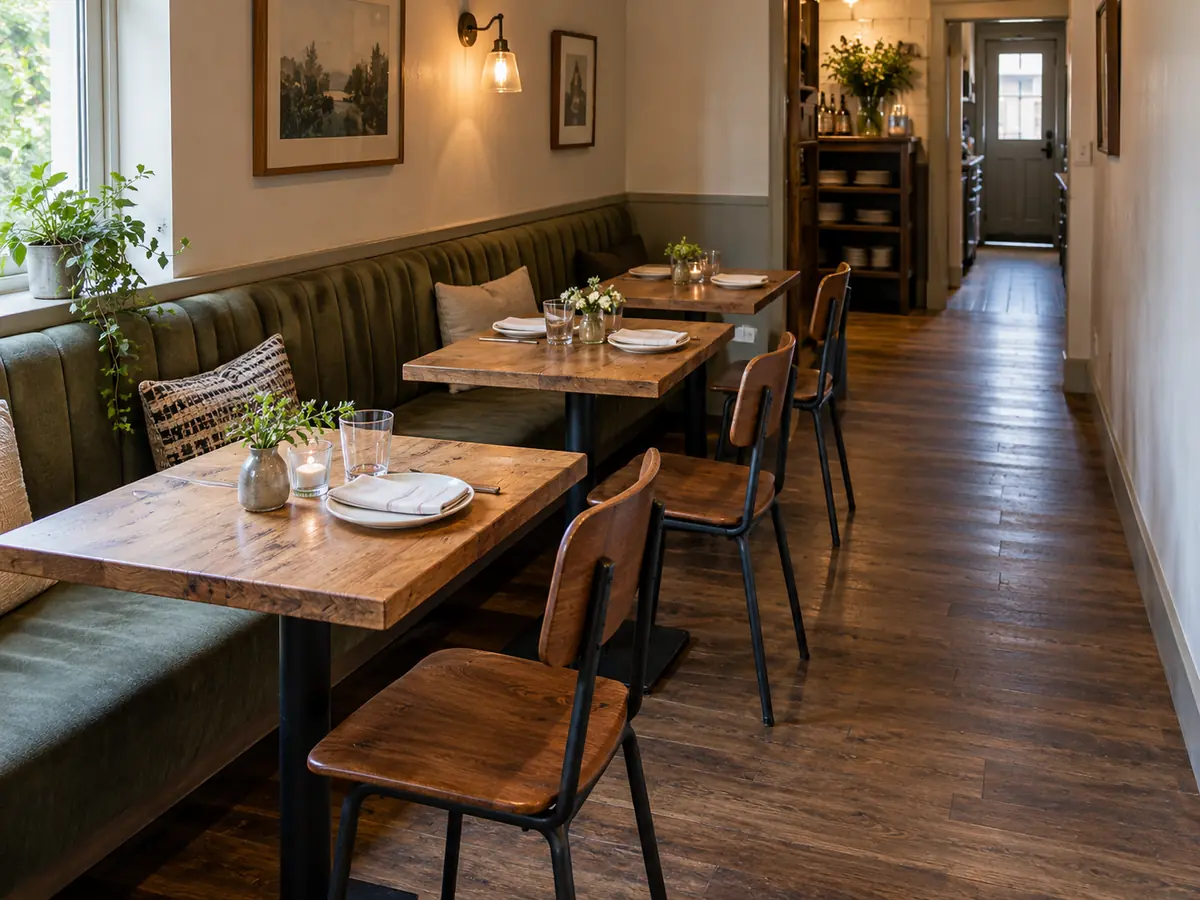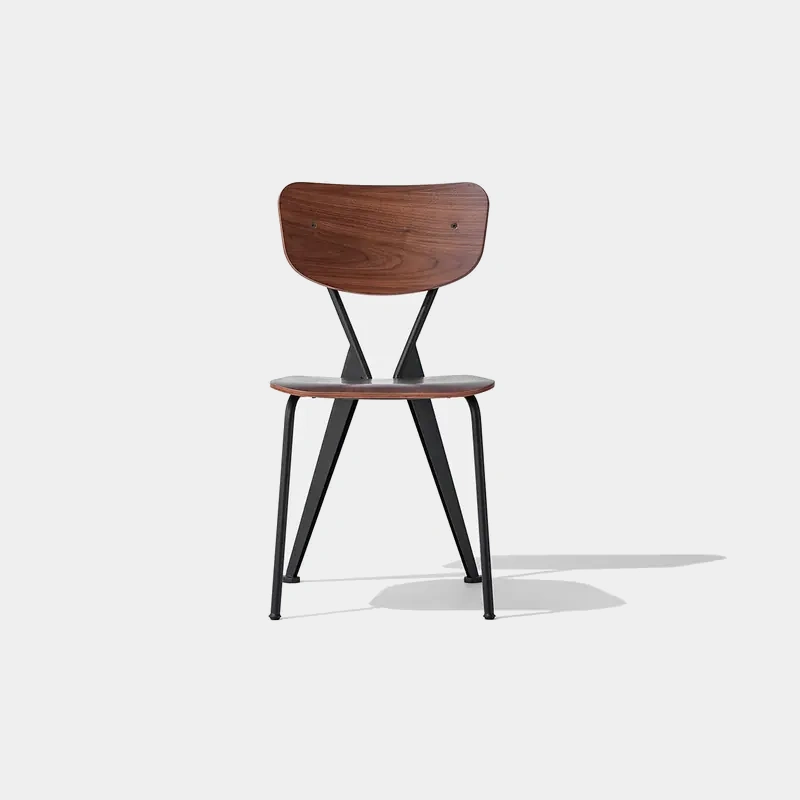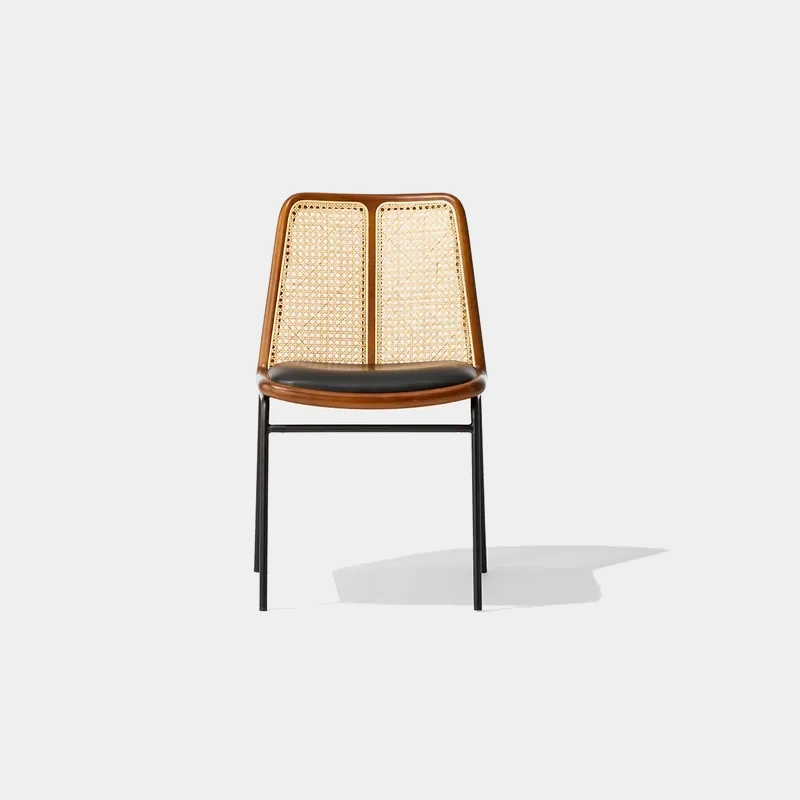
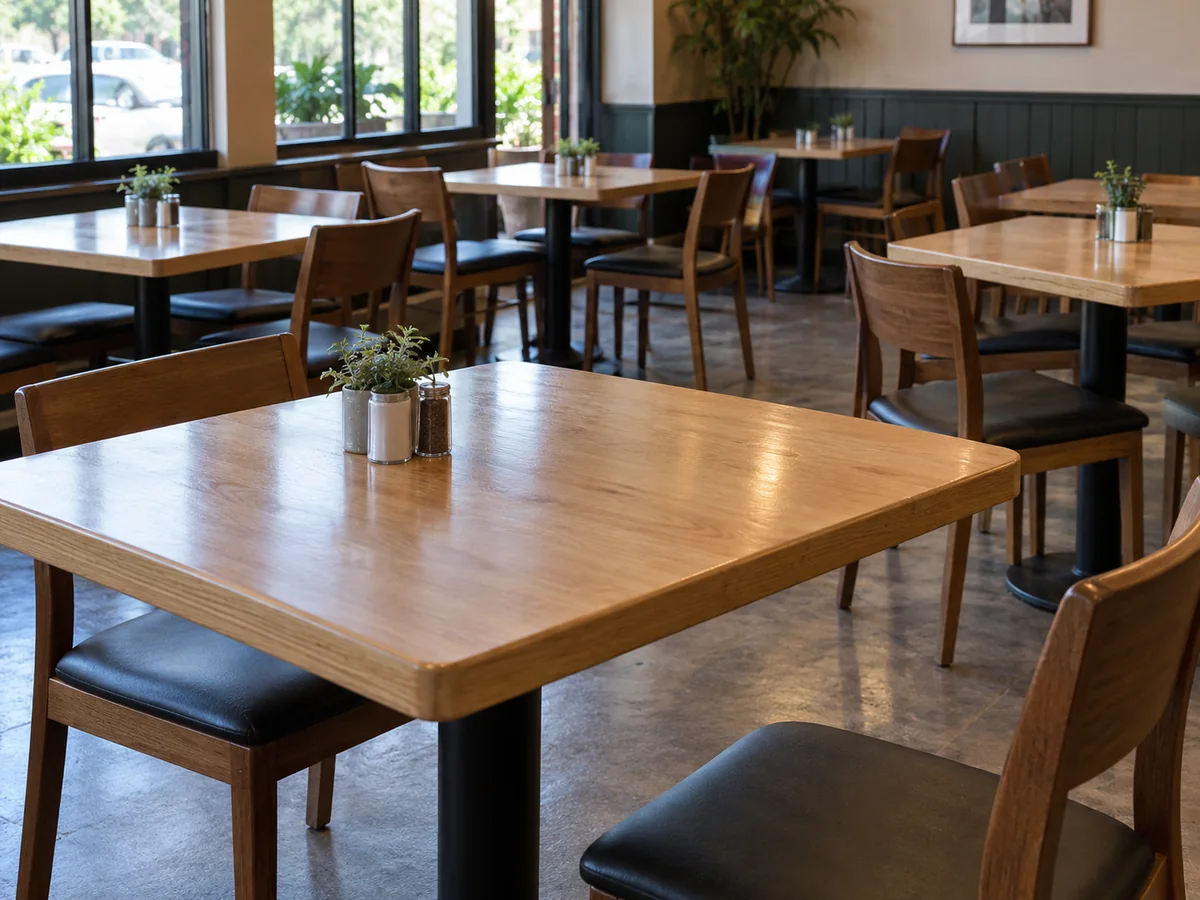
For a busy indoor restaurant, start with a well-built high-pressure laminate (HPL) top. Choose solid wood when natural feel and future refinishing matter more, and consider a specified porcelain or sintered surface when you want a stone look with less concern about marble etching. Use real marble when its changing appearance fits your concept and your team can care for it.
The best restaurant table top materials fit your menu, cleaning routine and daily handling. A tough face can still sit on a moisture-sensitive core. A beautiful slab can still be wrong for a small, frequently moved table. Start with the job the table must do, then choose its surface, construction and base together.
Which restaurant table top material should you choose?
For frequent wipe-downs and repeatable finishes, HPL is a practical first shortlist. For a genuine wood surface you can maintain and potentially refinish, choose solid wood. For outdoor tables, shortlist products expressly made for that exposure before comparing their looks.
Use this table to narrow the options, rather than rank every material from best to worst.
| Your restaurant needs | Start with | What could change the choice |
|---|---|---|
| Fast indoor table resets and a consistent wood or stone pattern | Commercial HPL on a properly finished core | Wet edges, unsuitable cleaners or weak mounting can defeat a good surface |
| A slim table edge with fewer separate edging parts | Compact laminate of the correct grade | Support spacing, fixings and indoor/outdoor approval still matter |
| Natural timber feel and a planned refresh later | Solid wood with a suitable finish | Large moisture swings or no time for refinishing favor another construction |
| Real wood grain with a controlled panel design | Wood veneer over a specified core | Deep damage may reach through the thin wood face |
| A stone appearance with frequent wine or citrus service | A suitable porcelain or sintered product; consider engineered quartz indoors | Edge impacts, hot cookware, weight and support must suit the product |
| Natural marble as part of the dining experience | Marble with an agreed care and appearance plan | Choose another surface if dull acid marks would be unacceptable |
You can also use different materials by zone. For example, keep a service-friendly surface in the busiest dining area and reserve natural wood or marble for spaces where its appearance earns the extra care. Keep heights, edge profiles and base finishes coordinated so the room still feels connected.
HPL, melamine and compact laminate: know what you are buying
Ask for the surface and the core separately. A quote that says “wood-look laminate, 30 mm thick” leaves out whether the face is HPL or melamine, what sits beneath it and how the perimeter is finished. Those details matter when staff wipe the same edge throughout a shift.
HPL: a separate durable sheet bonded to a core
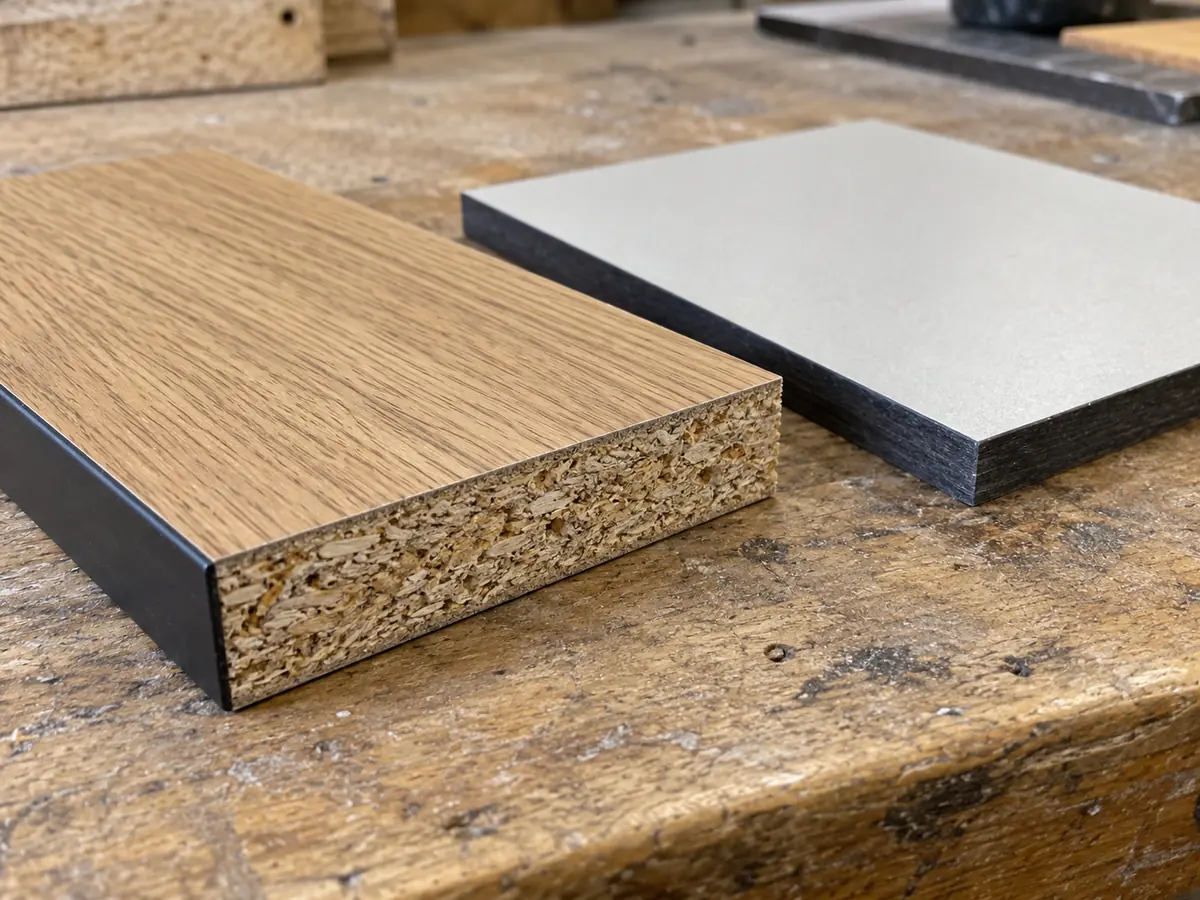
High-pressure laminate is made from resin-treated papers pressed into a sheet, then bonded to a supporting panel. The Composite Panel Association’s HPL guide distinguishes grades for different uses. Specify one intended for horizontal working surfaces rather than assuming every decorative sheet suits a restaurant table.
The core may be particleboard, MDF or another specified panel. Check its thickness, the underside, edge joints and mounting points. The visible edge thickness may include a built-up border; ask for the actual panel section if weight or screw fixing matters.
For indoor casual dining, we would put a smooth, easy-to-wipe HPL construction ahead of a deeply textured finish when fast resets are the priority. Compare the actual samples under your dining lights before settling the color and sheen.
Melamine or TFL: a different panel construction
What suppliers often call a melamine board is thermally fused laminate, or TFL. Its resin-treated decorative paper is fused directly to the core, as explained by the Composite Panel Association’s TFL guide.
TFL can suit a budget-led indoor project when the specified panel, edges and cleaning performance meet the task. Do not approve it as an equivalent HPL substitution just because the pattern matches. Compare the exact product specifications and finished sample, including any difference in the replacement price.
Compact laminate: a thick laminate panel
Compact laminate is a thicker, structural laminate rather than a thin face over a separate particleboard core. For example, Formica Compact is described as a two-sided structural phenolic panel with water and humidity resistance.
It is worth shortlisting when you want a slim edge or need to reduce concern about a separate wood-based core at the perimeter. Still match panel thickness, support and fixing details to the finished table. Water resistance alone does not establish suitability for full outdoor exposure.
With any laminated construction, inspect the perimeter closely. A lifted joint or exposed core gives liquid a route beneath the face. Once a wood-based core has swollen, wiping the top dry will not restore its original shape.
Solid wood or wood veneer?
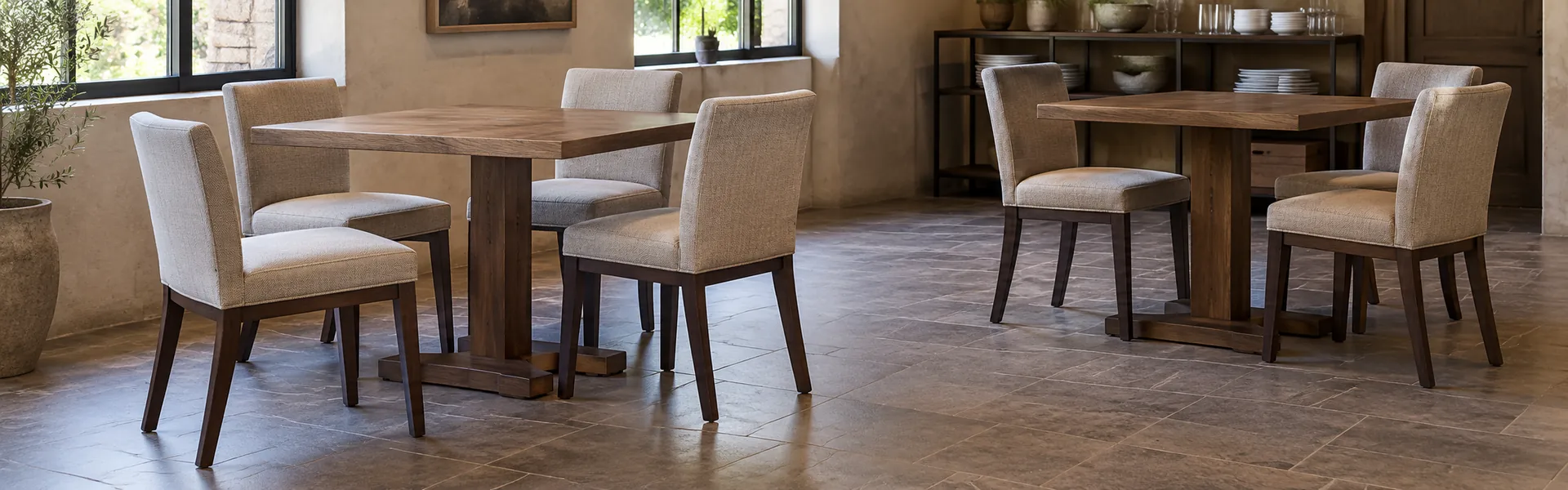
Choose solid wood when authentic grain and a future refinishing option are important. Choose veneer when you want a real wood face over a specified panel, and can accept more limited sanding and repair. Neither choice becomes suitable for constant wet cleaning simply because it looks substantial.
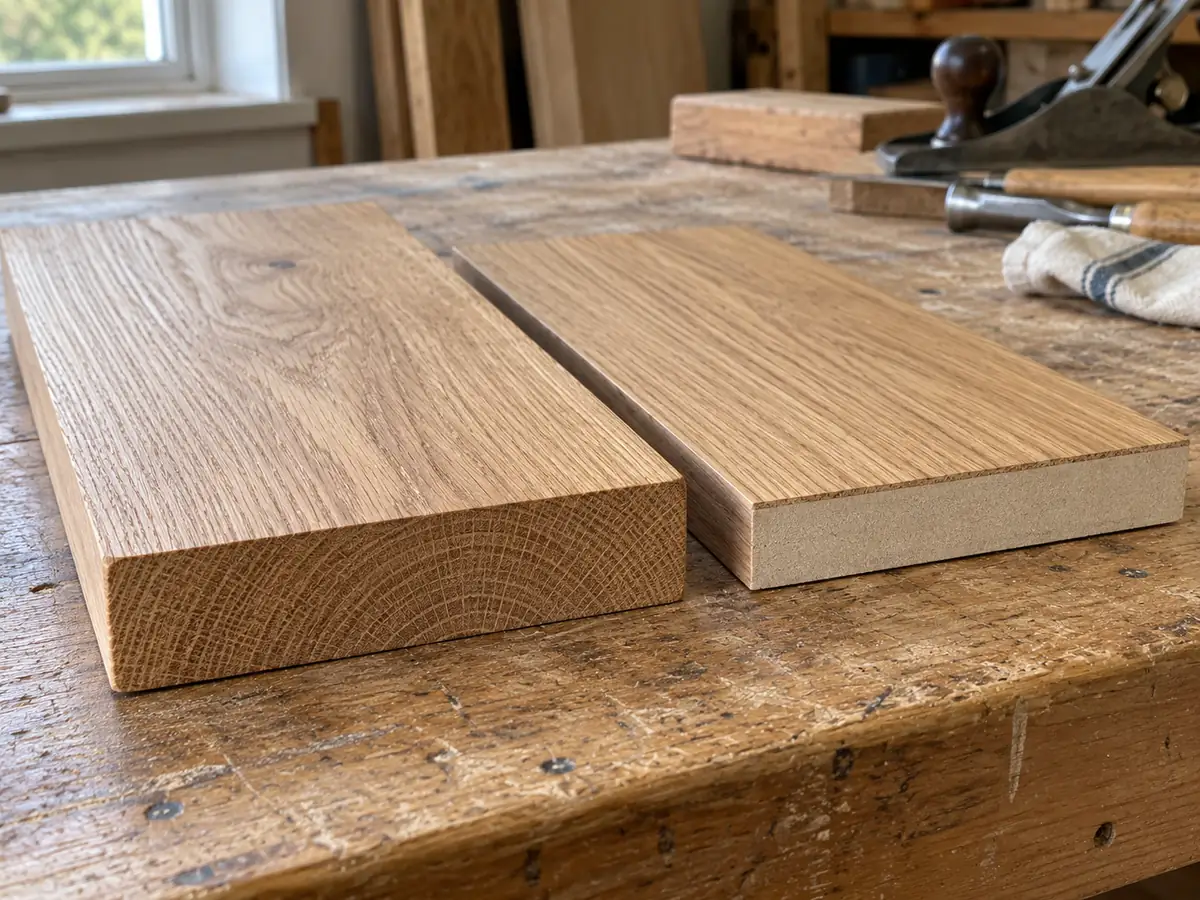
Solid wood contains timber through the main section. Veneer is a thin layer of real wood bonded to another material. A printed oak pattern on HPL is a third construction. If the material description is unclear, ask for a section sample and the face/core specification.
Solid wood needs a finish and room to move
For a restaurant, assess the finish as closely as the wood species. Ask which cleaner it accepts, how it is repaired and when a newly applied finish can return to service. An attractive sample tells you little about repeated cleaning unless you know which finish was used.
Wood gains and loses moisture with its surroundings. The USDA Wood Handbook, Chapter 4, explains how this causes swelling, shrinkage and possible distortion. In practice, specify attachment details that accommodate movement, and avoid putting an indoor timber top through repeated wet-and-dry exposure.
Refinishing is useful when the table has enough sound material and the construction allows it. Include removal, workshop work, curing and reinstallation in the plan. A surface that can be renewed still needs downtime to renew it.
Veneer needs a clear repair limit
Veneer can provide genuine grain without using solid wood through the whole top. Its useful repair depth depends on the veneer thickness, existing finish and damage. Do not plan to sand it like a solid timber slab. Sanding through the face exposes the core and changes the repair from a finish refresh to a much larger job.
For multiple tables, approve the acceptable grain and color range as well as one favorite sample. Natural variation can look good across a dining room; it becomes a problem when the order was expected to match a single piece exactly.
Marble, granite, quartz, porcelain and solid surface
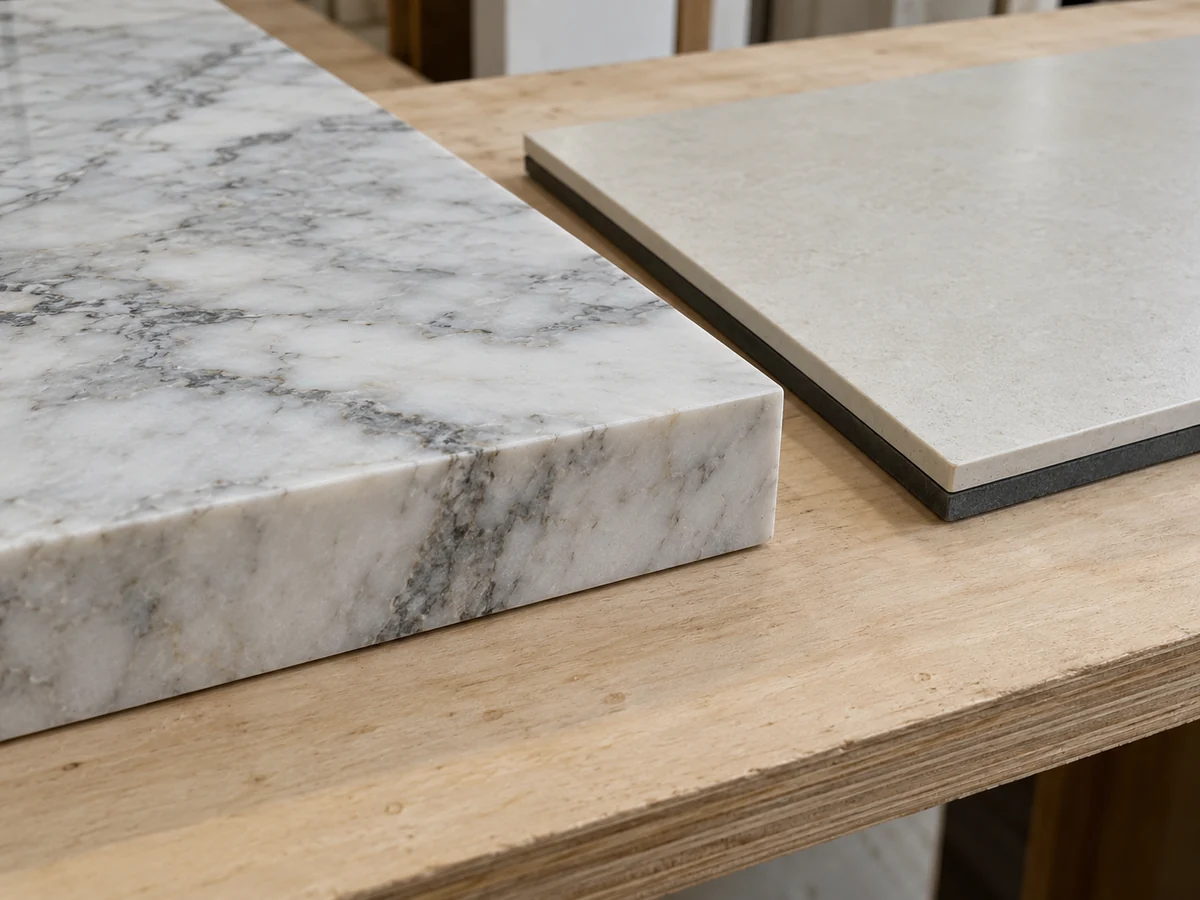
Separate the stone look from the actual material. Marble, granite, engineered quartz, porcelain and acrylic solid surface respond differently to acids, heat and repairs. A marble pattern printed on laminate has the care requirements of that laminate construction.
Marble and granite: natural variation, different care
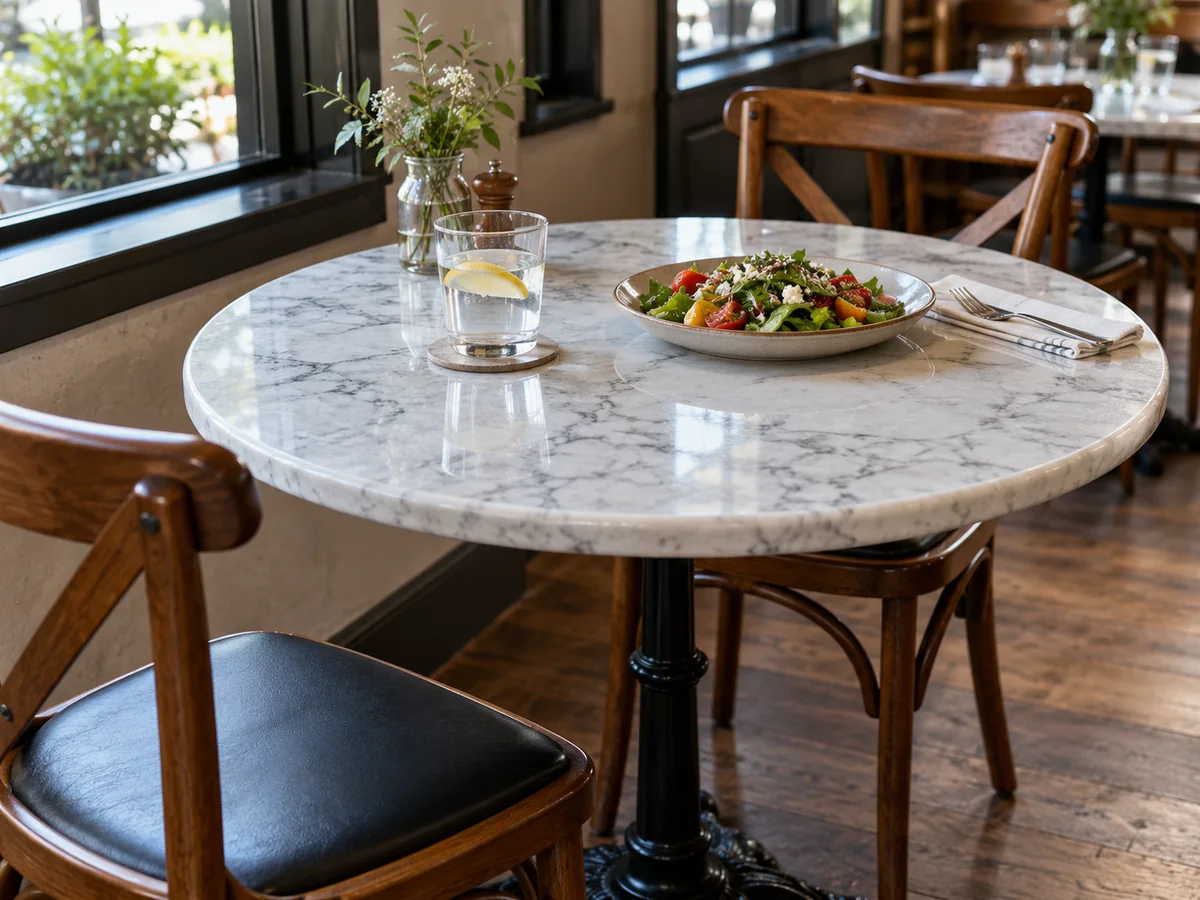
Marble works when its natural appearance is central to the concept and you accept a surface that changes with use. Wine, citrus and vinegar are especially relevant to menu planning: acids can dull or etch calcium-carbonate-rich stone. Granite is generally less sensitive to common food acids, but the particular stone and finish still matter.
The Natural Stone Institute’s care guidance explains the difference between calcareous and siliceous stones. It also notes that an impregnating sealer improves stain resistance rather than making stone stain-proof, and that some stones do not need sealing.
An absorbed stain and a dull etched patch need different treatment. Do not keep scrubbing an acid mark as if it were food residue. Identify the stone and have the appropriate surface treatment restored. For a citrus-heavy dining room that expects an unchanged polished face, we would shortlist another material before marble.
Engineered quartz: easy routine care with heat precautions
Engineered quartz is worth considering for indoor tables when a consistent stone appearance and straightforward cleaning are priorities. Match the finish to the cleaning effort your team can sustain.
For example, Caesarstone’s quartz care instructions call for trivets under hot cookware and explain that some textured or honed finishes need more cleaning than polished finishes. Compare the particular product instead of treating “quartz” as one uniform specification.
Porcelain and sintered surfaces: check edges and support
These products are useful candidates for a stone look where surface care is a concern. Choose the exact product, finish and fabricated construction, including any backing or mounting plate. A thin slab attached to another panel is different from a freestanding slab.
A hard surface still needs careful handling. Cosentino’s Dekton technical manual addresses support and warns against strong impacts that can break the material. On movable restaurant tables, pay particular attention to corners meeting neighboring tables, service carts or doorways.
Solid surface: consider the repair option
Acrylic solid surface is another choice when a uniform appearance and a practical repair route matter. Confirm how the selected product is renewed and how the finish is blended after repair.
For example, the Corian Solid Surface care bulletin describes scratch repair and surface renewal, with professional work needed for some damage and finishes. It also requires protection from hot pots and pans. Include both the repair method and heat routine in your comparison.
Other restaurant table surface options deserve a shorter check:
| Material | When to consider it | Detail to settle first |
|---|---|---|
| Glass | A light visual appearance and a smooth face | Safety-glass specification, protected edges, support and replacement process |
| Stainless steel or coated metal | A metal appearance or a particular service environment | Metal grade, coating, corrosion exposure, edge construction and cleaning method |
| Molded resin or synthetic wood-look products | A repeatable finish or a specific outdoor product | Exact formulation, exposure approval, heat limits and fixing method |
“Resin,” “metal” and “stone” are broad families. Buy the documented construction rather than assuming every member behaves the same way.
How do you check cleanability before ordering?
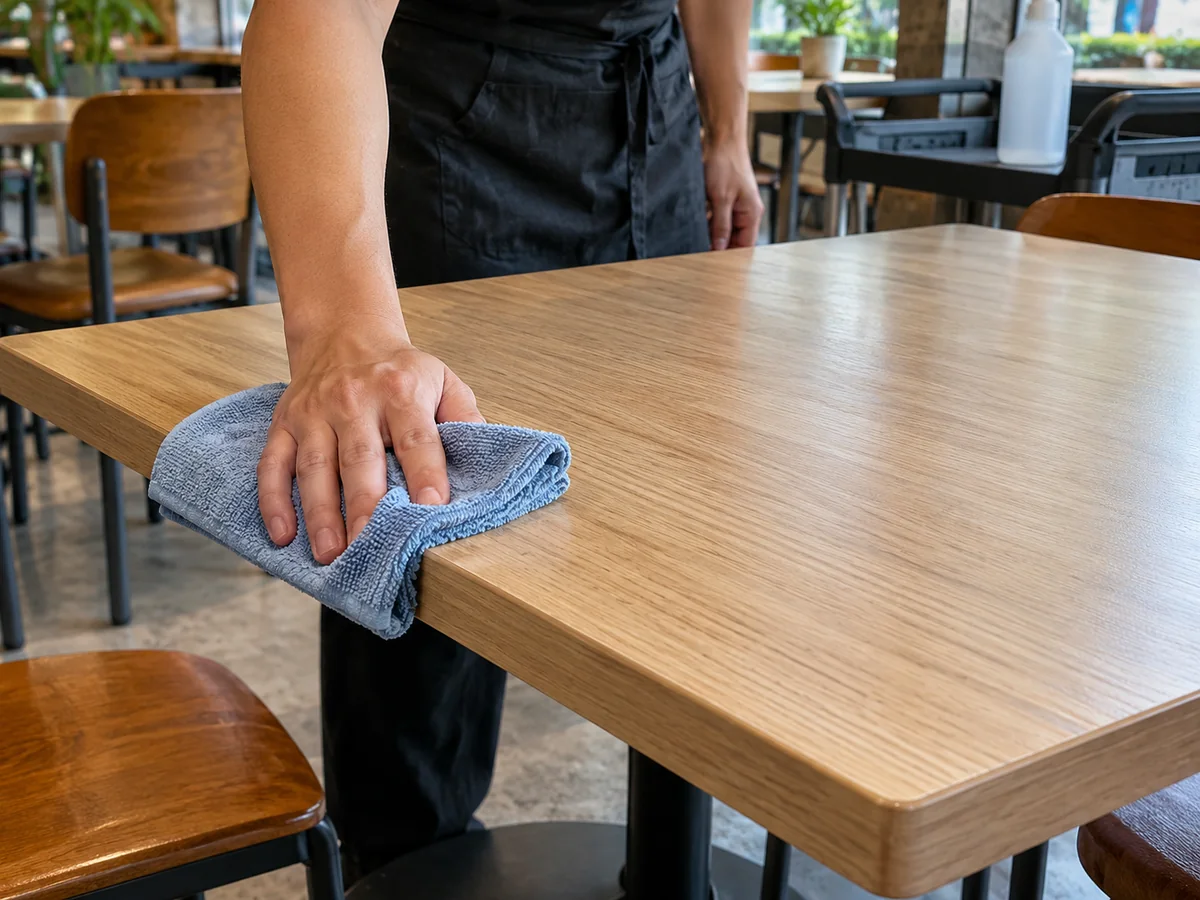
Test the finished sample with your menu and your normal approved cleaning routine. Include the edge and underside details, then inspect the dry surface. This gives you a more useful comparison than a clean sample under showroom lighting.
- Use comparable samples. Request the proposed face, finish, core and finished edge. Keep an untouched sample for reference.
- Choose relevant spills. Use items your staff actually handle, such as coffee, cooking oil, wine or tomato sauce. Set the same agreed exposure time for each sample.
- Clean as staff will clean. Use the named product at its required dilution and contact time, where compatible with the surface. Record the process rather than changing cleaners until each sample looks good.
- Let the samples dry. Check for residue, dull patches, color change, raised joints, swelling or loose edging. View them in daylight and under the planned restaurant lighting.
- Compare the work required. Record wiping, rinsing and drying time as well as the appearance. Repeat the routine to compare how the finished samples respond.
For HPL over a wood-based core, avoid flooding joints. Formica’s care instructions specifically warn that water entering seams can swell the substrate. If the sample develops a raised edge, change the construction or edging detail before ordering; a more stain-resistant face will not solve that route for water.
A surface can wipe clean yet be incompatible with the sanitizer your operation uses. If the required routine damages the finish, choose a compatible finish or an approved alternative cleaning process before purchase.
For easy clean table tops, favor an uninterrupted face and an edge staff can wipe in one pass. For hot pans, heated serving dishes or tabletop appliances, settle the heat-protection arrangement separately. A coffee-spill check does not answer the heat question.
What table top materials work outdoors?
Choose a product expressly specified for your outdoor conditions, with a matching base and fixings. Exterior-grade compact laminate, suitable porcelain or sintered products, and purpose-made metal or resin tops are possible starting points. The product’s exposure limits decide which stays on the shortlist.
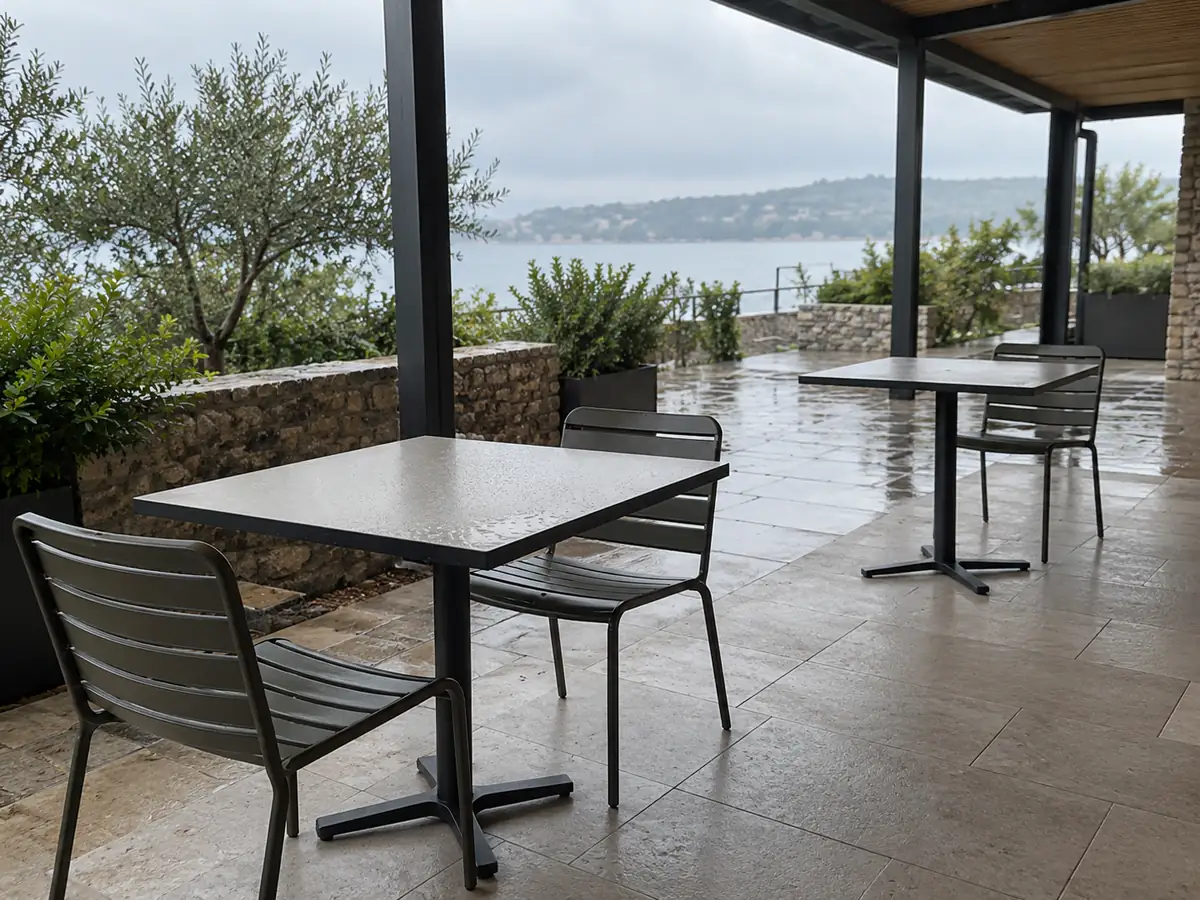
Describe the site as uncovered, roof-covered or enclosed. Add direct sun, wind-driven rain, freezing weather and coastal salt exposure where relevant. A covered terrace can still get wet at its perimeter.
Ask whether the approval covers the top’s face, core, adhesive, edging and mounting parts. Indoor HPL over a moisture-sensitive core is not converted into an outdoor table by adding a metal base. An interior compact laminate panel is not automatically suitable for prolonged sun exposure either.
Also plan how staff will move and store the complete tables. A heavy top may suit a permanent terrace but complicate daily storage. A light assembly needs a separate wind and stability assessment for the site. Confirm the handling and storage method while choosing the material, rather than after the delivery arrives.
Match the table top to the base and chairs
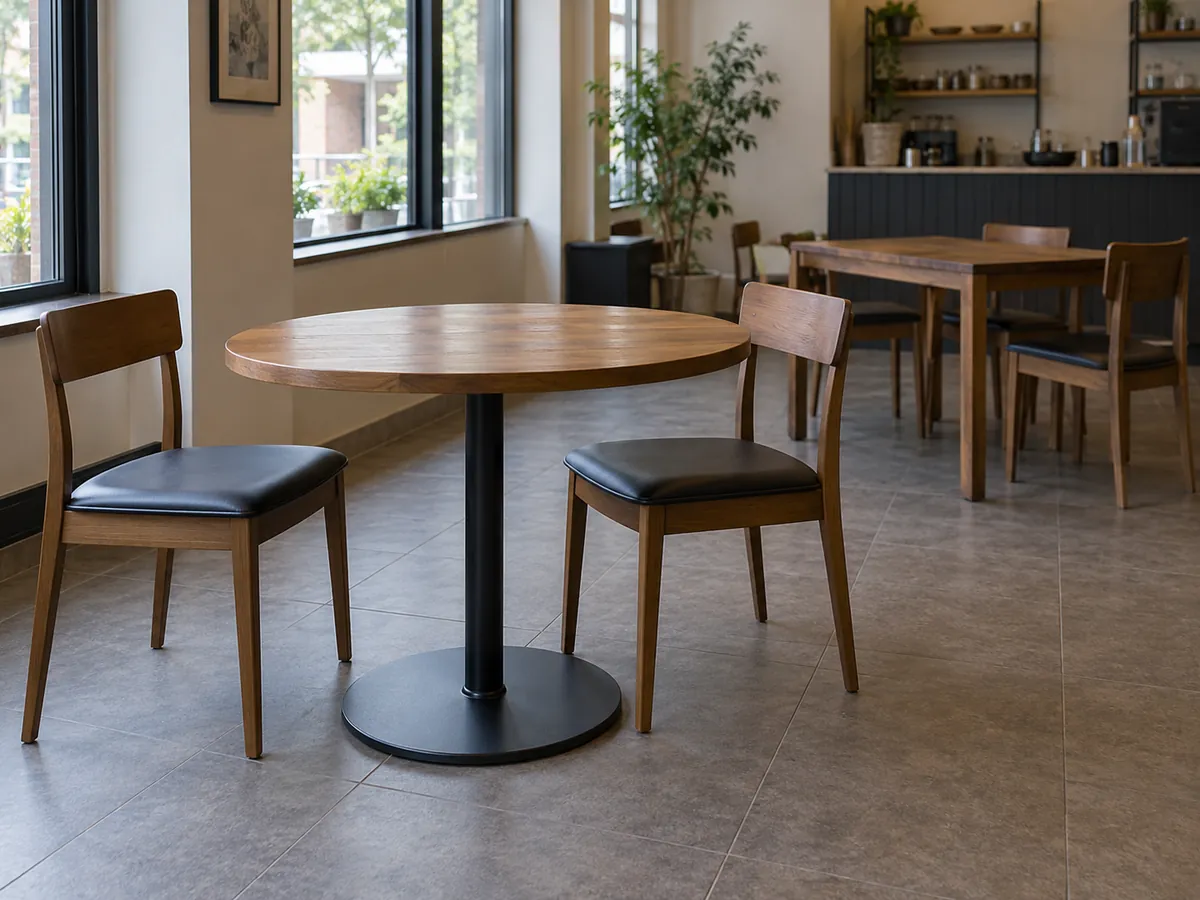
Choose the top and base as one assembly, especially when changing from a light panel to stone. A base’s stated load capacity does not by itself show that the finished table will resist tipping or fit your chairs.
For either a new table or a replacement top, compare:
- Top length, width, shape, actual thickness and weight.
- Base footprint, column height and mounting-plate dimensions.
- The top maker’s support and overhang limits.
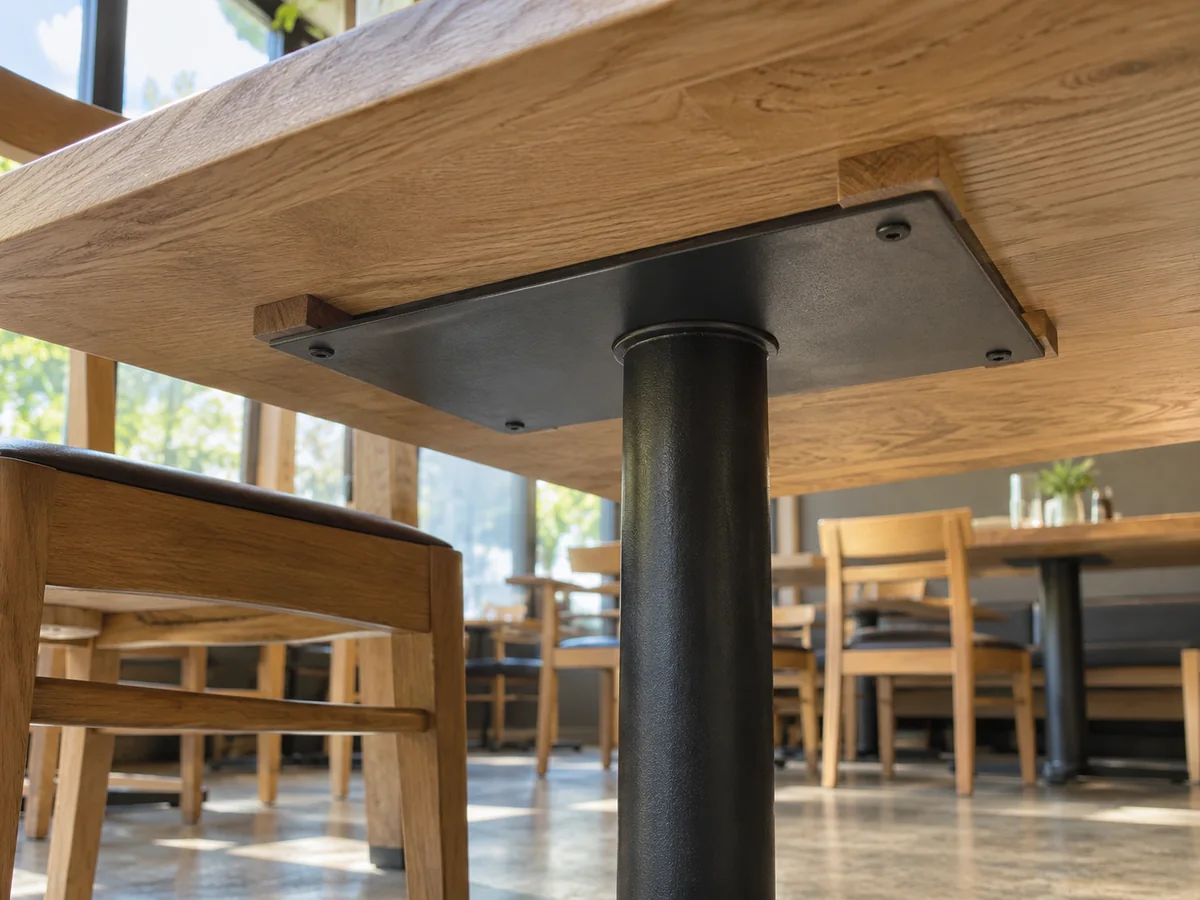
- Fixing positions, permitted screw engagement and any required inserts or backing plate.
- Finished table height and clear space beneath the top, apron and supports.
For example, a thicker top on the same base raises the dining surface and can reduce usable knee space if a deeper apron or backing frame is added. Assemble one complete table with the planned chairs and check how guests sit, how chairs tuck in and whether neighboring tables can join at the same height.
For durable restaurant table tops, the connection is as important as the face. Do not drive ordinary wood screws into a stone slab or guess the fixing depth of a thin panel. Use the specified mounting arrangement. Check the assembled table for rocking and loose connections; correct uneven-floor contact separately from a loose top.
Our restaurant table dimensions guide covers the size and seating side of this decision. Keep the chosen material, base and chair combination together when approving the final dimensions.
Compare table top costs over the same period
Compare the landed, usable table cost and the work it creates. Put quotes on the same size, quantity, construction and delivery basis before judging which material costs less.
Include tops, bases or adapters, packing, freight, applicable import costs, assembly, cleaning labor, repairs and replacements over your chosen period. Ask whether quoted thickness is the full panel or only the visible edge, and whether mounting parts are included.
A simple cleaning-labor calculation is:
Hours = tables × resets per table per day × seconds per reset × operating days × years ÷ 3,600.
Suppose you compare two acceptable finished samples for 20 tables. The second costs $30 more per top. For illustration, assume it takes five seconds less to clean per reset, with four resets per table each day, 300 operating days a year, three years and labor at $15 an hour.
| Difference being compared | Calculation | Result |
|---|---|---|
| Extra purchase cost | 20 × $30 | $600 |
| Cleaning time released | 20 × 4 × 5 × 300 × 3 ÷ 3,600 | 100 hours |
| Labor value of that time | 100 × $15 | $1,500 |
Under those assumptions, the cleaning-time value exceeds the extra purchase cost by $900 before other differences. That is staff capacity released, not automatically a $900 cash saving. Use observed sample times and your loaded labor cost to decide whether the difference is useful. Do not shorten a required sanitizer contact time to achieve the result.
If cleaning takes the same time, that advantage disappears. Then compare repair access, expected replacement needs and landed cost. Use your own service history for replacement assumptions; do not assign every material an invented five- or ten-year life.
What to include in a restaurant table enquiry
Send the intended use and the complete table requirements together. This makes it easier to compare suitable constructions and avoid a quote for a surface that cannot work with your base.
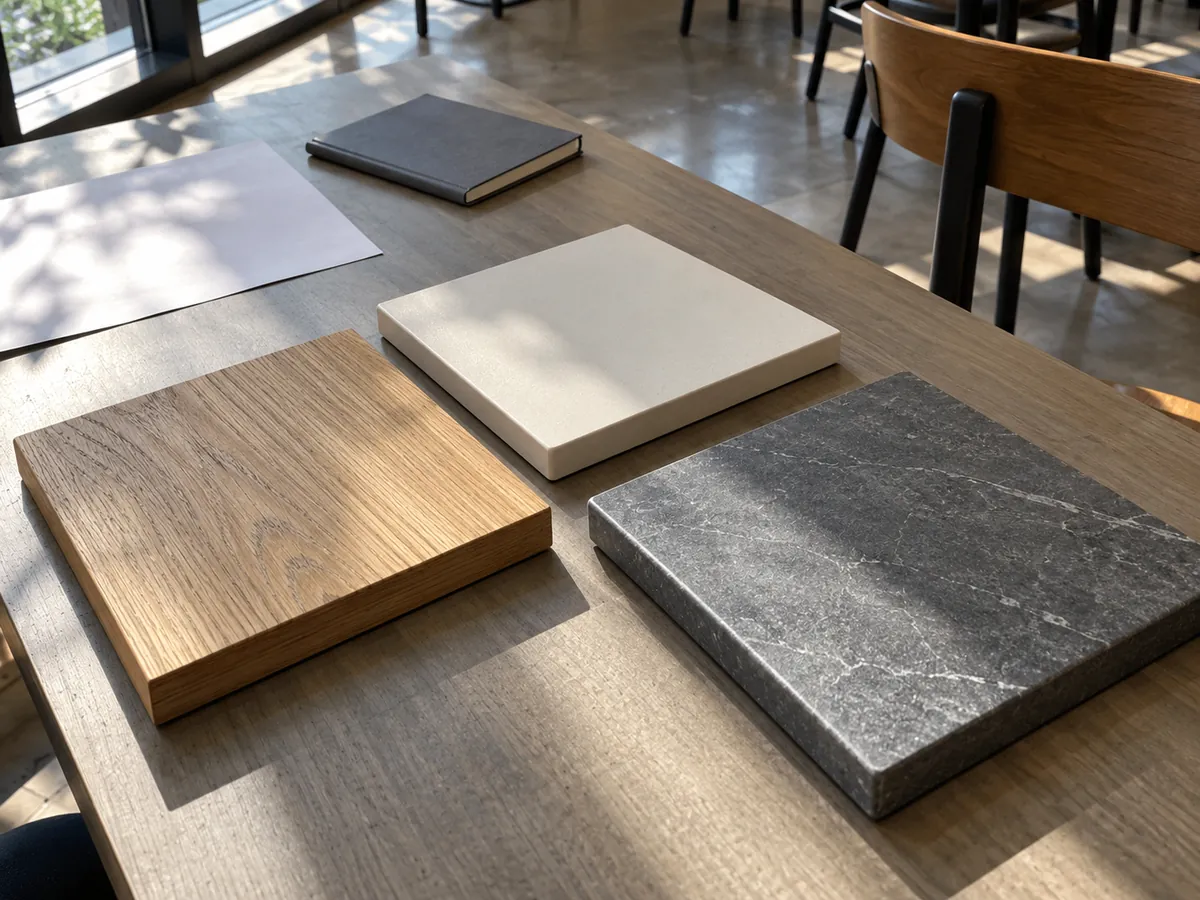
Include dimensions and quantities by size, indoor or outdoor exposure, preferred face and finish, core and edge details, cleaning-product names, base drawings, destination and target schedule. Add a finish sample or reference and state how much grain or color variation you will accept.
For a replacement order, include clear photos of the existing mounting arrangement and measurements between fixing positions. For a new project, agree a finished sample and a complete table sample before approving the batch. Record the approved material and finish codes so a later top order can be compared with the original.
At YeZhi Furniture, start with our dining tables range to explore the available designs. Send your dimensions, quantities and material priorities through our contact page. Discuss the construction for the chosen design rather than assuming every material in this guide is offered on every table.
A practical final choice
For most busy indoor dining areas, begin your restaurant table top materials comparison with a well-specified HPL construction. Choose solid wood when its feel and repair potential justify the care. Shortlist suitable porcelain or sintered products when a stone look and service-friendly care matter; choose marble when you accept its particular upkeep and patina.
Then make the final decision on the finished table: surface, core, edges, cleaner compatibility, support and base together. A sample that fits your service routine is a better starting point than a material name alone.
Frequently asked questions
Is a marble-look table top made from marble?
No. A marble pattern can be printed on HPL or appear on porcelain, resin and other surfaces. Request the face material, core or backing, and edge section. Use the care instructions for that construction, not instructions for natural marble.
Why do restaurant tables become sticky after cleaning?
Residue is one possible cause; a damaged or softened finish is another. First clean a small area with the finish maker’s approved method, including any required rinse and drying. If the dry surface remains tacky or the finish lifts, stop applying stronger cleaners and arrange a finish assessment. Record the cleaner, dilution and routine so the cause can be investigated.
Do all restaurant table tops need sealing?
No. Sealing depends on the actual material and finish. Some natural stones benefit from an impregnating treatment; others do not need it. Laminates and engineered surfaces have their own care instructions. Do not add a generic stone or wood sealer to an unfamiliar top without checking its compatibility.
Are thicker table tops always more durable?
No. Thickness alone does not tell you how the face, core, edge or attachment will perform. A thick-looking rim can hide a thinner main panel. Compare a section drawing, actual weight, support requirements and finished sample before paying more for thickness.
Can you replace the top and keep an existing table base?
Yes, if the new top fits the base’s permitted size, weight, support and fixing arrangement. Check finished height and chair clearance as well. When changing material or increasing size, have the complete assembly checked rather than relying on the old top’s screw pattern.