Quick answer
To style a coffee table, start with one visual anchor, add one or two supporting objects at different heights, include texture or an organic element, and deliberately leave part of the tabletop empty. The best arrangement changes with the table shape: keep round tables compact, rectangular tables directional, oval tables aligned with the long axis, square tables balanced rather than filled corner to corner, and glass tables visually lighter.
For hotels, cafés, reception areas and other commercial lounges, we use the same styling principles with additional checks for usable surface, seated sightlines, cleaning, reset and circulation.
| Coffee table | Best starting layout | Main risk |
|---|---|---|
| Round | One compact central cluster | Scattering small objects around the edge |
| Rectangular | Two or three visual zones along the length | Turning décor into a straight row |
| Oval | One low arrangement following the long axis | Making both curved ends visually heavy |
| Square | Central or diagonal composition | Filling all four corners equally |
| Large square | One larger anchor plus one supporting element | Adding too many small pieces |
| Glass | Fewer, stronger opaque objects | Visual clutter from reflections and see-through layers |
A simple 4-step coffee table styling formula
Start with the table as an empty surface. The goal is to create one readable composition with enough contrast, height variation and negative space to feel intentional—without making the tabletop look crowded or unavailable.
For a home, the arrangement can be highly personal. In a hotel, reception area or commercial lounge, the same composition also needs to be repeatable, stable and easy to reset.
What to put on a coffee table
A strong coffee table arrangement usually needs only a few object types. We recommend choosing pieces by role rather than filling the surface with decoration: one item can create height, another can organize smaller objects, and another can add texture or an organic shape.
| Object | What it adds | How we use it |
|---|---|---|
| Books | A low visual base and controlled height | Use one compact stack instead of several scattered piles. |
| Tray | Structure and a clear boundary | Group small pieces so the composition reads as one unit and can be moved more easily. |
| Vase or greenery | An organic shape and softer texture | Keep the scale appropriate to the table and avoid blocking seated views. |
| Bowl | A low anchor with visual weight | Useful when the arrangement needs presence without more height. |
| Sculptural object | Character, contrast and a focal point | Choose one stronger piece before adding several smaller ornaments. |
| Candle or decorative light | Warmth and atmosphere | Use only where the venue’s operating and fire-safety rules allow it. |
| Venue or branded object | Connection to the space | Keep it subtle so the table still feels like furniture rather than signage. |
How to style a round coffee table
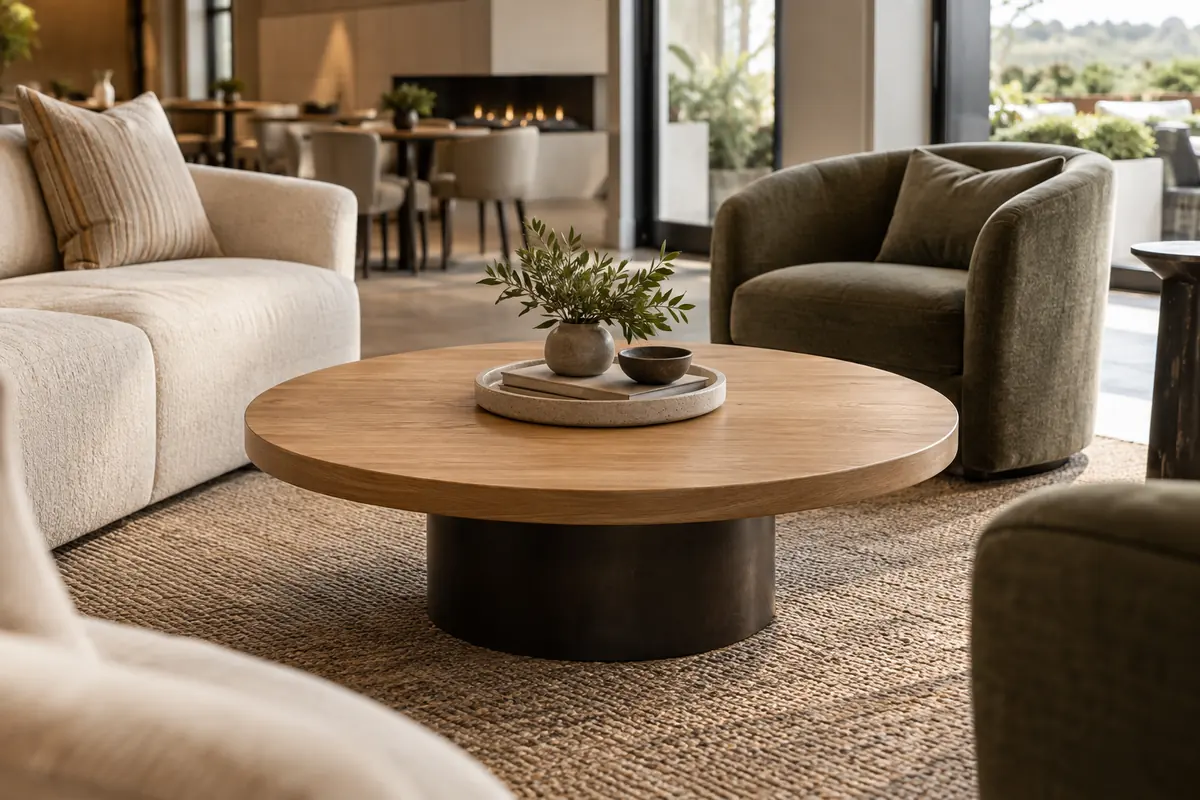
For a round coffee table, build one compact composition around the center and keep a clear ring of usable surface around it. A round top has no natural “ends,” so several unrelated groups can quickly make the table look scattered.
Best starting layout
- Use one visual anchor near the center: a round tray, shallow bowl, low book stack or compact arrangement.
- Create three different visual weights rather than three identical objects: for example, one low stack, one medium object and one soft or organic element.
- Keep the tallest item slightly off-center so the composition looks natural instead of symmetrical and rigid.
- Leave enough open edge for actual guest use.
How to style a rectangular coffee table
For a rectangular coffee table, divide the long surface into two or three zones instead of lining objects evenly from one end to the other. The long axis gives you room for contrast, but it also creates the common mistake of turning décor into a row.
A practical two-zone arrangement
Place the main decorative grouping toward one end and keep the opposite end mostly open for drinks, books or everyday use. In reception areas and café lounges, that open zone also makes the surface more practical for guests.
When to use three zones
On a longer table, use a low group, a quiet middle zone and a second smaller group. The second group should support the first rather than compete with it. Avoid putting equally tall objects at both ends; the table can start to feel staged rather than relaxed.

How to style an oval coffee table
Treat an oval coffee table as an elongated round table: follow the long axis, keep the ends light and avoid a rigid centerline. The curved ends already soften the layout, so the styling should preserve that visual flow.
We recommend one low anchor placed slightly off center, with one smaller companion element extending along the long axis. Keep the narrow ends relatively clear. This leaves the outline visible and makes the table easier to approach from several seats.

Example: YeZhi Gyro oval coffee table
The Gyro Oval Coffee Table has an approximate drawing size of 43.3 × 23.6 × 15.8 in / 110 × 60 × 40.2 cm, with a wood-top direction and slim metal frame shown in the supplied product images. For this proportion, we would keep the styling long and low: one compact tray or book stack, one smaller object, and a clear end for guest use.
The dimensions above are model-specific and come from the supplied drawing for this product. Custom requirements should be confirmed for the actual project.
How to style a square coffee table
For a square coffee table, think in quadrants but do not fill every quadrant. A square top naturally creates four equal areas; styling all four often makes the surface look like a display grid.
Start with a central grouping that reaches into two or three quadrants while leaving at least one area visibly open. Another option is diagonal balance: place the main group toward one corner and a smaller low element toward the opposite corner.

How to style a large square coffee table
A large square table needs more scale, not necessarily more objects. Use a larger tray, a broader book stack or one substantial sculptural piece, then add one smaller supporting element. In commercial seating groups, preserve multiple access points so people seated on different sides can still use the table.
How to style a glass coffee table
Glass coffee tables usually look better with fewer, larger objects and one opaque anchor. Because you can see through the top, every object, cable, lower shelf and floor surface becomes part of the composition.
- Use a tray, book stack or textured mat to create a visible base for small items.
- Choose a few objects with clear silhouettes instead of many transparent or reflective pieces.
- Check the view from above and from seated eye level; the underside matters more on a glass table than on an opaque top.
- Use coasters, felt pads or other surface protection appropriate to the actual glass/top specification, especially under hard decorative pieces.
- Keep the reset simple. Fingerprints, crumbs and water marks are more visible on glass, so staff should be able to clear and wipe the surface quickly.

How to style a coffee table by material
Shape controls placement, but the tabletop finish changes which objects look balanced. We recommend using contrast in material, tone or texture so the accessories do not visually disappear into the table or compete with an already strong surface.
Three easy coffee table styling formulas
If you want a repeatable starting point, use one of these simple formulas and then adjust the scale to the table. The goal is not to copy the same objects everywhere; it is to control the number of visual roles in the composition.
Useful when the table needs to stay calm and highly functional.
Works well with warm wood and softer hospitality interiors.
Useful on stone, black, glass or visually strong tables.
What changes the formula: increase the scale of the anchor on a larger table before adding more pieces. On smaller tables, reduce the object count rather than shrinking every object until the composition becomes visually weak.
Coffee table styling for hotels, cafés and commercial lounges
Once the basic styling works, commercial spaces add a second decision layer: how the table performs during real use. The arrangement needs to suit the venue, turnover pattern and way guests use the surface—not only the shape of the table.
| Commercial setting | Default styling direction | Main risk | What to keep clear |
|---|---|---|---|
| Hotel lobby | Low, calm composition with one strong anchor and restrained height. | Tall décor interrupting conversation or reception sightlines. | Guest-facing edge and the part of the surface used for drinks or documents. |
| Reception / waiting area | Minimal grouping that can coexist with brochures, forms or temporary guest items. | Decorative clutter making the table feel unavailable for use. | One obvious functional zone near the most accessible seats. |
| Café lounge | Compact, wipeable styling with few movable pieces. | Small loose objects being moved, spilled on or lost during turnover. | Service area for drinks and light food. |
| Serviced apartment / model room | More layered and residential, but still easy to reset. | Photo-ready styling that is awkward for real occupants. | Space for books, devices and everyday guest use. |
| Coworking lounge | Very light styling; prioritize work surface over decoration. | Objects competing with laptops, notebooks and chargers. | Largest practical portion of the top. |
Five coffee table styling mistakes we would avoid
| Problem | What goes wrong | Better check |
|---|---|---|
| Filling the entire top | The table becomes decorative only and guests have nowhere obvious to place items. | Clear the table first and reserve the functional zone before styling. |
| Using several equally tall objects | The arrangement creates a visual wall across the seating group. | Sit in the surrounding chairs and check the sightline before approval. |
| Adding many small loose pieces | The surface looks busy and takes longer to reset and clean. | Group small pieces on one anchor or reduce the object count. |
| Ignoring the table shape | The arrangement fights the geometry: a round table looks scattered or a long table looks like a row. | Use the shape-specific layout above as the starting structure. |
| Styling before checking circulation | The seating group can look good in a photo but still be awkward in a real project. | Confirm the furniture footprint and required access route first; décor comes afterward. |
Commercial layout and accessibility come before decoration
A styling rule is not a building-code clearance. When a coffee table sits beside a main circulation route, keep the table and its decorative objects inside the approved seating footprint and confirm the local access requirements for the project.
For U.S. projects, the U.S. Access Board guide to accessible routes explains that required clear width cannot be reduced by other elements. Use the applicable local code and project drawings for final approval rather than treating a furniture-styling guideline as a compliance dimension.

Before you finalize the coffee table arrangement
Review the composition from the seats that actually face the table—not only from above or from the camera angle used for styling.
- Usable surface: Is there an obvious clear area for the way the table will actually be used?
- Sightline: Can seated guests see and talk across the table without a decorative object becoming a visual wall?
- Scale: Does the anchor feel large enough for the table without needing many small filler objects?
- Stability and care: Are hard, fragile or unstable objects appropriate for the tabletop and venue?
- Reset: Can the arrangement be moved, cleaned around and returned to a clear position without unnecessary steps?
- Circulation: Is the styling contained within the approved furniture footprint rather than extending into a required path?
If the table itself is not locked yet, solve that decision first
Decorating and specifying are different decisions. If you are still choosing the table, start with the seating plan, intended use, material direction and maintenance requirement before you choose the accessories.
You can review YeZhi’s commercial coffee table range and lounge chair range when coordinating a complete seating group. Once the furniture geometry is right, the styling becomes much easier.
FAQ
How much of a coffee table should be left empty?
There is no universal percentage. Leave a clearly usable portion of the tabletop open, then adjust the arrangement to the table size and intended use. A coworking lounge may need substantially more clear surface than a model room or decorative reception setting.
Should coffee table decor match the shape of the table?
It should respond to the shape, but it does not have to copy it. A round table can use a round tray, but a contrasting shape can also work. Placement matters more: keep round layouts compact, rectangular layouts directional, oval layouts aligned with the long axis and square layouts balanced without filling all four corners.
Can I use a tall vase on a coffee table?
Yes, if it does not block seated sightlines and is stable enough for the setting. In hotel lobbies and reception areas, we usually favor lower arrangements because guests need to see and talk across the seating group.
What is the easiest coffee table setup to maintain?
One anchor plus two supporting elements is usually easier to reset than many independent objects. Choose pieces that can be moved together, wiped around quickly and replaced in an obvious position.
How should nested coffee tables be styled?
Treat the nested set as one composition. Put the main styling on the largest table and keep the smaller table mostly available for use. If both tables carry full decorative groupings, the set can become visually crowded and less flexible.
Planning a coffee table and lounge seating package?
Send us the project type, seating dimensions or layout, preferred coffee table shape, target size, finish direction, quantity and destination. We can review the furniture configuration before quotation so the table works with the seating group rather than relying on styling to solve a layout problem later.
Send Your Coffee Table Project Details