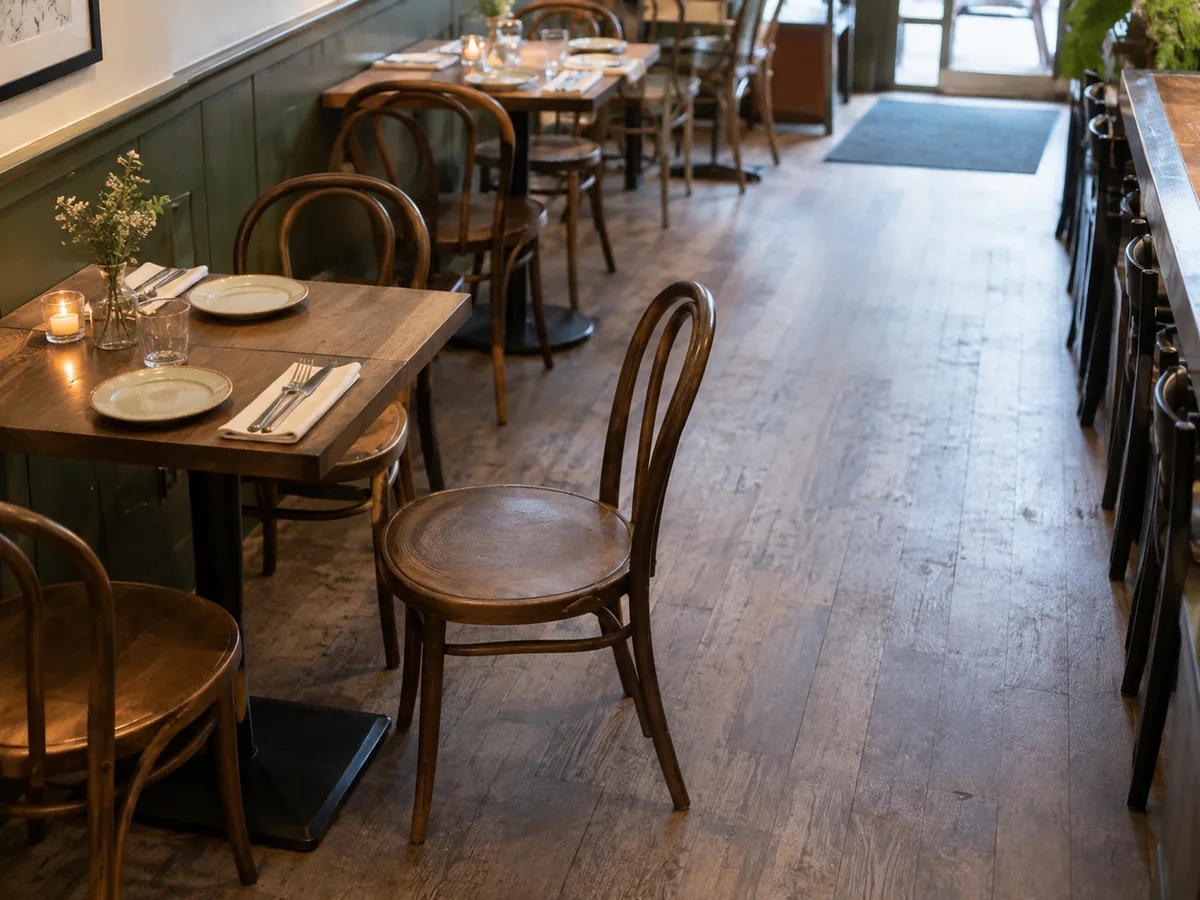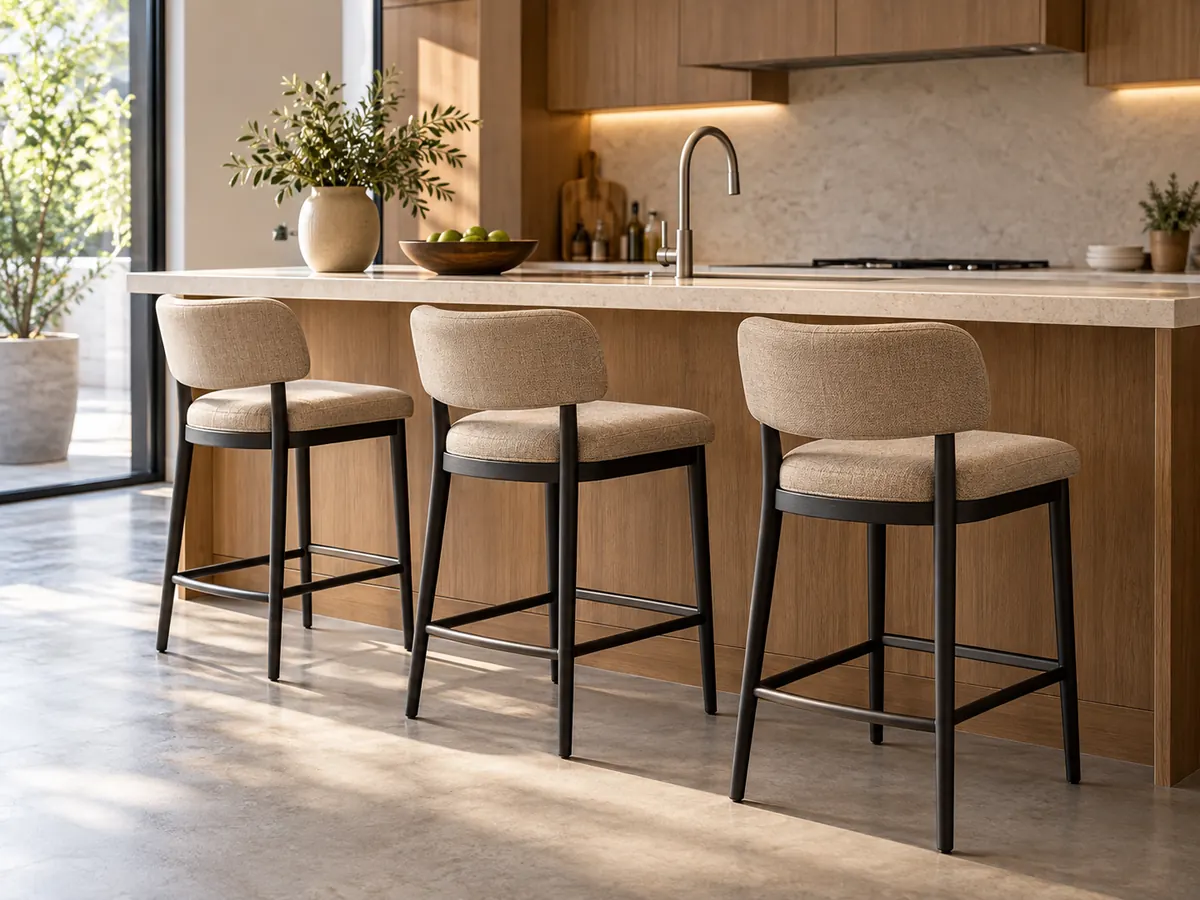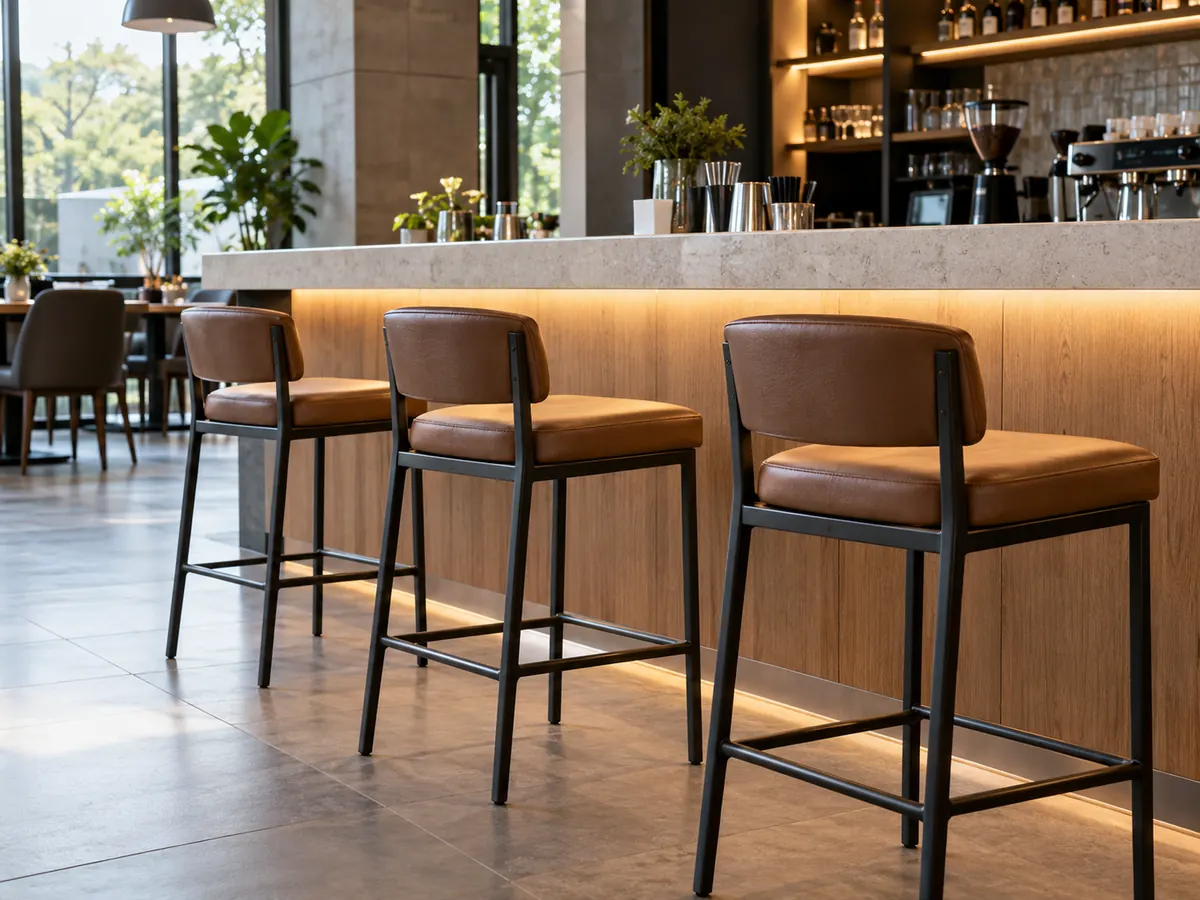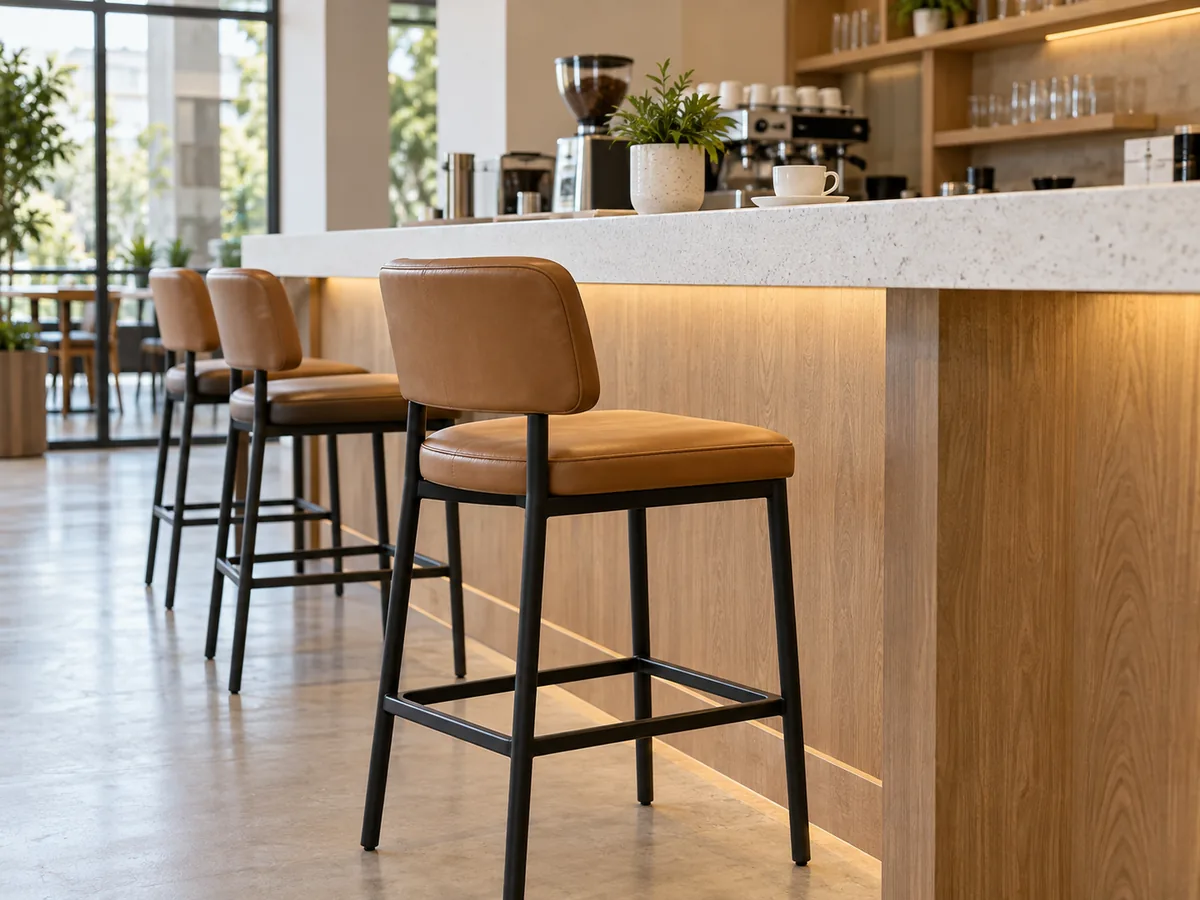
When people search for dining room chair height, the number that usually matters is seat height—the distance from the finished floor to the sitting surface. Overall chair height can change dramatically with backrest design, but it does not tell you whether the chair will fit a dining table.
For restaurant, café, hotel, dealer, and furnishing projects, we recommend using standard dimensions only as a first filter. The final decision should be made from the chair drawing and the actual table geometry. A chair can have a familiar seat height and still fail because of a deep apron, a thick tabletop, high armrests, a sloped seat, or upholstery compression.
Default recommendation: start around 18 in / 46 cm seat height for a standard dining-table application.
Change condition: move away from that benchmark when the table height, lowest underside point, seat construction, or user requirement changes.
Main risk: choosing from tabletop height alone and discovering too late that the apron, arms, or seat geometry reduces usable clearance.
Required check: measure the actual chair and table relationship before quotation or production approval.
What Is the Standard Dining Room Chair Height?
For selection and project planning, 18 in / 46 cm is a useful standard dining room chair seat-height benchmark. A broader market selection range often runs roughly from 17–20 in / 43–51 cm, but that broader range should not be treated as one universal specification.

We use the 18 in / 46 cm figure as a starting point because it sits near the center of common dining-chair geometry and pairs with many standard-height dining tables. The final height still depends on the table and the chair design.

| Measurement | Planning reference | How to use it |
|---|---|---|
| Dining chair seat height | 18 in / 46 cm benchmark | Start here, then verify the actual model and table. |
| Common dining-chair selection range | About 17–20 in / 43–51 cm | Use as a search/filter range, not a guaranteed fit range. |
| Standard dining table height | About 28–30 in / 71–76 cm | Measure the actual table, including the lowest underside obstruction. |
| Overall chair height | Model-specific | Backrest height affects appearance and support, not the primary chair-to-table fit calculation. |
Dining Room Chair Seat Height Is Only Half the Fit Check
The fastest way to avoid a bad chair-and-table match is to separate two questions that are often mixed together.
Check 1: Is the seat proportionally matched to the table?
A common planning relationship is roughly 10–12 in / 25–30 cm between the seat top and the tabletop level. This gives a fast proportion check for standard dining furniture. It is useful for screening combinations, not for approving them.
For example, an 18 in / 46 cm seat paired with a 30 in / 76 cm tabletop gives a 12 in / 30 cm difference. That is a familiar starting relationship.
Check 2: Is there enough real space under the table?
This is the check that controls actual fit. Measure from the finished floor to the lowest obstruction where the sitter’s thighs, knees, or chair arms need to pass. That obstruction may be the underside of the tabletop, a timber apron, a metal rail, a frame, or another structural element.
Then compare that measurement with the chair’s seat height and, for armchairs, the arm height. We do not recommend applying one universal “apron clearance” number to every table construction. A deep apron and a thin open tabletop can have the same tabletop height but very different usable space.
- Measure finished floor to tabletop.
- Measure finished floor to the lowest relevant underside obstruction.
- Measure chair seat height at the actual sitting zone.
- For armchairs, measure floor to the top of the arm.
- Check the proportional seat-to-table relationship, then check actual underside and arm clearance separately.
- For a high-risk or custom project, test the actual chair/table combination or approve a representative sample before the bulk order.

If your project also needs width, depth, footprint, and space-planning dimensions, use our standard dining chair dimensions guide for those adjacent measurements. This page remains focused on vertical height and table fit.
Are Dining Room Chairs With a 20-Inch Seat Height Standard?
We would not use 20 in / 51 cm as the universal default for a standard dining room chair. The search results for this size can be confusing because some retail pages describe 20 inches as “standard,” while many other current sizing guides center standard dining seats lower.
A 20 in / 51 cm seat can still be correct. The right question is not “Is 20 inches standard?” but “Does this 20-inch seat fit this table and this use?”
| 20 in / 51 cm seat condition | Our decision | What to verify |
|---|---|---|
| 30 in / 76 cm table with thin/open underside | Possible | Check the real underside and sitting comfort. |
| 30 in / 76 cm table with a deep apron | High risk | Measure floor-to-apron-bottom and compare with the actual seat. |
| 28–29 in / 71–74 cm table | Usually not our first choice | Do not approve from tabletop height alone; usable clearance may become tight. |
| Thick upholstered 20 in / 51 cm seat | Needs physical confirmation | Check the supplier’s measurement method and seated compression. |
| 20 in / 51 cm armchair | Needs two clearances | Check both leg/thigh space and arm-to-apron clearance. |

This is especially important in commercial projects where changing hundreds of chairs after delivery is far more expensive than checking the geometry before approval.
Starting Seat Heights for 28, 29, and 30-Inch Dining Tables
The table below is a selection filter, not a product guarantee. It helps narrow chair candidates before you check the actual underside.
| Tabletop height | Seat-height starting point | What can change the answer |
|---|---|---|
| 28 in / 71 cm | About 17–18 in / 43–46 cm | Thick top, apron depth, seat padding, user mix. |
| 29 in / 74 cm | About 18–19 in / 46–48 cm | Lowest underside point, seat slope, upholstery compression. |
| 30 in / 76 cm | About 18–19 in / 46–48 cm as the safer default; 20 in / 51 cm is conditional | Apron/frame depth, arm height, actual seated position. |

If the table is still being selected, compare chair candidates and table geometry together rather than finishing one specification first. Our commercial dining table range can be reviewed alongside the chair shortlist so the dimensional relationship stays visible.
How to Measure Dining Room Chair Height Correctly
A seat-height number is only useful when everyone measures the same point. Before comparing models, define the measurement method.
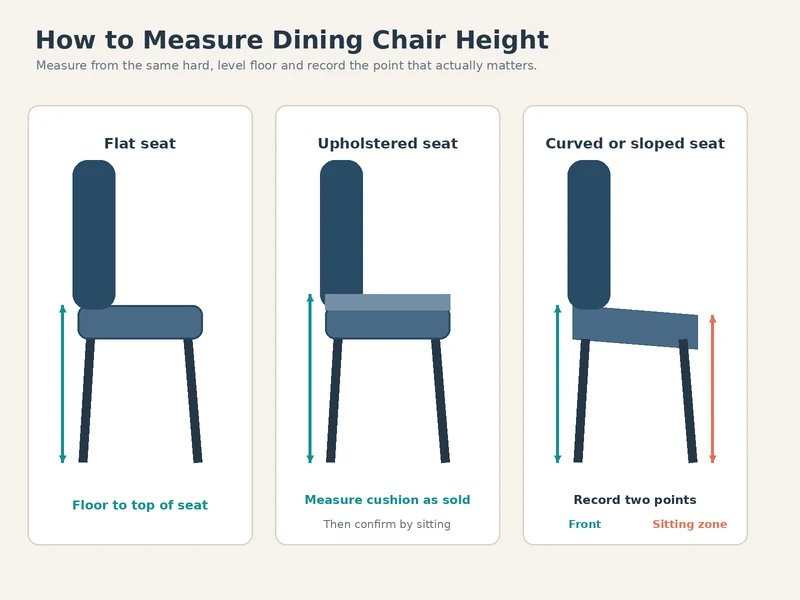
Flat wood, metal, or molded seat
Place the chair on a hard, level finished floor. Measure vertically from the floor to the top of the primary sitting surface.
Upholstered seat
Record the specified uncompressed seat height shown on the current drawing or product specification. If cushion compression materially affects the project fit, verify the effective seated height with a physical sample instead of estimating it from foam thickness alone.
Sloped or curved seat
Do not compare only the front edge with a flat-seat chair. Record the measurement point used by the drawing and identify the main sitting zone. If the design slopes substantially, a sample check is the safest way to resolve the real sitting position.
Finished floor matters
Measure from the final floor level. Thick rugs, raised platforms, floor transitions, or a table installed on a different finished level can change the real relationship enough to matter on a tight fit.
Why a “Standard” Chair Can Still Feel Too High
Most height failures come from an interaction between several dimensions rather than from one obviously wrong chair number.
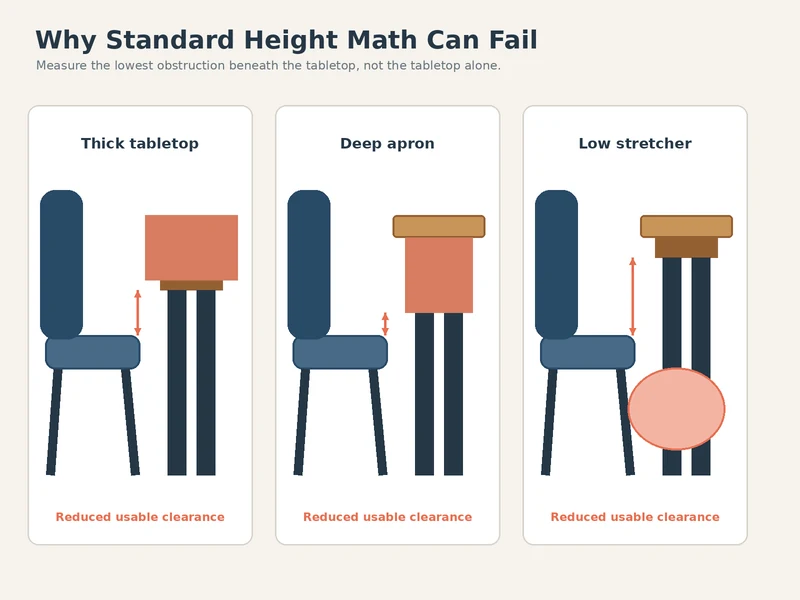
Deep table apron or frame
The tabletop may be 30 in / 76 cm high while the lower frame sits several inches below it. If the chair is selected from the 30-inch number alone, the usable thigh space can be much smaller than expected.
High armrests
An armchair can have a correct seat height but still refuse to slide under the table. Measure the top of the arm against the table’s lowest relevant underside point.
Soft upholstery
A plush seat may compress noticeably under load. That can improve one clearance while changing the user’s elbow relationship to the tabletop. Do not convert cushion thickness directly into “seated height” without a sample or a confirmed test method.
Seat slope
A chair that lists the same nominal height as another model may place the sitter lower at the rear of the seat. Compare measurement methods, not just headline numbers.
Commercial Project Height Check Before You Order
For a single dining set, a small mistake is inconvenient. For a restaurant, café, hotel, dealer program, or multi-location project, the same mistake can become a specification and replacement problem. We recommend documenting the fit inputs before the chair model is locked.
- tabletop height in inches and centimeters;
- floor-to-lowest-underside measurement;
- table apron/frame drawing or a clear dimensioned photo when the underside is complex;
- target chair model or design;
- seat height and the measurement point used on the drawing;
- arm height for armchairs;
- whether the seat is hard, lightly upholstered, or deeply upholstered;
- project quantity and whether a sample fit check is needed before bulk approval.

If you are still comparing styles, start with our commercial dining chair collection, then request the current drawing for the shortlisted model. We do not recommend transferring a generic 18 in / 46 cm benchmark onto a specific SKU without checking that SKU’s current specification.
Accessibility: Do Not Treat Chair Seat Height as the ADA Rule
For U.S. projects, accessibility requirements should be handled separately from general dining-chair sizing. The U.S. Access Board ADA Accessibility Standards address accessible dining surfaces and related clear floor, knee, and toe space. Section 902.3 places the tops of applicable dining surfaces at 28 in / 71 cm minimum to 34 in / 86.5 cm maximum above the finished floor.
That requirement is not a universal movable dining-chair seat-height standard. Project teams still need to check the applicable federal, state, local, and project-specific accessibility requirements for the actual layout and furniture scope.
Dining Room Chair Height FAQ
What is the standard height of a dining room chair?
If “height” means seat height, use 18 in / 46 cm as a practical planning benchmark. Common dining-chair products can fall around 17–20 in / 43–51 cm, so the actual model must still be checked against the table.
What is the standard dining room chair seat height?
For a standard-height dining table, 18 in / 46 cm is a strong starting point. We recommend treating it as a planning value, not a universal model specification.
Is a 20-inch seat height too high for a dining chair?
Not always. A 20 in / 51 cm seat can work with some 30 in / 76 cm tables, but it is more sensitive to tabletop thickness, apron depth, upholstery, and arm height. We would verify the real underside before approving it.
What seat height works with a 30-inch dining table?
Start around 18–19 in / 46–48 cm for a conventional 30 in / 76 cm dining table. A 20 in / 51 cm seat is conditional. Measure the lowest underside point before making the final selection.
Should I measure to the tabletop or the apron?
Use the tabletop to make a quick proportional check, then measure to the lowest underside obstruction for the real fit check. The lower point is what can limit thigh, knee, and arm clearance.
Does overall dining chair height matter?
Overall height matters for back support, visual scale, storage, and room appearance, but seat height controls the basic sitting position at the table. Do not use overall back height as a substitute for seat-height measurement.
Need us to check a chair-and-table combination? Send the table height, lowest underside measurement, chair style or model, arm requirement, and project quantity through our contact page. We can use those dimensions to narrow the fit question before quotation or production approval.