Side table height looks simple until the same table is placed beside different sofas, lounge chairs, or reception seating. A table that feels natural next to one chair can be awkwardly high or low next to another. For commercial projects, that mismatch can spread across dozens of rooms or seating groups.
We recommend using a relationship rule rather than choosing from a generic “standard side table height” alone. The table should support a comfortable seated reach, work with the actual arm height, and fit the intended use. The final height should then be confirmed on the drawing or product specification before production.
What Is the Standard Side Table Height?
Published sizing references do not all use the same range. Wayfair lists 18–28 in / 46–71 cm, while Dimensions.com emphasizes matching the nearest sofa or chair arm. That is why we use 18–28 in / 46–71 cm only as a broad screening range, not as a universal standard.
For project planning, the stronger default rule is simple: measure the adjacent sofa or chair arm, then start with the side-table top at about the same height or up to 2 in / 5 cm lower. The final choice should be checked with the actual seating and intended use.
| Measured arm height | First side-table height to screen | How to use the number |
|---|---|---|
| 20 in / 51 cm | 18–20 in / 46–51 cm | Planning range only; verify seated reach. |
| 22 in / 56 cm | 20–22 in / 51–56 cm | Planning range only; verify the actual seating model. |
| 24 in / 61 cm | 22–24 in / 56–61 cm | Planning range only; confirm final floor-to-top height. |
| 26 in / 66 cm | 24–26 in / 61–66 cm | Planning range only; check reach and visual proportion. |
These examples apply the same-height-to-2-in-lower relationship. They are not dimensions for a specific YeZhi model.
Published side-table ranges are useful for early screening, but they are not a formal industry height standard and they do not replace the actual seating measurement. We use outside references to understand common market ranges and fit rules. For a YeZhi project, the final recommendation comes from the measured seating relationship and the confirmed table specification.

Why Sofa or Chair Arm Height Is the Better Reference
The side table is normally used while a person is seated. That makes the relationship between tabletop and armrest more useful than a standalone table number. When the tabletop is near the armrest, a guest can usually reach a drink, phone, menu, or small personal item without an exaggerated shoulder lift or deep lean.
The default changes when the seating changes. Low-profile lounge seating may need a lower table. A high-arm sofa may need a taller table. Armless chairs remove the easiest reference point. In that case, check seated reach—how far a person can reach without leaning—plus seat height, how much the cushion sinks when occupied, and what the tabletop will be used for.
How to Measure Side Table Height for a Project
1. Measure from the finished floor
Measure vertically from the finished floor to the top of the usable sofa or chair arm. Use the actual production seating or the approved drawing when possible. Do not measure from the seat cushion and assume it equals the arm height.
2. Define what the side table must do
A table used mainly for drinks and personal items can follow the arm-height relationship closely. If the surface will support laptops, frequent food service, display pieces, lamps, or other special functions, a different height may be more practical. The use case should be stated before the table height is locked.
3. Confirm the finished overall table height
For bulk and custom orders, confirm the final floor-to-top height after the top, frame, feet, glides (the small feet or floor protectors under the table), and any structural changes are included. A concept drawing can look correct while the final height changes after the top thickness or base details are revised.

When the Side Table Height Rule Changes
The arm-height rule is a strong default, but it is not the right control point for every table or chair. Use the change condition below before approving a height.
| Situation | What changes | Required check |
|---|---|---|
| Recliner | Arm height is still a useful starting point, but movement clearance becomes equally important. | Check the chair fully upright and fully reclined so the table does not interfere with the footrest, back movement, or access. |
| Armless chair or chaise | There is no armrest reference. | Use seated reach, seat height, and the actual table position. Confirm that a person can use the surface without a deep lean. |
| C-shaped or over-seat table | The top may pass over the seat, so arm height no longer controls the design. | Check seat-to-top clearance, leg room, cushion compression, and whether the base clears the chair or sofa underframe. |
| Lamp table | The table and lamp work as one setup. | Check the seated eye line, shade position, glare, and the space needed for the lamp base before fixing the table height. |
| Laptop, food, or active task use | Task posture can override the arm-height default. | Check hand position, working posture, top clearance, and stability for the intended task. |
Living Room and Commercial Lounge Side Table Height
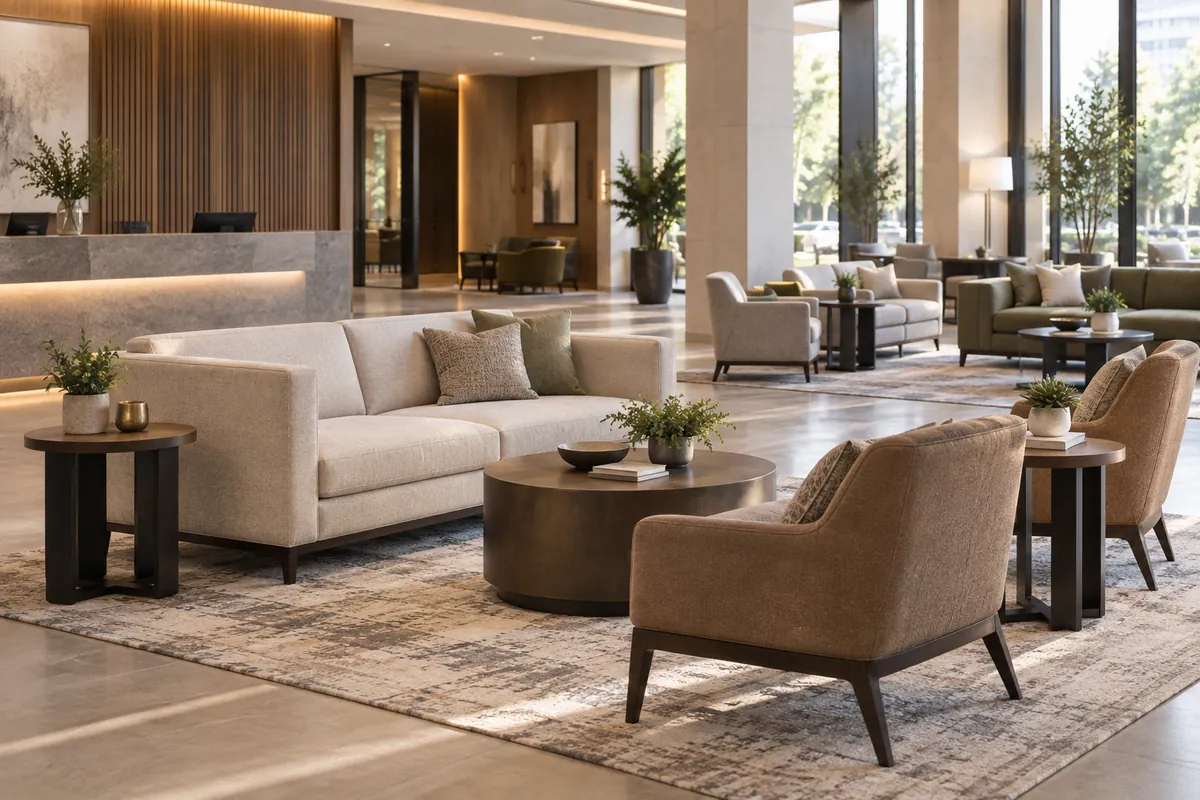
The same basic rule applies in a living room, hotel lounge, reception area, waiting zone, or guest-room seating group: start from the adjacent seating, not from the table by itself. The difference in commercial projects is repetition. A small mismatch repeated across many seating groups becomes a purchasing and installation problem rather than a single-room styling issue.
| Seating condition | Height decision | Required check before ordering |
|---|---|---|
| Conventional sofa or lounge chair with arms | Start level with the arm or up to 2 in / 5 cm lower. | Measure actual finished arm height. |
| Low-profile lounge seating | Move below the generic market midpoint if the arm is low. | Check seated reach and the approved seating drawing. |
| Armless chair | Do not force an arm-height rule. | Run a seated-reach check using the actual seat and table position. |
| Mixed sofa and chair heights | One table height may not fit every seat equally well. | Choose the dominant seating relationship or plan more than one table height. |
| Table used for active work or food | Function may justify a different height. | Confirm the task, user posture, and tabletop clearance before production. |
Common Side Table Height Mistakes
Using a broad range as the final specification
An 18–28 in / 46–71 cm market range is too broad to approve production by itself. A table at one end of that range can be very different from the adjacent arm height. The correction is simple: measure the seating first and convert the broad range into a project-specific target.
Changing the seating after the table height is approved
If the sofa or lounge chair changes, the original table-height decision may no longer be valid. This is a common coordination risk when seating and tables are approved separately. Recheck the relationship whenever the seating model, cushion construction, legs, or finished floor level changes.
Ignoring the finished height after customization
A thicker top, different foot, glide, or structural revision can change the final height. For customized tables, we recommend confirming the final floor-to-top height on the production drawing rather than relying only on the original concept dimensions.
Checking height but not footprint
Correct height does not guarantee a good layout. The table still needs the right width and depth beside the seating without causing a collision or blocking normal movement. Review height, the amount of floor space the table uses, the seating position, and the walking path together.
A Current YeZhi Side Table Size Example
The HU Leather Sling Side Table is a current YeZhi model with a verified size of 21.7 in W × 15.0 in D × 19.7 in H / 55 × 38 × 50 cm. Its 19.7 in / 50 cm height is a model specification, not a standard for every side table.
For a project using this model, the next step is still to compare its 19.7 in / 50 cm finished height with the actual sofa or lounge-chair arm. For example, it may be a reasonable starting match beside lower lounge seating, but the seating measurement must decide the fit.
You can also review our commercial side tables and commercial lounge chairs when planning coordinated seating groups.
Does a Furniture Standard Define the Correct Side Table Height?
Furniture performance standards and project sizing are different questions. BIFMA lists desk and table product standards such as ANSI/BIFMA X5.5 for desk and table products, which addresses product performance requirements. That does not create one universal side-table height for every sofa, chair, or hospitality layout.
For height selection, the project still needs the actual seating relationship and intended use. A test standard should never be treated as proof that a particular height will fit a particular seating group, and an external standard does not by itself prove compliance for a YeZhi model.
What to Send Before a Bulk Side Table Order
For a faster project review, send the dimensions that control the decision instead of only asking for a “standard height.” We recommend including:
- sofa or lounge-chair model and finished arm height;
- target side-table height, width, and depth;
- quantity for each model/SKU (the exact item configuration);
- material, color, finish, and any size customization;
- intended use, such as hotel lounge, reception, restaurant waiting area, or guest room;
- destination market and required delivery term.
Side Table Height FAQ
What is the standard height of a side table?
A broad 18–28 in / 46–71 cm range is useful for screening, but the better project rule is to match the table to the adjacent sofa or chair arm. Start around arm height or up to 2 in / 5 cm lower, then verify the actual seating.
Should a side table be higher or lower than a sofa arm?
Our default is level with the usable armrest or slightly lower, up to about 2 in / 5 cm. Change that default when the seating is unusually low, armless, or the table has a special working function.
What is a good living room side table height?
Measure the living-room sofa or chair arm first. If the arm is 24 in / 61 cm high, a first screening range of about 22–24 in / 56–61 cm is more useful than selecting from a generic table-height list.
Is a 20 in / 51 cm side table too low?
Not necessarily. A 20 in / 51 cm table can work well with lower seating or with an arm around 20–22 in / 51–56 cm, but the final decision should be checked from the actual seated position.
How do I choose side table height for an armless lounge chair?
Use a seated-reach check instead of an arm-height rule. Place the proposed table beside the actual chair or a verified mock-up and confirm that normal use does not require an excessive lean or shoulder lift. Lock the finished table height on the drawing after that check.

Can a side table be taller than a sofa arm?
Yes, but we would not use that as the default. A taller table can make sense when a lamp, laptop, food service, or another specific task needs it. If the tabletop sits above the arm, check seated reach, elbow clearance, and the actual use before approval.
Final Recommendation
Use 18–28 in / 46–71 cm only as a broad side-table height screening range. For the final selection, measure the adjacent sofa or lounge-chair arm and start with the tabletop level with the arm or up to 2 in / 5 cm lower. Then check the change conditions: recliners need movement clearance, armless chairs need a seated-reach check, and C-shaped or task tables need seat and working clearance. Recheck the decision whenever the seating, finished floor level, tabletop, feet, glides (small floor-contact feet), or intended use changes.
For a commercial project, send your seating arm height, target table dimensions, quantity, finish, and application to YeZhi Furniture. We can review the side-table selection or custom configuration against the project requirements before production.