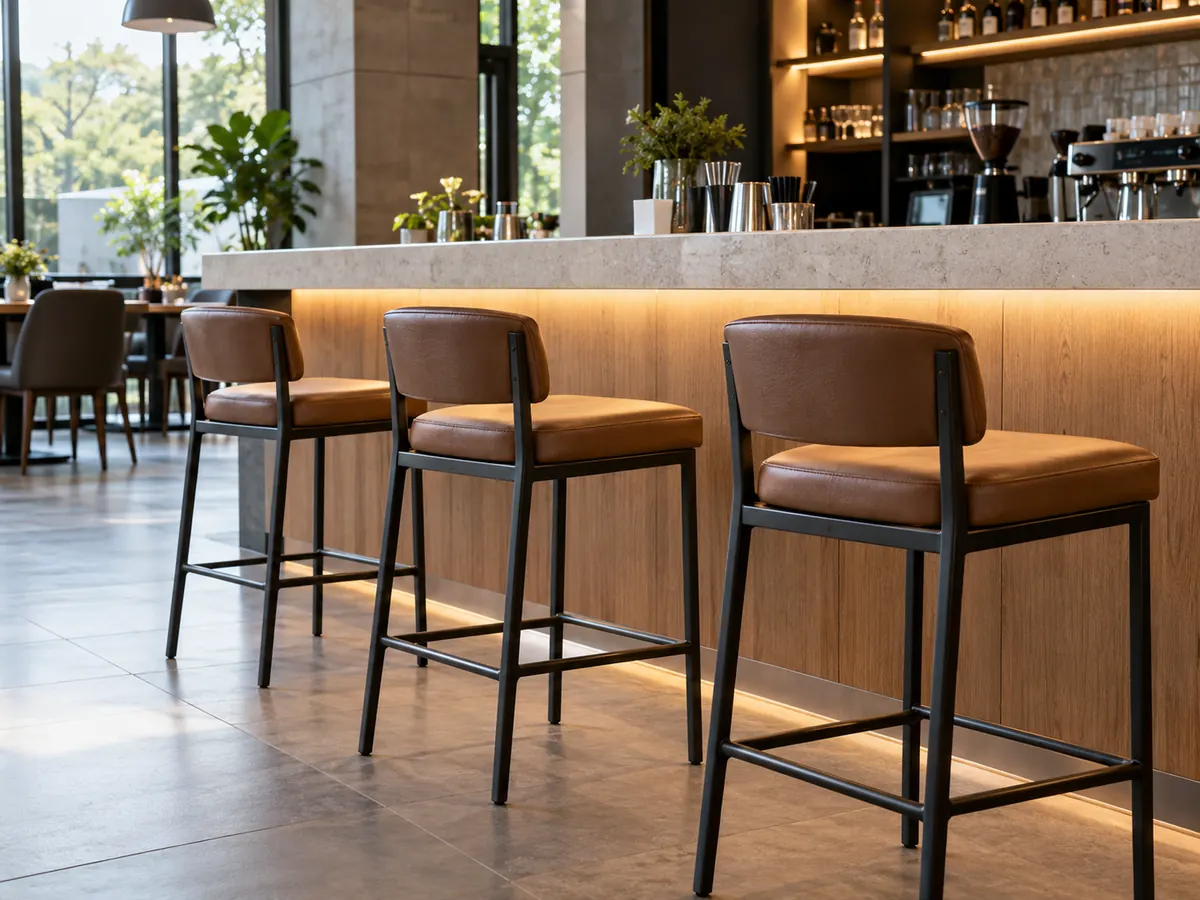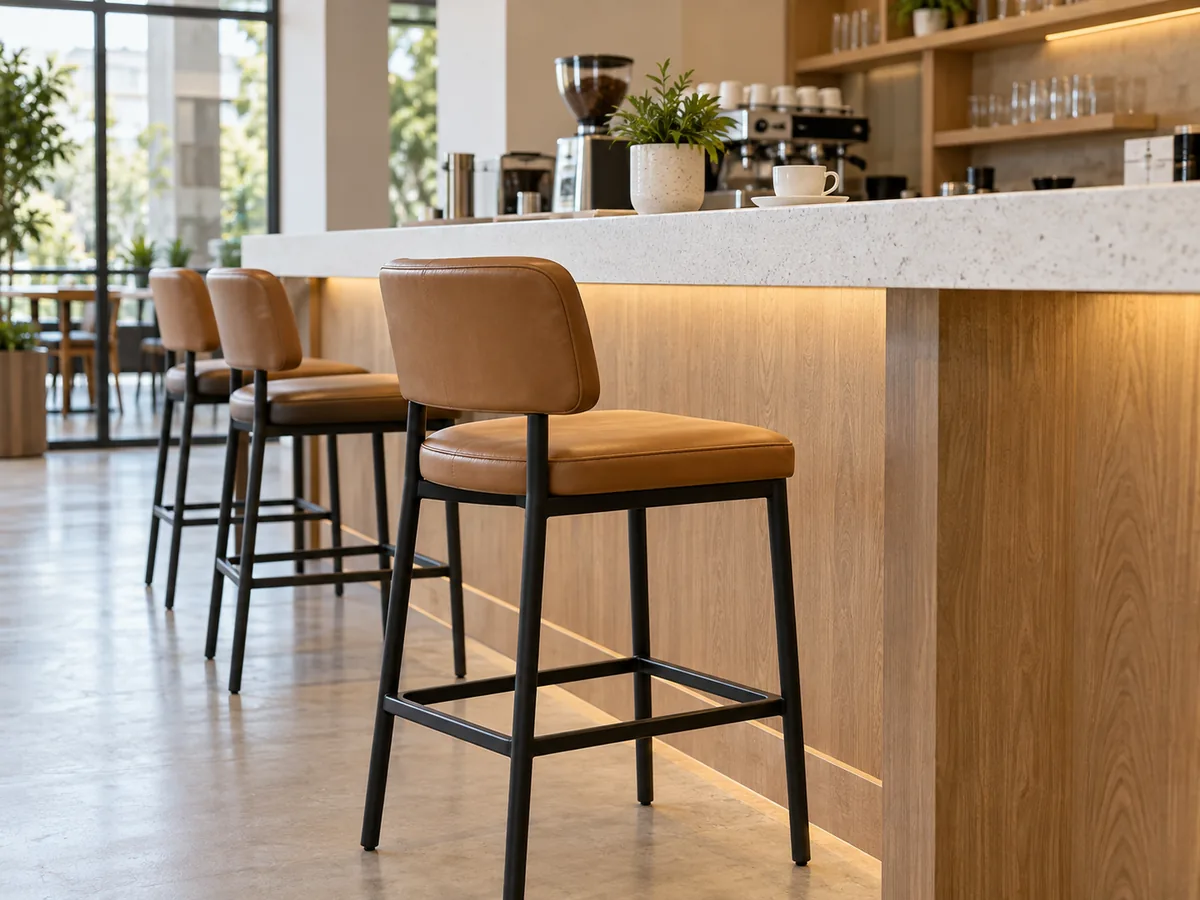
The phrase “best dining chairs” sounds like a request for one winning chair. For a restaurant, café, hotel, distributor program, or multi-site project, there is no responsible one-model winner. The better answer is a default chair type plus clear conditions that change the choice.
Retail lists often rank chairs by appearance, home comfort, price, or editor preference. We use a different filter at YeZhi Furniture: table fit, seating density, sitting duration, cleaning, environment, finish control, repeat-order consistency, packing, and the information that can be locked before bulk production. The selections below are therefore project-selection categories, not third-party product rankings.
Best Dining Chairs at a Glance
If you need a fast starting point, use the table below. These are commercial-project recommendations, not universal rankings. The chair still has to fit the actual table, venue, cleaning routine, quantity and destination requirements.
| Need | Our starting recommendation | Why | Main check |
|---|---|---|---|
| Best overall commercial starting point | Compact armless dining-height chair | Usually gives the easiest balance of table fit, seating density and layout flexibility | Seat height, overall width, table underside and base clearance |
| Best for round tables | Compact armless chair with controlled footprint | Uses the curved table perimeter more efficiently and avoids unnecessary arm-clearance conflicts | Table diameter, pedestal/base geometry and pull-out space |
| Best comfortable direction | Upholstered chair or dining armchair | Better starting point when longer sitting and hospitality comfort matter more than maximum seating density | Usable seat width, arm clearance, upholstery and sitting duration |
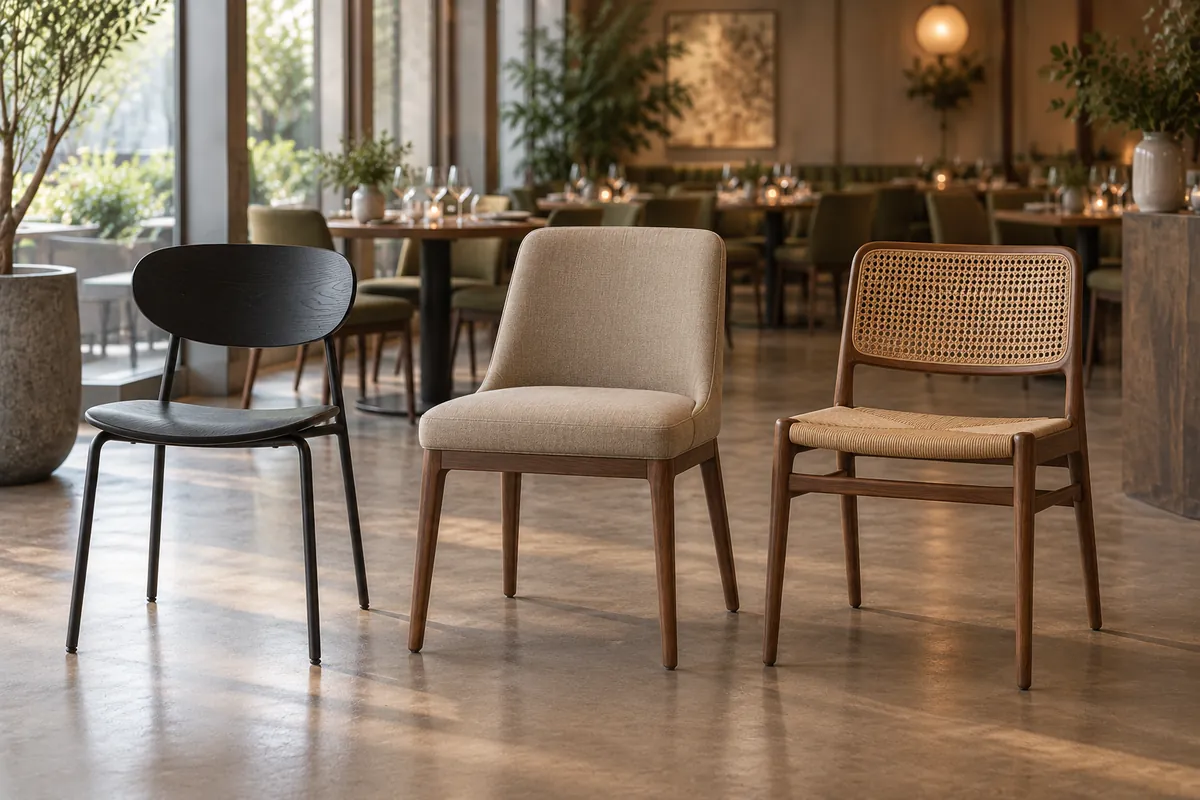
| Best black YeZhi example | NERO21 | Compact indoor black plywood + metal direction with a firm, wipe-friendly seating surface | Indoor use only; verify final table fit and finish |
| Best natural / mid-century YeZhi direction | CR215 | Natural cane + walnut-tone surround + steel legs support a restrained warm-material direction | Indoor dry-use conditions and natural-material appearance variation |
| Best upholstered YeZhi armchair direction | DC-F42 | Wider upholstered armchair format for design-led hospitality layouts | Arm clearance and seat density |
| Best inexpensive project route | Established configuration with limited custom complexity | Reduces the number of variables that must be sampled, approved and repeated in bulk | Total project cost, MOQ, packing and finish approval |
| Best patio route | Outdoor-specific chair configuration | Outdoor suitability depends on the complete material/finish/joint system, not on “metal frame” alone | Actual rain, UV, moisture, coastal/poolside exposure and required documentation |
How We Decide What “Best” Means for a Commercial Dining Chair
At YeZhi Furniture, we do not define “best” by appearance alone. We treat a chair as a strong project candidate only when the application, table relationship, comfort target, maintenance route, material/finish, order complexity and pre-production controls can work together.
Table and layout compatibility
We check the chair against the actual table height, underside, base or pedestal, chair footprint and required seats per table.
Sitting time and support
We change the chair direction when longer sitting, upholstery or arm support matters more than maximum seating density.
Cleaning and material reality
We look at the approved surface, upholstery and cleaning routine rather than assuming a generic material name proves easy maintenance.
Indoor versus outdoor exposure
Outdoor projects require an exposure-specific route. An indoor chair is not converted into a patio chair by appearance or frame material alone.
Finish, configuration and bulk control
For wholesale and multi-site work, the approved structure, dimensions, materials, finish and packing need to be repeatable across the confirmed order.
MOQ, customization, packing and schedule
The lowest unit price is not automatically the lowest project cost when customization, rework, damage, table mismatch or schedule risk is ignored.
Commercial Planning Snapshot
Standard payment basis: T/T 30% deposit + 70% balance before shipment. EXW, FOB and CIF can be reviewed; LCL/FCL ocean shipment depends on order size. Final model, quantity, customization and quotation govern the commercial terms.
Best Dining Chairs by Project Condition
| Project condition | Our default recommendation | What changes the recommendation | Main check before approval |
|---|---|---|---|
| Most indoor restaurants and cafés | Compact armless dining chair; non-upholstered or lightly upholstered according to cleaning and comfort needs | Longer dwell time, premium service, arms required, or daily storage | Seat height, overall width, table apron/base clearance, cleaning method |
| Longer-stay dining or hospitality | Upholstered chair or dining armchair | High-turnover cleaning, narrow spacing, or table underside too low for arms | Arm clearance, actual seat construction, upholstery specification and maintenance |
| Round dining tables or tight layouts | Compact armless chair with a controlled footprint | Large pedestal/base, low apron, required arms, or wider comfort profile | Table diameter, pedestal/base geometry, chair width/footprint and pull-out space |
| Patio or exposed outdoor dining | Outdoor-rated chair configuration selected for the real exposure | Covered terrace vs rain exposure, strong UV, coastal salt, poolside use, or frequent wet cleaning | Frame, finish, joints/drainage, upholstery if used, and required outdoor performance documentation |
| Black, modern or contemporary scheme | Choose the structure first, then lock the black/neutral finish with a physical reference | Natural-material brief, warm wood program, high-touch upholstery, or strict finish-matching requirement | Material underneath the color, gloss/texture, sample control and batch consistency |
| Cost-sensitive wholesale program | Established configuration with limited custom complexity | Brand-specific materials, structural changes, special testing, custom cartons or small mixed runs | Total landed/project cost, not unit price alone |
Best Dining Chairs for a Round Table or Any Dining Table: Fit Comes First
A chair can have the right style and still be wrong for the table. The interaction is not only “table height minus seat height.” Tabletop thickness, apron or support rails, leg position, pedestal size, chair width, arms, and the floor footprint all change how many seats actually fit and whether a chair can be pulled in comfortably.
For a round table
We normally start with a compact armless chair because the usable perimeter is shared around a curve. A central pedestal can help or hurt depending on its width and foot shape. Send the table diameter and base drawing rather than relying on a nominal “four-seat” or “six-seat” label.
For tables with aprons
Seat height alone cannot prove fit. A deep apron or lower support may reduce thigh and knee clearance. Dining armchairs add another variable because the arm must clear the underside if you expect the chair to tuck in.
For this reason, we treat published chair dimensions as layout inputs, not as a complete fit decision. If you are sourcing chairs together with tables, compare them against the actual table drawing or review YeZhi’s dining table range as part of the same layout discussion.
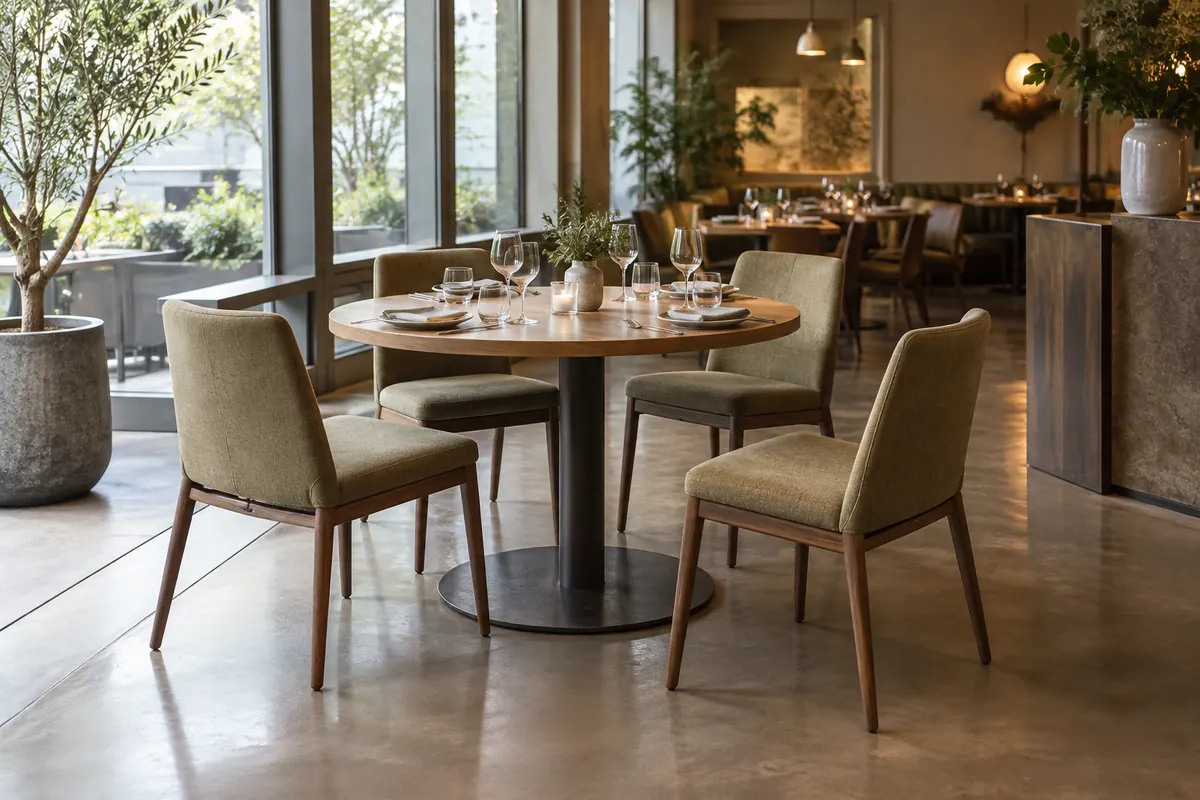
For U.S. projects, accessibility also belongs in the dining-layout check rather than being treated as a chair-style feature. The U.S. Department of Justice’s 2010 ADA Standards require a portion of seating/standing spaces at dining surfaces to comply with the dining-surface provisions, including clear floor/knee/toe space and specified dining-surface height. That is a project layout and dining-surface requirement, not a universal certification of a dining chair.
What Are the Best Comfortable Dining Chairs?
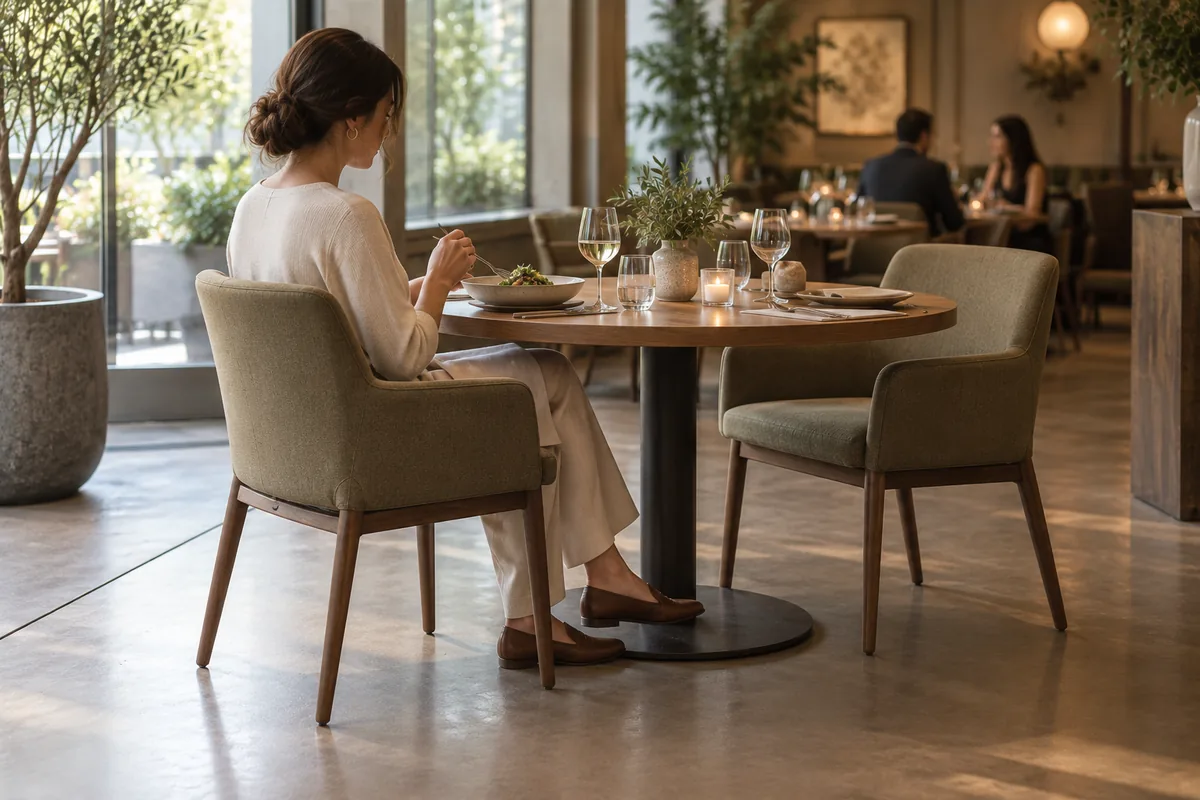
For longer meals, hotel dining, private dining rooms, and hospitality spaces where people remain seated for more time, we usually move the shortlist toward upholstered seats, supportive backs, or a properly fitted dining armchair. But “more padding” or “wider chair” does not automatically mean better comfort.
Comfort results from the interaction of seat construction, foam or support layer, upholstery, seat angle, back shape, usable seat width, sitting duration, and how the chair meets the table. A wide wraparound chair can feel inviting but may reduce seats per table. A thick cushion can change effective sitting height. An armchair can support the upper body but can also fail to slide under a low table.
Best upholstery for dining room chairs
There is no single upholstery that is best for every commercial dining room. We recommend specifying upholstery by construction, intended use, cleaning method, appearance target, and any destination-market performance requirement. A coated surface may be attractive for frequent wipe-down routines; a woven or knit textile may support a different tactile and design brief. The exact answer depends on the approved material, not the generic label “fabric” or “leatherette.”
The Association for Contract Textiles performance guidelines are a useful external reference because they separate requirements by fabric construction, application, and indoor/outdoor use, and cover issues such as flammability, crocking, lightfastness, physical properties, and abrasion. ACT also notes that test results are produced under laboratory conditions and may not reflect every local requirement. We therefore do not turn a single abrasion figure into a universal lifespan conclusion.
What Are the Best Patio Dining Chairs?
Patio dining chairs should be treated as a separate selection branch. Do not move an indoor dining chair outdoors simply because it has a metal frame or a firm seat. Outdoor suitability depends on the complete system: substrate, surface treatment, joints, water traps, drainage, glides, upholstery if present, UV exposure, moisture, cleaning, and—in some locations—salt exposure.
Before we recommend an outdoor configuration, we want to know whether the area is fully covered, occasionally wet, permanently exposed to rain, near a pool, or in a coastal environment. Those conditions can change the material/finish route and the supporting documentation required. If a project specification names a corrosion, UV, fire, or other performance standard, include the exact requirement before sampling.
The indoor models highlighted later in this guide—NERO21, CR215 and DC-F42—are not presented as outdoor or all-weather chairs. For patio sourcing, use the relevant outdoor route rather than treating a popular indoor design as a substitute.
Best Black, Modern, Contemporary and Mid-Century Modern Dining Chairs
Style keywords are useful for narrowing a collection, but they should not control the engineering decision. “Black dining chair,” “modern dining chair,” “contemporary dining chair,” and “mid-century modern dining chair” describe a visual direction; they do not tell you whether the chair fits the table, cleans easily, survives the intended environment, or can be repeated consistently across a bulk order.
Best black dining chair direction
Choose the structure and use case first, then lock the black component or finish. Black plywood, black upholstery and a black metal finish can look similar in a photo but behave differently in cleaning, touch, edge wear and finish control.
Best modern / contemporary direction
Use a restrained silhouette, controlled materials and a repeatable finish program, then test the chair-table relationship. A visually light frame can help a small room feel less crowded, but the actual floor footprint still governs density.
Best mid-century modern direction
Warm wood tones, cane, shaped plywood and slender frames can support this brief. Treat “mid-century” as a design direction, then verify commercial-use fit, maintenance and project requirements separately.
Best quality direction
Quality is the ability to hold the approved structure, dimensions, finish and packing consistently for the intended project—not simply choosing the heaviest chair or the most expensive upholstery.
Need a Shortlist?
Send us your table dimensions, chair quantity, venue type and preferred visual direction. We can narrow the chair type and compatible YeZhi models before you spend time comparing finishes that do not fit the layout.
Best Inexpensive Dining Chairs: Reduce Total Project Cost, Not Just Unit Price
For wholesale and project orders, the lowest quoted unit price can become expensive if it creates finish rework, table-fit problems, damage in transit, difficult assembly, or replacement demand after opening. We recommend comparing configuration complexity, MOQ, sample route, packing, freight basis, assembly, expected maintenance, and the cost of correcting a mismatch.
A reliable cost-control route is often an established chair configuration with fewer structural changes and a finish/material program that can be approved efficiently. Deep customization, new materials, unusual dimensions, special testing, branded packing, or many low-volume variants can change both price and lead time.
Existing configuration + controlled finish
Usually the most efficient starting point when the priority is cost control, repeatability and a simpler approval path.
Existing structure + selected material/finish changes
Useful when the project needs visual differentiation without changing every structural variable.
Custom design or configuration
Use when dimensions, structure, materials, branding, packing or testing requirements justify a deeper development route. Quantity and lead time need to be confirmed by quotation.
Compare project cost, not chair price alone
Include sample/approval effort, packing, freight basis, assembly if applicable, mismatch risk and the cost of correcting a problem after bulk production.
Our YeZhi Dining Chair Shortlist by Project Need
These are condition-based YeZhi shortlists, not universal winners. Each recommendation is tied to a specific project need and keeps the confirmed public product boundary visible.
| Recommendation | Model | Best for | Why we shortlist it | Confirmed public configuration | Main limitation / check |
|---|---|---|---|---|---|
| Best compact black YeZhi option | NERO21 | Compact indoor restaurant/café layouts and black design programs | 43 cm / 16.9 in overall width, armless format, firm black plywood seat/back and metal frame give a straightforward indoor commercial direction | Indoor; W43 × D54.5 × H81 cm / 16.9 × 21.5 × 31.9 in; seat height 47.5 cm / 18.7 in | Not an outdoor recommendation. Change direction when padded comfort, arms or verified stacking is required. |
| Best natural / mid-century YeZhi direction | CR215 | Indoor projects wanting cane texture, warm wood tone and a slim natural-material look | Natural cane, walnut-tone wooden surround and steel legs support a restrained warm-material / mid-century direction without adding thick upholstery | Indoor; W43.6 × D54.1 × H81.8 cm / 17.2 × 21.3 × 32.2 in; seat height 45.2 cm / 17.8 in | Natural cane/wood appearance can vary. Do not use this model as an outdoor or frequent-wet-cleaning substitute. |
| Best upholstered YeZhi armchair direction | DC-F42 | Design-led hospitality layouts where a wider upholstered armchair fits the floor plan | 63 cm / 24.8 in width, wraparound upholstered form and armchair format make it a stronger comfort-led direction than the compact armless models | Indoor; W63 × D57.5 × H73 cm / 24.8 × 22.6 × 28.7 in; seat height 47 cm / 18.5 in; plywood, upholstery and metal | Arm height is not publicly confirmed. Check actual table underside and required seat density before approval. |
| Best slim mixed-material YeZhi direction | DC-H54-CM | Projects wanting a slim cross-frame appearance with plywood back and firm or upholstered seat direction | The cross-frame format gives a lighter visual footprint while allowing a plywood or upholstered seat route | Indoor; published sources place overall size around W44 × D54 × H82.8–83 cm / 17.3 × 21.3 × 32.6–32.7 in | Published seat-height data conflicts. Do not choose a value from the public sources; the final production drawing must govern. |
You can browse the broader YeZhi dining chair collection after the selection logic has narrowed the chair type. For restaurant-specific seating programs that may also include other chair constructions, review our restaurant chair range.
Common Dining Chair Selection Failures We Try to Catch Before Production
The most expensive chair problem is often not a broken chair; it is a chair that was approved before the project variables were checked together. These are the failure patterns we want to eliminate early.
1. Chair width works on paper, but the table does not
Root cause: nominal chair width is checked without pedestal, apron or pull-out space. Result: fewer seats fit than planned or guests lose legroom. Check: chair footprint + table underside + base geometry on one layout.
2. Armchair chosen before arm clearance is known
Root cause: seat height is checked but arm height/table underside is not. Result: the chair cannot tuck in. Check: confirm arm height and actual table underside before approval.
3. Upholstery selected by appearance only
Root cause: color and texture are approved without the real cleaning routine or required performance documentation. Result: maintenance or specification conflict appears after sampling. Check: exact material + cleaning route + named requirement.
4. Indoor chair assumed to be patio-ready
Root cause: “metal frame” is treated as proof of outdoor suitability. Result: the real rain, UV, moisture or salt exposure is not addressed. Check: specify the exposure first, then select the outdoor configuration.
5. Low unit price hides project cost
Root cause: price is compared before customization, packing, freight basis and correction risk. Result: rework or logistics cost removes the apparent saving. Check: compare the confirmed configuration and landed/project basis.
6. Bulk production starts before approval references are locked
Root cause: drawing, finish/material reference, sample route or packing method remains open. Result: expectations are harder to reconcile after production. Check: lock the controlled references before bulk production.
What We Need to Confirm Before You Order Dining Chairs
A good shortlist should reduce uncertainty before the quotation, sample and drawing stages. Send the following information so we can move from a general “best dining chair” discussion to a project-specific recommendation.
- Venue and environment: restaurant, café, hotel, distributor collection or other use; indoor, covered outdoor, exposed outdoor, coastal, poolside, etc.
- Table information: table height, tabletop thickness, apron/support height, base or pedestal geometry, diameter/length, and required chairs per table.
- Quantity: total chairs and quantity per model, finish or upholstery.
- Comfort target: fast-turn dining, standard dining, longer-stay dining, arm support, firm or upholstered seat preference.
- Material and finish: wood/metal/cane/upholstery direction, color code or physical reference, gloss/texture when important.
- Maintenance: routine cleaning method, wet-cleaning frequency and any restricted cleaning chemistry.
- Destination requirements: country/market and any named fire, durability, stability, corrosion, accessibility or other project specification.
- Packing and branding: assembled/knock-down preference where feasible, labels, carton artwork, barcode or other packing requirement.
- Schedule and trade basis: target delivery date, destination port and required EXW/FOB/CIF basis.
Before bulk production, we recommend locking the chair drawing/specification, finish or material reference, approved sample route, packing method and commercial terms. YeZhi’s standard warranty period is 1 year; it generally focuses on confirmed structural issues involving frames and joints, while final coverage, exclusions and remedy terms should be stated on the PI before production.
Frequently Asked Questions
What is the best overall dining chair for a commercial project?
For many indoor restaurant and café projects, our default starting point is a compact armless dining-height chair because it usually gives the easiest balance of table fit, seating density and layout flexibility. Change that default when longer sitting, arms, upholstery, storage or outdoor exposure becomes more important.
How do you decide whether a dining chair is good for commercial use?
We check the chair against the real table and layout, expected sitting time, cleaning routine, environment, approved material/finish, quantity, packing and any named destination requirement. A style label or one material specification is not enough by itself.
What are the best dining room chairs for restaurants?
For most indoor restaurants, we recommend starting with a compact armless dining-height chair that fits the actual table and matches the cleaning routine. Move to upholstery or arms when longer sitting and hospitality comfort matter more than maximum seating density.
What are the best inexpensive dining chairs?
For a commercial order, the better low-cost choice is usually an established configuration with limited custom complexity and a packing/finish route that can be controlled. Compare total project and landed cost rather than unit price alone.
What are the best quality dining chairs?
“Quality” should mean the chair can meet the approved structure, dimensions, finish, material, packing and project requirements consistently. Weight, price or one material label is not enough to prove quality.
What are the best black dining chairs?
First decide whether you need a non-upholstered, upholstered, wood/plywood or metal-led structure. Then lock the black finish with an approved sample or coded reference. NERO21 is one current indoor black-plywood example, but it is not the right route when you need thick padding, arms or outdoor use.
What are the best modern or contemporary dining chairs?
We usually prioritize a clean silhouette, controlled footprint and coordinated finish after the application and table-fit checks. “Modern” or “contemporary” should narrow the visual direction, not override maintenance, comfort, clearance or commercial-use requirements.
What are the best mid-century modern dining chairs?
Use warm wood tones, cane, shaped plywood, upholstery and slender frames as design cues, then verify the project fit. CR215 can support a restrained natural/mid-century direction in indoor dry-use settings, but its material and use boundaries still govern.
What is the best upholstery for dining room chairs?
There is no universal best upholstery. Specify the cover by construction, cleaning routine, indoor/outdoor condition, appearance and any required performance standard. Approve the exact material rather than relying on a generic “fabric” or “leatherette” description.
What are the best dining chairs for a round table?
Compact armless chairs are often the safest starting point, but the final answer depends on table diameter, pedestal/base geometry, chair width and footprint, pull-out space, and the required number of seats. Send the table drawing for a reliable fit review.
What are the best patio dining chairs?
Use a chair specifically selected for the real outdoor exposure. A metal frame alone does not make an indoor chair patio-ready. Confirm rain, UV, moisture, coastal/poolside exposure, cleaning and any required outdoor performance documentation before sampling.
Send Your Dining Chair Requirements
Send us the table dimensions or drawing, venue type, chair quantity, preferred style/material, comfort target, destination market and target schedule. We can use those inputs to narrow the chair type and compatible YeZhi models before quotation.
For the quotation stage, we then confirm the relevant model/configuration, MOQ, sample or approval route, production basis, packing requirements and trade basis.
Send your dining chair project requirements to YeZhi Furniture or review our commercial furniture resources for additional planning guides.