The best pool lounge chairs for a hotel, resort, club, or apartment pool must fit the real job. Start with where the chairs will be used, how often staff will move and clean them, and how they will be stored or repaired. For most normal dry pool decks, we recommend a stackable commercial chaise with a quick-drying, replaceable sling or surface and a frame designed for outdoor exposure. If the chair will sit partly or fully in water, use a purpose-built in-water lounger approved for the actual ledge depth and pool conditions.
Best Pool Lounge Chairs by Commercial Use: Recommended Starting Configurations
For a commercial project, “best” should mean the chair fits the real job, not that it has the highest retail rating. Use the table below as a first shortlist. The exact model still needs to be checked against the final layout, exposure, maintenance plan, and project documents.
| Best for | Recommended starting configuration | Why we recommend it | What can change the choice |
|---|---|---|---|
| Normal hotel or resort pool deck | Stackable commercial aluminum-frame chaise with a quick-drying sling | Fast drying, easy visual inspection, and efficient storage when the exact model is designed to stack | Coastal exposure, high wind, aggressive cleaners, guest profile, or a different design brief |
| Splash-heavy pool deck | Commercial resin chaise or a serviceable sling chaise with outdoor-use hardware | Avoids thick wet cushions and can simplify routine wet-area cleaning | Surface temperature, finish requirements, replacement-part availability, and cleaning chemistry |
| Shallow tanning ledge / sun shelf | Purpose-built in-water lounger approved for the actual water depth | Designed for partial or repeated water exposure instead of normal deck-only use | Finished water depth, water chemistry, pool finish, fill/ballast method, drain time, and manufacturer use limits |
| Projects that move chairs often | Wheeled commercial chaise with replaceable wear parts | Reduces staff effort when the deck is reconfigured or cleared for cleaning | Wheel material, axle/hardware, thresholds, storage path, and replacement availability |
| Compact seasonal storage | Verified stackable chaise with a known stack quantity and stacked footprint | Makes storage planning more predictable | Actual stack geometry, storage-room dimensions, handling equipment, and chair weight |
| Guests who may prefer easier sit-to-stand access | Chaise with a higher seat position and stable arm/support geometry | Can reduce the amount a guest must lower or raise their body | Exact seat height, arm geometry, target user group, and local accessibility requirements |
| Coastal or high-exposure site | Project-specific frame, finish, and hardware package | Exposure affects the whole system, not only the main frame material | Salt exposure, wind, finish damage risk, drainage, maintenance plan, and required evidence |
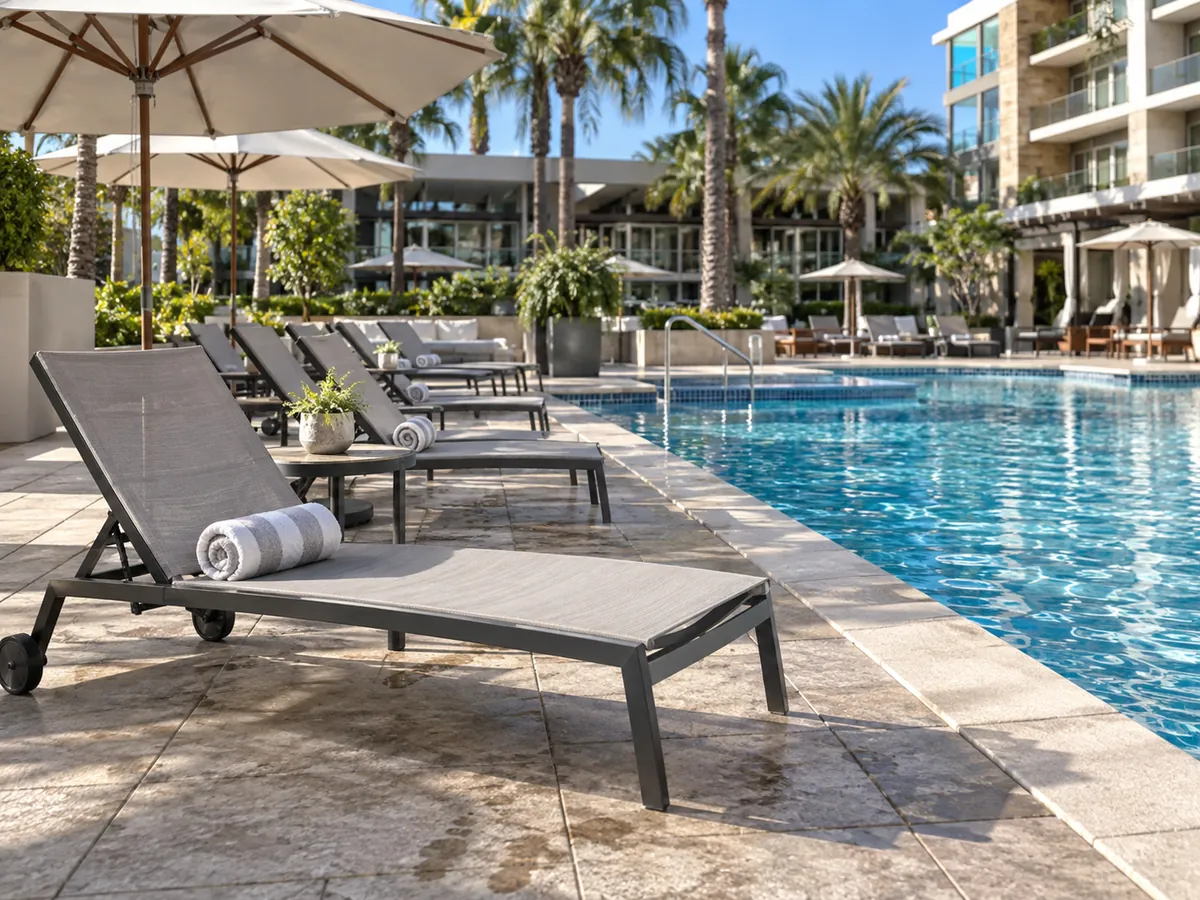
Poolside and In-Water Lounge Chairs Are Different Products
The first decision is not color or cushion thickness. It is where the chair will physically sit. A chair used on the deck and a chair used in the water solve different problems.
| Decision point | Dry-deck / splash-zone chaise | In-water / tanning-ledge lounger |
|---|---|---|
| Where it sits | On the pool deck; may get splashed but is not selected for repeated submersion | Partly or fully on a shallow shelf or ledge |
| Main material question | Outdoor exposure, drainage, finish, sling/surface, and hardware | Water-depth approval, material compatibility, fill/ballast behavior, drainage, and pool-finish contact |
| Movement | Often moved by staff for cleaning, layout changes, or storage | May become harder to lift after filling/ballasting; removal method must be planned |
| Storage | Stackability and wheeled movement can matter | Confirm where the chair goes when the ledge must be cleared |
| Main failure risk | Using an indoor or lightly protected chair in a demanding wet outdoor zone | Putting a normal deck chair in water because the material looks waterproof |
| Required check | Exact outdoor-use construction and operating footprint | Exact model approval for the finished water depth and pool conditions |
Dry-deck or splash-zone chaise
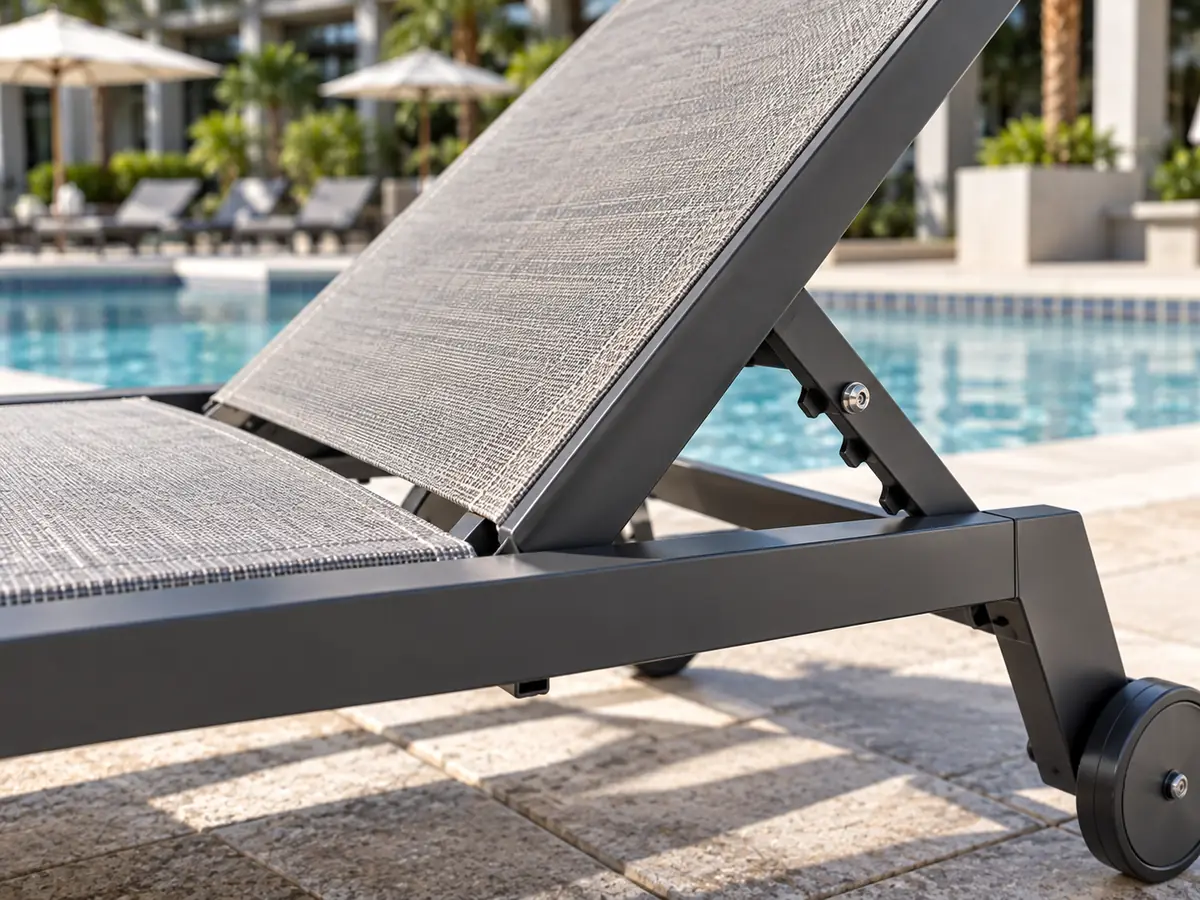
A normal commercial pool chaise is expected to stay on the deck. It may receive splashes, wet towels, sunscreen, frequent cleaning, and strong sun, but that does not mean it is designed to stay in the water. Check the frame, finish, joints, screws/bolts and other fasteners, sling attachment, and drainage as one system.
In-water tanning-ledge lounger
An in-water chair should be selected as an in-water product from the start. The exact model must be approved for the finished water depth and intended pool conditions. Do not move a normal patio or deck chaise onto a shallow shelf simply because the material looks waterproof. Repeated or continuous placement in water—often called immersion—changes the requirements for materials, weight or ballast, drainage, handling, and contact with the pool finish.
Before we shortlist a configuration, tell us whether the chair will be on a dry deck, in a splash-heavy zone, or on an in-water ledge. For an in-water application, include the finished water depth. If immersion suitability is not confirmed for the exact model, we do not treat it as approved for in-pool use.
Which Material Is Best for Pool Lounge Chairs?
There is no useful one-word material answer. A commercial chaise is a system: frame material, finish, hardware, joints, surface material, drainage, and cleaning exposure interact. We recommend comparing the complete system rather than asking only whether the chair is “aluminum,” “steel,” “resin,” or “wood.”
Aluminum frame with sling: a strong dry-deck starting point
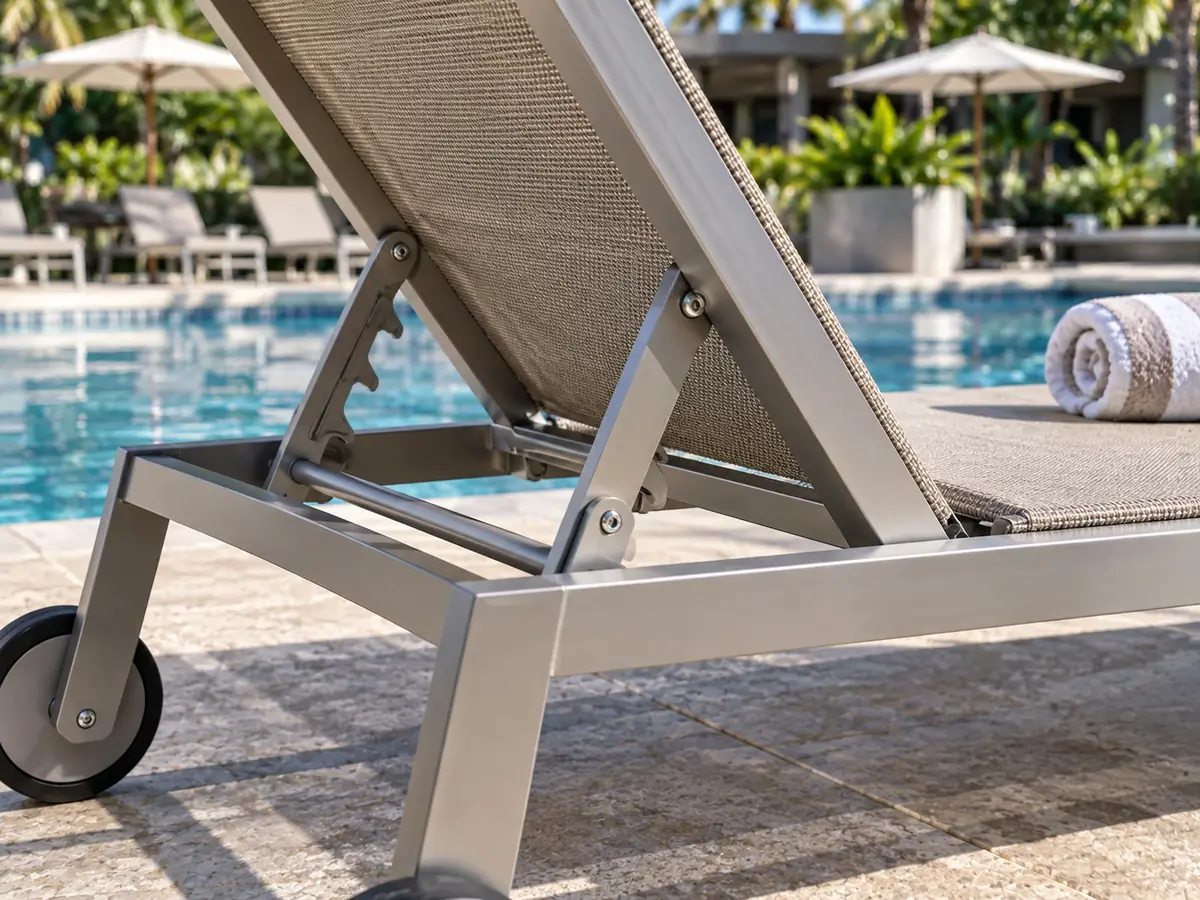
For many commercial dry-deck projects, an aluminum frame with a stretched mesh or fabric seat—often called a tensioned sling—is a practical first shortlist. It can keep the chair relatively light and avoids thick cushions that hold water. But “aluminum” does not describe the whole corrosion behavior. The Aluminum Association notes that alloying changes aluminum properties, including corrosion resistance. For a real project, we still check the available material specification, finish, screws/bolts and other fasteners, welds or joints, and the actual exposure.
Commercial resin: useful where simple wet-area care is important
Commercial resin can be useful where simple wet-area cleaning matters, and some purpose-built in-water loungers also use molded resin systems. Do not assume every resin chair performs the same way. Check the exact model’s outdoor-use claims, water-depth limits where relevant, weight or ballast behavior, surface temperature, cleaning instructions, drainage, and replacement strategy.
Protected steel: conditionally suitable, not automatically wrong
Steel can work outdoors when the protection system matches the environment, but the words “powder-coated steel” are not enough for a pool project. Coating coverage, joints, drainage, screws/bolts and other hardware, impact damage, and maintenance all affect the result. ISO 12944-2 is an established framework for classifying atmospheric environments for corrosion protection of steel structures. We use it only as an exposure reference here; it does not prove that a specific lounge chair has been tested or certified to that standard.
Wood, woven looks, and cushioned chaises: use when the maintenance plan supports them
These options can support a premium visual direction, but they add more variables: moisture retention, finish maintenance, drying time, fabric removal, cushion storage, and replacement. For high-turnover pool decks, we usually ask whether that extra maintenance is acceptable before approving the visual choice.
Dimensions, Seat Height, and Pool-Deck Layout
Pool chaises vary enough in size that a floor plan should never be approved from a category name alone. In current commercial examples reviewed for this guide, overall sizes commonly fall around 27–31 in / 69–79 cm wide and 75–85 in / 192–216 cm long. Use that only for early planning. Replace it with the selected model’s drawing before final layout approval, quotation lock, or production.
Seat height also changes how easy the chair is to use. Very low chaises can create a relaxed resort look, but some guests may find them harder to sit down on or stand up from. Decide who will use the space, then confirm the exact seat height and arm geometry from the drawing.
Use the real chair footprint, not only seat width
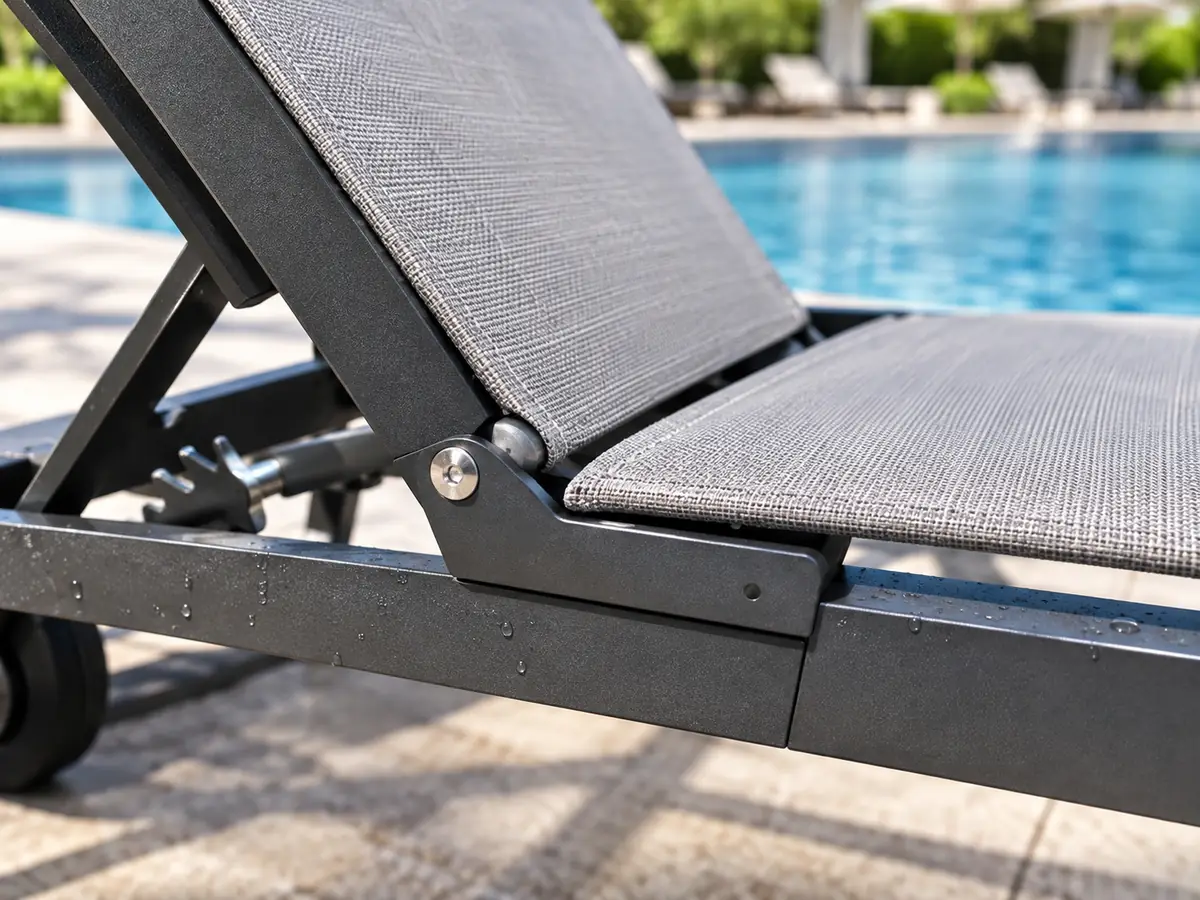
A reclining back, rear legs, wheels, armrests, and the user’s entry side can consume more space than a simple width number suggests. The layout should be checked with the chaise in its operating positions, not only in its most upright position.
Plan cleaning and movement paths
Staff need to move around, clean under, reposition, and sometimes stack or store the chairs. A technically “fitting” layout can still be operationally poor if every unit must be moved before routine cleaning or if stacked chairs have no defined storage location.
Stackability, Wheels, Drying, and Repair Matter More Than They Look
Commercial pool furniture is moved, cleaned, and repaired repeatedly. Small details that affect how easy the chair is to repair and replace wear parts—its serviceability—can become large operating costs across dozens or hundreds of chairs.
- Stackability: confirm the exact stack quantity and stacked footprint; do not assume all chaises nest efficiently.
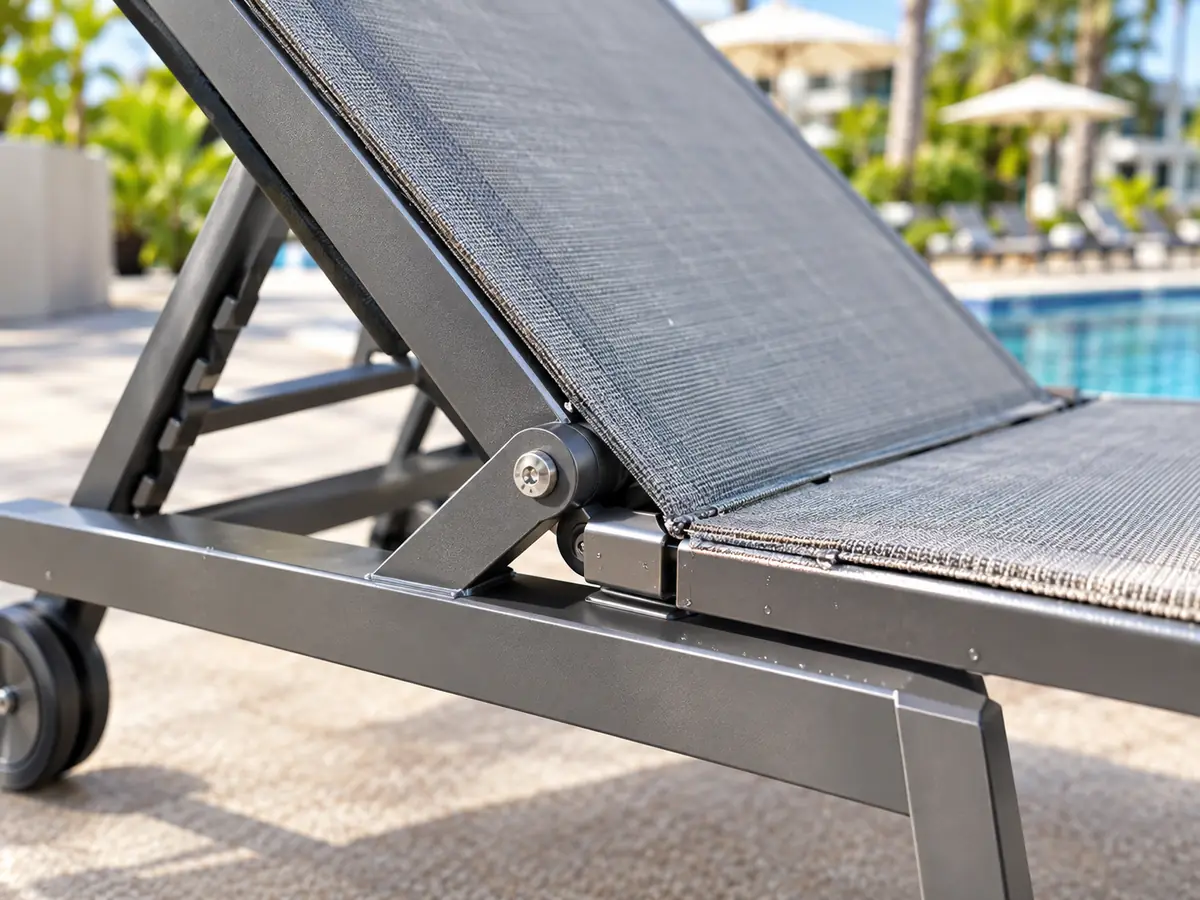
- Wheels: useful when staff regularly reconfigure the deck, but wheel material, axle/hardware, and replacement availability still need checking.
- Replaceable sling or surface: a replaceable wear surface can allow repair without discarding the full frame when the model is designed for service.
- Drainage and drying: avoid details that trap water after cleaning or rain. For upholstered options, confirm how covers/cushions are removed and stored.
- Cleaning compatibility: submit the actual cleaning chemicals and procedure when they are unusually aggressive; do not rely on a generic “outdoor” label.
If the pool has an automatic cover, plan chair removal before ordering
If a tanning ledge must be cleared before the pool is covered, confirm how staff will remove the loungers and where they will go. Check the dry weight and whether the chair fills with water or uses ballast. Also check drain time, grip points, the travel path to storage, and how often removal is required. A chair that works well in the water can still create an operating problem if it is difficult to lift, drain, move, or store.
What Usually Goes Wrong on Commercial Pool Projects
| Root mistake | What happens on site | Commercial consequence | How we prevent it |
|---|---|---|---|
| A deck chaise is treated as an in-water chair | The product behaves differently than expected under immersion or the maker’s use limits are exceeded | Re-selection, replacement, pool-finish risk, or delayed opening | Lock the use zone and water depth before model approval |
| Frame material is selected without checking finish, fasteners, and joints | Weak points show wear or corrosion before the main frame appears to fail | Appearance complaints, maintenance work, and shortened service intervals | Review the complete material/finish/hardware system against the environment |
| Only chair width is used for the floor plan | Reclined chairs, movement routes, or cleaning access conflict | Fewer usable positions than planned or costly layout changes | Use the full operating footprint from the final drawing |
| Stacking is assumed but not verified | Storage takes more floor area or handling time than expected | Back-of-house congestion and slower seasonal changeover | Confirm stack quantity, stacked dimensions, and storage location |
| The wear surface has no repair plan | A damaged sling, wheel, or fitting makes the whole chair difficult to return to service | Higher replacement cost and inconsistent deck appearance | Confirm replaceable parts and order a sensible spare-parts plan where available |
How We Specify a Pool Lounge Chair Project Before Production
We do not start with a photo and assume it will work. We start with where the chair will be used, how it will be handled, and what the project must prove before approval. Then we narrow the construction and commercial details.
- Define the use zone. Dry deck, splash-heavy deck, coastal deck, high-wind site, or in-water ledge.
- Lock the environmental inputs. Indoor/outdoor exposure, sun, salt exposure where relevant, cleaning process, and finished water depth for in-water use.
- Confirm the full geometry. Overall width and length, seat height, back positions, arm/leg geometry, stack behavior, wheels, and the space the chair needs when fully reclined.
- Confirm the material system. Frame, finish, screws/bolts and other hardware, sling/resin/fabric, drainage points, and color or finish sample requirements.
- Check repairability. Confirm whether common wear parts such as slings, wheels, feet, or hardware can be replaced on the selected model.
- Check movement and storage. Confirm stack quantity, stacked footprint, chair weight, storage path, and any frequent removal requirement such as pool-cover operation.
- Review project documents. Layout drawings, required standards or test reports, finish approvals, quantity, destination, and commercial terms.
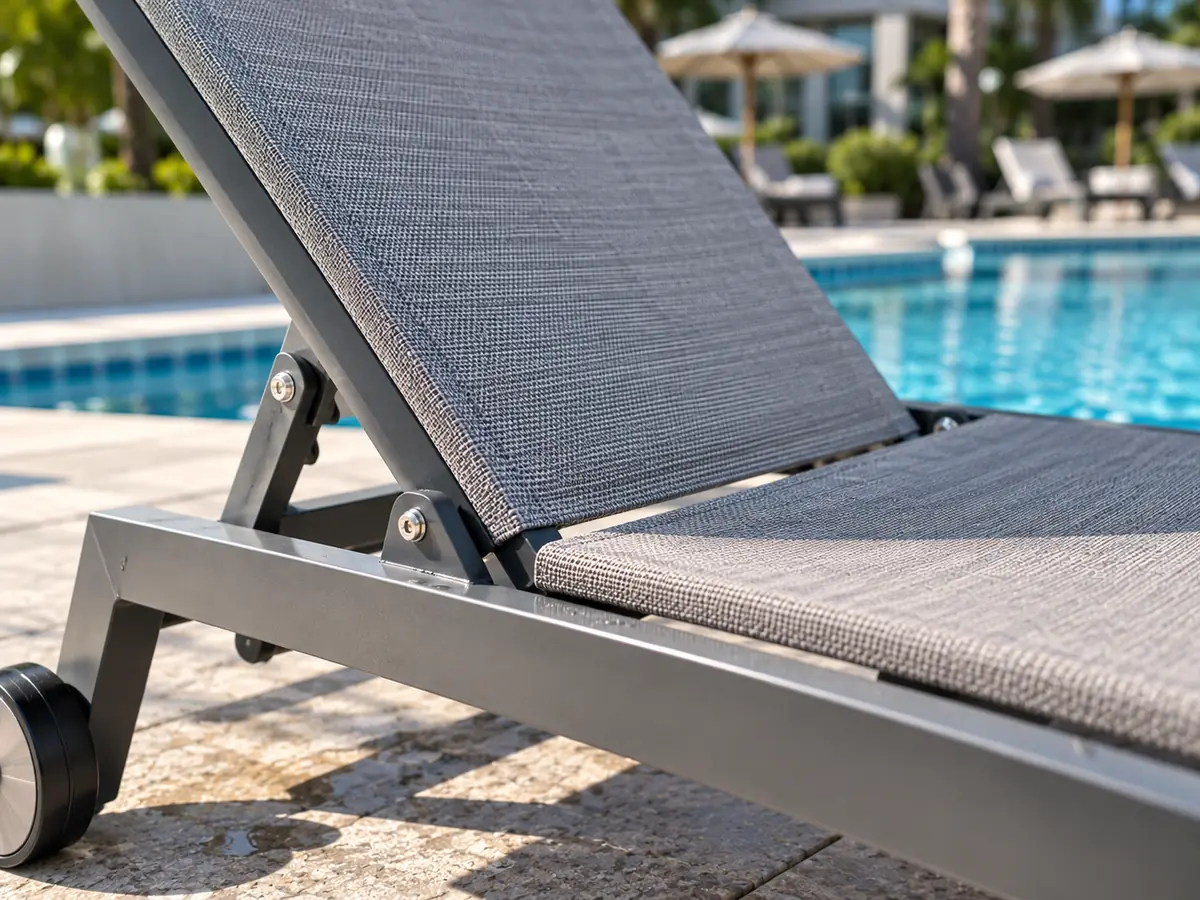
A pool environment does not automatically prove that every outdoor chair is suitable, and an “outdoor” label does not prove salt-spray, UV, chlorine, load, or other quantified performance. If a project requires a specific test, standard, rating, or chemical-resistance claim, send that requirement before quotation so we can confirm whether the exact model has adequate evidence.
Commercial Order Planning With YeZhi Furniture
For a normal YeZhi Furniture order, the regular MOQ starts from about 15 pcs per model/SKU, although some models can require a different quantity. Full OEM or deeper custom development usually starts around 100 pcs per design or configuration. Standard production planning is about 30 days after order confirmation; more complex custom work can require roughly 35–45 days or a project-specific schedule.
Our standard payment structure is T/T: 30% deposit and 70% balance before shipment. We can quote EXW, FOB, or CIF—common Incoterms that define which transport costs and responsibilities are handled by the seller or buyer at different stages. Ocean shipments can be planned as LCL (less-than-container load) or FCL (full-container load). Standard warranty is 1 year. Final warranty scope, exclusions, and remedy follow the confirmed model and the proforma invoice (PI), the commercial order document issued before shipment.
If you want to review YeZhi’s current lounge-chair range, you can browse our commercial lounge chair collection. The models in that category should not be assumed to be poolside or in-water products unless the exact model and exposure are separately confirmed.
What to Send for a Pool Lounge Chair Request for Quotation (RFQ)
A request for quotation (RFQ) is most useful when it includes the project inputs that can change the chair specification, price, packing, or shipping plan:
- Project type: hotel, resort, club, apartment or residential development (multifamily), spa, or other commercial site
- Use zone: dry deck, splash-heavy deck, coastal deck, or in-water shelf
- Finished water depth if the chair will be in the pool
- Approximate quantity per model and whether mixed models are required
- Removal and storage requirement: automatic pool cover, storm preparation, seasonal shutdown, or frequent deck clearing
- Preferred construction: sling, resin, padded, wood-look, or open to recommendation
- Floor plan or target footprint and any seat-height preference
- Stacking, wheel, storage, or spare-part requirements
- Required standards, test reports, certificates, finish samples, or approval documents
- Destination country/port and preferred EXW, FOB, or CIF basis
Send Us Your Pool-Deck Requirements
Send the use zone, quantity, layout, preferred material direction, destination, and any required test/document list. We will use those inputs to confirm whether a current model or project configuration is appropriate before quotation and production.
FAQ
What is the best type of pool lounge chair for a hotel or resort?
For a normal dry commercial pool deck, our first shortlist is a stackable chaise with a quick-drying, replaceable sling or surface and a frame designed for outdoor exposure. Choose a different configuration when the site is coastal, chairs must be moved often, storage is tight, guests need a higher seat, or the chair will sit in the water.
What are the best in-water pool lounge chairs?
Use purpose-built in-water loungers whose exact model is approved for the finished ledge depth and pool conditions. Also check how the chair fills or uses ballast, how it drains, how staff will remove it, and where it will be stored if the ledge must be cleared.
Are aluminum pool chaise lounge chairs a good choice?
Yes, aluminum-frame sling chaises are a practical starting point for many dry commercial decks because they can be relatively light, quick to dry, and easy to inspect. The material specification, finish, screws/bolts and other hardware, joints, and exposure still need to be checked together.
Can an indoor lounge chair be used beside a pool?
Not by assumption. Indoor upholstery, foam, finishes, adhesives, hardware, and frame details may not be designed for wet outdoor exposure. We only treat a model as poolside/outdoor-capable when the relevant construction and use condition are confirmed.
How much space should I allow for a pool chaise lounge?
For preliminary blocking, current commercial examples often fall around 27–31 in / 69–79 cm wide and 75–85 in / 192–216 cm long. That is not a standard size. Use the selected model’s full drawing, reclined footprint, cleaning route, and local access requirements for final planning.
What is YeZhi Furniture’s MOQ for a commercial lounge-chair project?
Regular MOQ starts from about 15 pcs per model/SKU, with some models differing. Full OEM or deeper custom development usually starts around 100 pcs per design or configuration. Final MOQ is confirmed with the selected model and quotation.