How Tall Is a Coffee Table?
For most sofa and lounge seating, start with a coffee table around 16–18 in / 41–46 cm high. The more reliable rule is to match the actual seating: keep the tabletop roughly level with the seat cushion or up to about 1–2 in / 2.5–5 cm lower.
We change that starting point when the seating is intentionally low, the cushions compress deeply, the center table must serve a different function, or the project uses several seating heights in one group. The main mistake is choosing a table from a generic “standard height” without checking the sofa or lounge chair it will actually sit beside.

Use the Sofa Seat Height as the Main Reference
For a fixed coffee table, the sofa or lounge-chair seat is the dimension that should drive the first height decision. A room may have a tall sofa back, thick arms, or deep cushions, but those measurements do not tell you whether the tabletop is easy to reach from the seated position.
Use that formula as a planning value, not as a final product specification. The finished furniture, cushion behavior, floor build-up, tabletop thickness, glides, and intended use can all change the final height you approve.
| Sofa or lounge seat height | First coffee-table height range to test | What this means |
|---|---|---|
| 15 in / 38 cm | 13–15 in / 33–38 cm | Low-profile lounge seating; avoid forcing a standard-height table into the group. |
| 16 in / 41 cm | 14–16 in / 36–41 cm | Often suits relaxed, lower seating compositions. |
| 17 in / 43 cm | 15–17 in / 38–43 cm | Useful range for many contemporary lounge arrangements. |
| 18 in / 46 cm | 16–18 in / 41–46 cm | Falls directly inside the common 16–18 in starting range. |
| 19 in / 48 cm | 17–19 in / 43–48 cm | A slightly taller table may be more practical than a low sculptural design. |
| 20 in / 51 cm | 18–20 in / 46–51 cm | Check whether the seating is genuinely high or whether the cushion compresses heavily in use. |
If your seating height is between rows, do not round the sofa to the nearest “standard.” Keep the real measurement and test a table height within about 0–2 in / 0–5 cm below it.
Why 16–18 in / 41–46 cm Is a Starting Point, Not a Universal Standard
Many coffee tables cluster around 16–18 in / 41–46 cm because that height pairs reasonably with common sofa seat heights. But commercial lounge projects regularly use lower lounge chairs, deep modular sofas, firm reception seating, mixed seating groups, and custom floor finishes. One fixed number cannot fit every combination.
For YeZhi projects, we treat the common range as a quick filter. The actual approval point is the relationship between the selected seating and the finished table. This prevents a design team from approving a table that looks proportionate in an isolated product image but feels wrong after the full lounge set arrives.
Is 14, 16, 18, 20, or 24 Inches Too Tall for a Coffee Table?
Use the number below as a screening check, then compare it with the actual seat height. The same table can be comfortable beside one sofa and clearly wrong beside another.
| Table height | First interpretation | What we would check before approval |
|---|---|---|
| 14 in / 36 cm | Low coffee-table height | Best evaluated with low lounge seating around the mid-teens. With conventional upright seating, check whether the reach becomes too low. |
| 16 in / 41 cm | Common lower-to-middle range | Often pairs well with lounge seats around 16–18 in / 41–46 cm, depending on cushion compression and placement. |
| 18 in / 46 cm | Common upper end of the usual range | Often works with seats around 18–20 in / 46–51 cm. Check carefully beside low-profile sofas. |
| 20 in / 51 cm | Tall for many conventional coffee-table layouts | Confirm that the seating is genuinely high or that the project has a specific access/function reason for the added height. |
| 24 in / 61 cm | Unusually tall for a standard fixed coffee table | Do not treat it as a normal coffee-table default. Check whether the project actually needs a side, work, dining, or lift-top surface instead. |
How to Measure Coffee Table Height Correctly
- Measure from the finished floor to the top of the sofa seat cushion. Use the actual seating model or the approved drawing/specification.
- Record the finished coffee-table height from floor to top surface. Do not use the metal-frame height, leg height, or base height as a substitute for overall height.
- Check whether both pieces sit on the same floor build-up. A thick rug under only the table or only the sofa changes the real height relationship after installation.
- Review cushion compression. For soft lounge cushions, keep the drawing dimension as the manufacturing reference, then test the seated relationship physically when the difference is critical.
- Include the final tabletop material and thickness. Changing from one top construction to another can change finished height even when the base geometry stays similar.
- Mock up the height before bulk production when the project is sensitive. A temporary surface at the proposed height can reveal reach, knee, and visual-proportion problems before the dimension is frozen.
For a commercial order, the drawing should state the finished overall height. If a custom top, glide, foot, or floor-protection component changes that height, we want the change resolved on the drawing rather than discovered during installation.

When Should a Coffee Table Be Lower?
Low-profile sofas and lounge chairs
If the seat is around 15–16 in / 38–41 cm, a conventional 18 in / 46 cm coffee table can sit noticeably above the cushion line. In that situation, we start lower and keep the table close to the actual seat height.
Deep, relaxed seating
A deep sofa can position the user farther from the center table. Height alone cannot correct excessive reach distance, so review both the table height and the sofa-to-table gap instead of raising the table to compensate for poor placement.
Design-led lounge settings
Hotel lobbies and reception lounges sometimes use deliberately low furniture to create a relaxed visual profile. That can work well when the seating is equally low. The height should still be tested as a seating system rather than chosen as an isolated styling decision.
When Can a Coffee Table Be Taller?
A fixed center table can move toward the sofa seat height when the seating itself is higher or when easier tabletop access is a priority. We normally avoid pushing a standard center table well above the seat cushion just to make it function as a dining or working desk.
If guests need to eat, work, or use laptops frequently from the sofa, a lift-top table, side table, or purpose-built work surface is usually a cleaner solution than making the entire coffee table unusually tall. This keeps the main lounge layout comfortable without asking one fixed height to solve two different functions.
Choose Coffee Table Height by Intended Use
Seat height is the starting reference, but the table also has to support the job the project expects it to do. When the required function conflicts with a comfortable coffee-table height, we change the furniture solution rather than forcing one fixed center table to do everything.
| Primary use | Height direction | YeZhi project check |
|---|---|---|
| Drinks and casual conversation | Near seat height or slightly lower | Check reach from the primary sofa or lounge chair and keep the table within the planned spacing zone. |
| Hotel lobby documents / guest items | Usually close to seat height | Check easy access without making the center table dominate low lounge seating. |
| Laptop or frequent work use | A standard fixed coffee table may be the wrong tool | Consider a lift-top, side table, or purpose-built work surface instead of simply raising the coffee table. |
| Decorative or display-led use | Can move lower if the seating group supports it | Keep real reach and guest use in the decision; appearance alone should not lock the height. |
| Mixed seating heights | Align the center table with the primary seating | Use side tables or a second table height for higher chairs rather than compromising the main seating group. |

What Goes Wrong When the Height Is Not Checked
The prevention rule is simple: approve the seating and coffee-table heights together. Do not treat the table dimension as complete until the adjacent seating is identified.

How Far Should the Coffee Table Be from the Sofa?
Height works together with reach distance. A common planning range is about 12–18 in / 30–46 cm between the sofa edge and the coffee table. For many hospitality layouts, we start inside that band and then adjust for seat depth, guest movement, table depth, and the main circulation route.
Do not raise a low table simply because it feels hard to reach. First check whether the table is too far from the sofa. A correctly proportioned table placed too far away can feel less usable than a slightly lower table placed within a sensible reach zone.
This article keeps length, width, and circulation as supporting checks only. The primary decision here is height; a full coffee-table dimension plan should treat all three dimensions together.

Commercial Application Checks by Seating Area
Commercial projects often use the same nominal coffee-table height differently because the seating behavior, dwell time, and surrounding furniture change. These are project checks, not fixed application standards.
| Application | Main height question | What can change the recommendation |
|---|---|---|
| Hotel lounge / lobby | Can a seated guest reach the table without the table visually overpowering the lounge group? | Low lounge chairs, deep sofas, mixed seating heights, decorative center-table concepts. |
| Reception / waiting area | Does the table support documents, drinks, and personal items from an upright seated posture? | Firmer/high seats, short dwell time, tighter circulation, accessibility requirements defined by the project team. |
| Café lounge | Is the surface mainly for drinks, or is the operator expecting frequent laptop/food use? | Work/eating use may justify a different furniture type rather than a taller conventional coffee table. |
| Serviced apartment / showroom | Is the table being judged for real use, visual staging, or both? | Residential-style deep seating, rug build-up, styling-led low tables, mixed-use layouts. |
A Real YeZhi Coffee Table Height Example
Our Gyro Oval Coffee Table has a drawing-based overall size of 110 × 60 × 40.2 cm / 43.3 × 23.6 × 15.8 in. The 40.2 cm / 15.8 in height places it at the low end of the common coffee-table range, which is appropriate to evaluate with lounge seating rather than dining-height chairs.
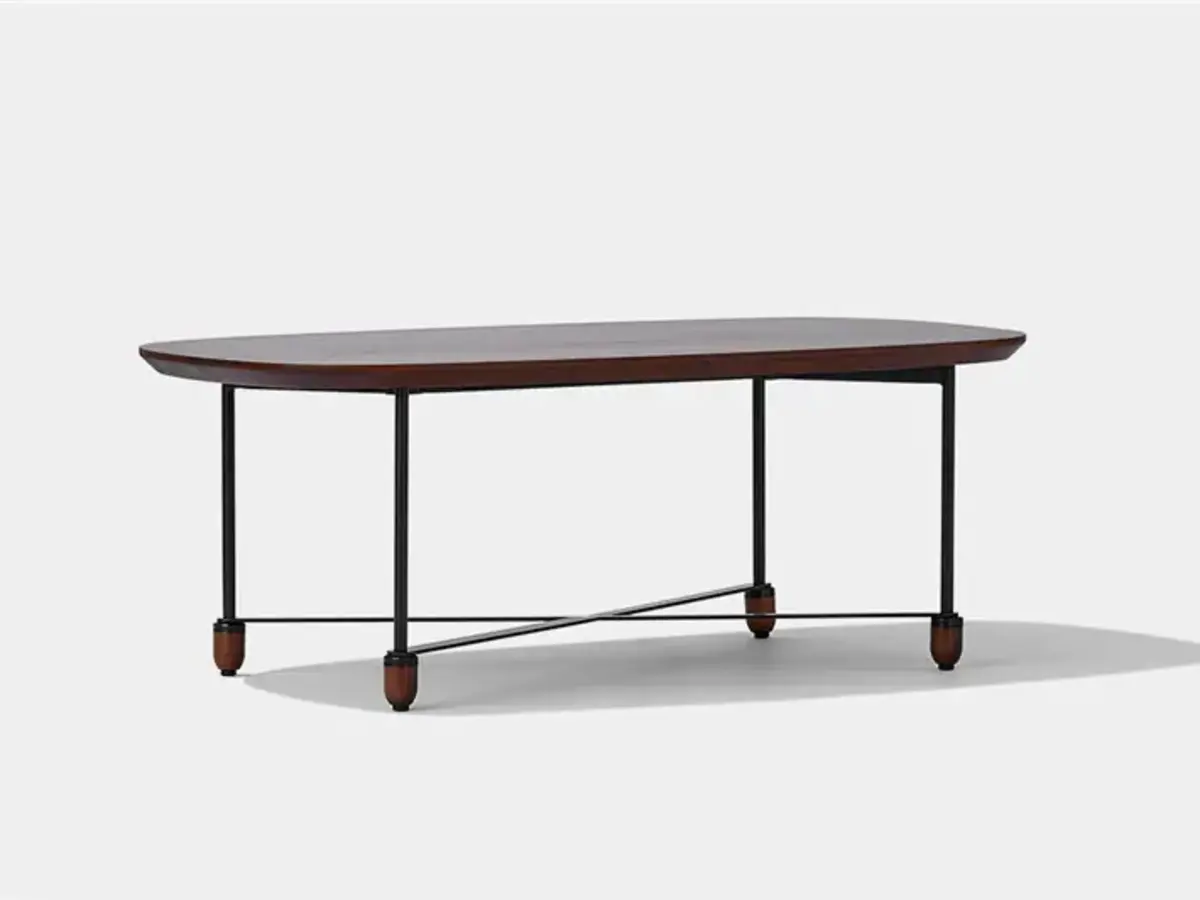
We do not use this model to define the “standard” height for every project. We compare its confirmed 40.2 cm / 15.8 in height with the actual sofa or lounge-chair seat height in the intended layout. If the relationship is wrong, the project should move to a more suitable model or a reviewed customization route.
The current Gyro quotation baseline is 20 pcs with production at about 30 days, subject to final quantity, finish, and order confirmation. If your project needs other configurations, browse our commercial coffee tables and coordinate them with the selected lounge seating.
What We Confirm Before a Custom Coffee Table Goes to Production
- Finished overall height, width/depth, and length or diameter
- Related sofa or lounge-chair seat height
- Tabletop material direction and finished thickness
- Base structure, feet, glides, and floor-contact details
- Target sofa-to-table gap and room layout
- Quantity by model or configuration
- Color and finish reference
- Packing and destination requirements
Regular YeZhi wholesale MOQ starts from about 15 pcs per model/SKU, although individual models can be higher. Full custom/OEM development normally starts around 100 pcs per design or configuration. A major height change can affect the base proportion, stability, drawing, sample route, packing, and final quotation, so we review it as a product change rather than editing one number in isolation.
Ordering Baselines to Confirm Before RFQ
These are YeZhi planning baselines, not universal specifications for every model. The selected product page and quotation take priority when a model has different terms.
Coffee Table Height FAQ
How tall are coffee tables normally?
A common starting range is 16–18 in / 41–46 cm. The better rule is to compare the table with the actual sofa seat and keep the tabletop roughly level with the cushion or up to about 1–2 in / 2.5–5 cm lower.
Should a coffee table be lower than the sofa?
Usually, yes. We normally start at the same height as the sofa seat or slightly lower. A table that sits much higher than the seat needs a clear functional reason.
Is a 40 cm coffee table too low?
40 cm / 15.7 in is not automatically too low. It can work well with lower lounge seating. Compare it with the actual seat height; if the seat is roughly 40–45 cm / 15.7–17.7 in, a 40 cm table falls within the same-height-to-5-cm-lower planning rule.
Is an 18 in / 46 cm coffee table too tall?
Not for many conventional sofas. If the sofa seat is around 18–20 in / 46–51 cm, an 18 in / 46 cm table can fit the normal relationship. It may be too tall beside intentionally low lounge seating.
What coffee table height works with a sectional?
Use the sectional’s actual seat height, not the back height. If every module shares the same seat height, use the same 0–2 in / 0–5 cm-lower rule. If the sectional has unusually soft cushions, test the seated reach before freezing the table height.
Can a coffee table be higher than the sofa seat?
It can, but that is not our default for a fixed center table. When a higher work or dining surface is needed, we prefer a lift-top or separate side/work table rather than raising the whole coffee table without checking the seating function.
Is 24 inches / 61 cm too high for a coffee table?
For most conventional sofa coffee-table layouts, 24 in / 61 cm is unusually high. We would first check the real sofa seat height and the intended function. If the project needs a surface that high for working, dining, or easier access, a side table, lift-top table, or purpose-built work surface may fit the requirement better than treating 24 in as a standard coffee-table height.
Send Us the Seating Height Before You Lock the Coffee Table
If you are sourcing coffee tables for a hotel lounge, reception area, café lounge, serviced apartment, showroom, or furniture program, send us the sofa seat height, target table height, layout, quantity, material/finish direction, and destination. We will review the table as part of the seating group and confirm the dimensions that need to be locked before production.
Send Your Coffee Table Requirements Browse Commercial Coffee Tables